
Close Menu
    Facebook X (Twitter) Instagram
    SciTechDaily
    • Biology
    • Chemistry
    • Earth
    • Health
    • Physics
    • Science
    • Space
    • Technology
    Facebook X (Twitter) Pinterest YouTube RSS
    SciTechDaily
    Home»Science»Harvard Researchers Discover Rare Soft-Bodied Vertebrate Fossil in American Great Basin
    Science

    Harvard Researchers Discover Rare Soft-Bodied Vertebrate Fossil in American Great Basin

    By Harvard UniversityAugust 4, 2024No Comments3 Mins Read
    Facebook Twitter Pinterest Telegram LinkedIn WhatsApp Email Reddit
    Share
    Facebook Twitter LinkedIn Pinterest Telegram Email Reddit
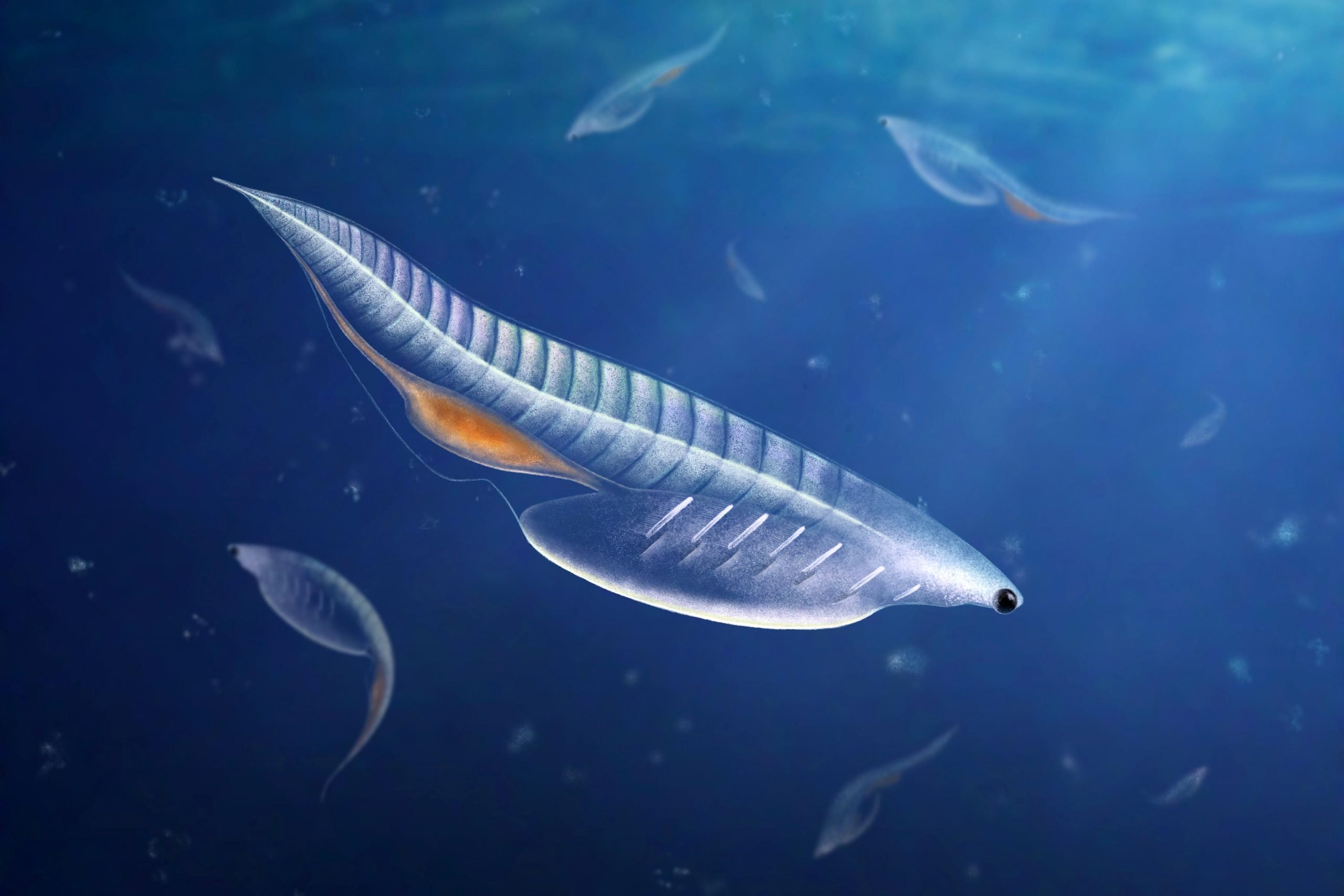
    Nuucichthys rhynchocephalus Illustration
    Nuucichthys rhynchocephalus, a newly discovered Cambrian chordate, provides valuable insights into early vertebrate evolution. Its unique characteristics highlight the transition from invertebrates to vertebrates. Due to its rapid decay, this species is rarely found in fossils, but ongoing research may lead to more discoveries. Credit: Franz Anthony

    The recent uncovering of a new soft-bodied vertebrate fossil in the American Great Basin region enhances our knowledge of vertebrate evolution.

    Harvard scientists discovered a new chordate species, Nuucichthys rhynchocephalus, in the American Great Basin, offering rare insights into the early evolution of vertebrates and their morphological transitions from invertebrates.

    The Cambrian fossil record shows that most animal phyla had diversified and populated the Earth’s oceans around 518 million years ago. However, despite being part of this early diversification, chordates—a group that includes vertebrates like humans—are relatively rare in fossils from over 50 Cambrian sites worldwide.

    In a new paper published in Royal Society Open Science, Harvard research scientist Rudy Lerosey-Aubril and associate professor Javier Ortega-Hernández present their surprising finding of a new species of chordate, and the first soft-bodied vertebrate to be discovered in the Drumian Marjum Formation of the American Great Basin.

    This new fossil was part of a collection of Cambrian soft-bodied fossils deposited in the Museum of Natural History of Utah, a long-term collaborator with researchers at Harvard.
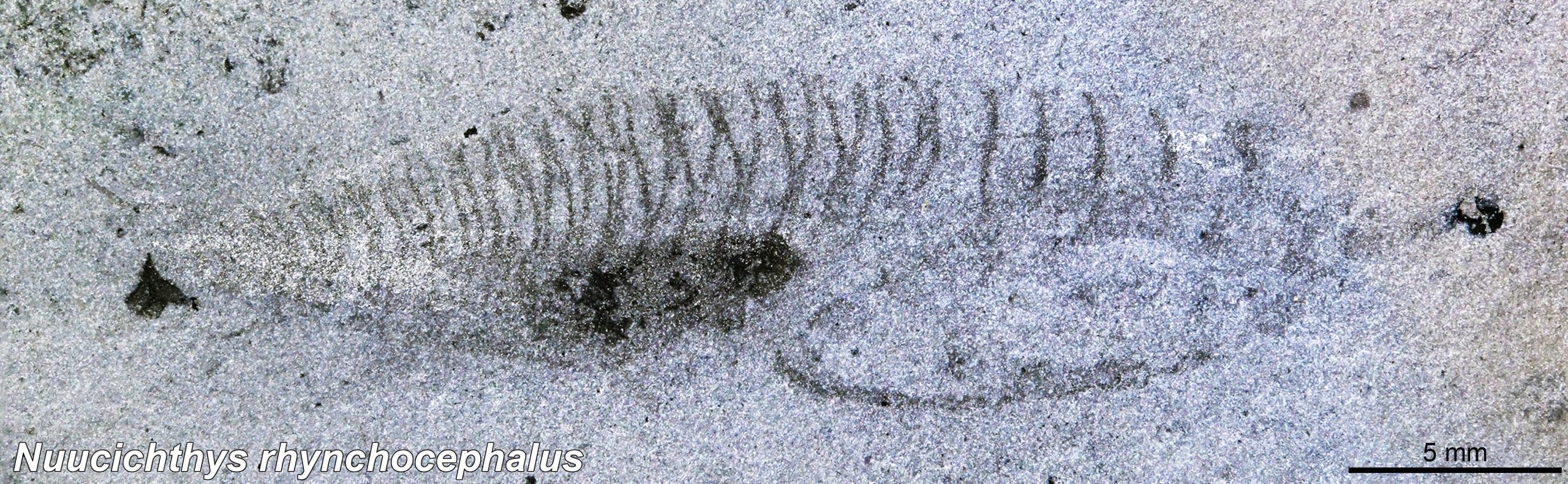
    Nuucichthys rhynchocephalus Fossil
    Nuucichthys rhynchocephalus is the first soft-bodied vertebrate from the American Great Basin. Credit: Franz Anthony

    Significance of Nuucichthys rhynchocephalus

    The discovery of this new species, dubbed Nuucichthys rhynchocephalus, is a valuable contribution to early vertebrate evolution and biodiversity because of the dearth of these types of organisms in Cambrian fossil sites—including South China, the Northeastern United States, and British Columbia.

    Nuucichthys is also one of only four species documenting the early evolutionary stage of vertebrate lineage and, as such, is one of humanity’s oldest relatives.

    In their paper, Lerosey-Aubril and Ortega-Hernández describe Nuucichthys as having a finless torpedo-shaped body that includes a number of markers characteristic of vertebrates.

    “Early vertebrates start to have big eyes and a series of muscle blocks that we call myotomes, and this is something we recognize very well in our fossil,” Lerosey-Aubril said.

    The new species also confirms that, despite their overall similarities to larval fish—having a cavity that is a sort of rudimentary gill system—they were devoid of fins and therefore had limited swimming capabilities.

    “But all of these characteristics clearly point to some vertebrate affinities,” Lerosey-Aubril said. “And because it’s very early in the evolution of the vertebrates, they don’t have bones yet—this is why these fossils are exceedingly rare.”

    Lerosey-Aubril and Ortega-Hernández speculate that Nuucichthys likely lived high up in the water column of the ocean. Because of this, and because it possessed no biomineralized parts like bones or a shell, it was particularly prone to rapid post-mortem degradation and decay, which explains why they were fossilized so rarely.

    “What’s interesting with this new species is that understanding how the morphology evolved from the invertebrate type to the vertebrate type is difficult without fossils, and this new fossil tells us a little bit about that,” Ortega-Hernández said.

    The Drumian Marjum site where the new fossil was found has been intensively investigated since 2022 by an international group of paleontologists led by Lerosey-Aubril and Ortega-Hernández, and both believe that continuous collecting efforts at this site may result in the discovery of new specimens of Nuucichthys rhynchocephalus in the future.

    Reference: “A long-headed Cambrian soft-bodied vertebrate from the American Great Basin region” by Rudy Lerosey-Aubril and Javier Ortega-Hernández, 1 July 2024, Royal Society Open Science.
    DOI: 10.1098/rsos.240350

    Never miss a breakthrough: Join the SciTechDaily newsletter.
    Follow us on Google and Google News.

    Evolution Fossils Harvard University Paleontology
    Share. Facebook Twitter Pinterest LinkedIn Email Reddit

    Related Articles

    Groundbreaking 555-Million-Year-Old Fossil Discovery Sheds Light on One of Evolution’s Greatest Mysteries

    500-Million-Year-Old Fossil Reveals Astonishing Secrets of a Strange Group of Marine Invertebrates

    New Species of Tardigrade (Water Bear) Discovered in 16 Million-Year-Old Dominican Amber

    Genetic Evidence From Fossilized Remains Show Climate Change Drove Mastodons Vast Distances Across North America

    New Fossil Ape Discovered in India Fills Major Gaps in the Primate Fossil Record

    Evidence of Hibernation-Like State Discovered in Tusks of Strange 250-Million-Year-Old Antarctic Creature

    MIT’s New Evidence on Dinosaur Evolution

    Remarkable Discovery of 1 Billion-Year-Old Green Seaweed Micro-Fossils in China

    What Came First, the Animal or the Embryo? New Research Has Answer

    Leave A Reply Cancel Reply

    • Facebook
    • Twitter
    • Pinterest
    • YouTube

    Don't Miss a Discovery

    Subscribe for the Latest in Science & Tech!

    Trending News

    One of the Universe’s Largest Stars May Be Getting Ready To Explode

    Scientists Discover Enzyme That Could Supercharge Ozempic-Like Weight Loss Drugs

    Popular Sweetener Linked to DNA Damage – “It’s Something You Should Not Be Eating”

    Ancient “Rock” Microbes May Reveal How Complex Life Began

    Researchers Capture Quantum Interference in One of Nature’s Rarest Atoms

    “A Plague Is Upon Us”: The Mass Death That Changed an Ancient City Forever

    Scientists Discover Game-Changing New Way To Treat High Cholesterol

    This Small Change to Your Exercise Routine Could Be the Secret to Living Longer

    Follow SciTechDaily
    • Facebook
    • Twitter
    • YouTube
    • Pinterest
    • Newsletter
    • RSS
    SciTech News
    • Biology News
    • Chemistry News
    • Earth News
    • Health News
    • Physics News
    • Science News
    • Space News
    • Technology News
    Recent Posts
    • Scientists Prove There Are Just Six Degrees of Separation in a Social Network
    • Bee Bacteria Could Fix a Major Flaw in Plant-Based Milk
    • Scientists Discover a Surprising Way To Make Bread Healthier and More Nutritious
    • Natural Compounds Boost Bone Implant Success While Killing Bacteria and Cancer Cells
    • After 60 Years, Scientists Uncover Unexpected Brain Effects of Popular Diabetes Drug Metformin
    Copyright © 1998 - 2026 SciTechDaily. All Rights Reserved.
    • Science News
    • About
    • Contact
    • Editorial Board
    • Privacy Policy
    • Terms of Use

    Type above and press Enter to search. Press Esc to cancel.