
According to Human Brain Project Experts, Strange Dreams May Help Your Brain Learn Better
According to the National Sleep Foundation, we dream four to six times a night on average. However, since we forget more than 95% of our dreams, you will only remember a few each month.
Although we dream throughout the night, our most vivid and memorable dreams occur during rapid eye movement (REM) sleep, which begins about 90 minutes after we fall asleep. Unexpected life events, high levels of stress, and other changes can all have an effect on our dreams, making them stranger, more vivid, and memorable. The exact purpose of dreaming is still a bit of a mystery to the scientists, however, recent research hopes to explain why people have strange dreams.
New Insights into the Purpose of Dreams
A new study from the University of Bern in Switzerland reveals that dreams, particularly those that seem genuine but are, on closer inspection, abnormal, help our brain learn and extract general ideas from previous experiences. The research, which was conducted as part of the Human Brain Project and published in eLife, offers a new hypothesis on the meaning of dreams by using machine learning-inspired methods and brain simulation.
The importance of sleep and dreams in learning and memory has long been acknowledged; the influence that a single sleepless night can have on our cognition is well documented. “What we lack is a theory that ties this together with experience consolidation, concept generalization, and creativity,” explains Nicolas Deperrois, the study’s lead author.
During sleep, we commonly experience two types of sleep phases, alternating one after the other: non-REM sleep, when the brain “replays” the sensory stimulus experienced while awake, and REM sleep when spontaneous bursts of intense brain activity produce vivid dreams.
Brain Simulation and Machine Learning Techniques
The researchers used simulations of the brain cortex to model how different sleep phases affect learning. To introduce an element of unusualness in artificial dreams, they took inspiration from a machine learning technique called Generative Adversarial Networks (GANs). In GANs, two neural networks compete with each other to generate new data from the same dataset, in this case, a series of simple pictures of objects and animals. This operation produces new artificial images which can look superficially realistic to a human observer.
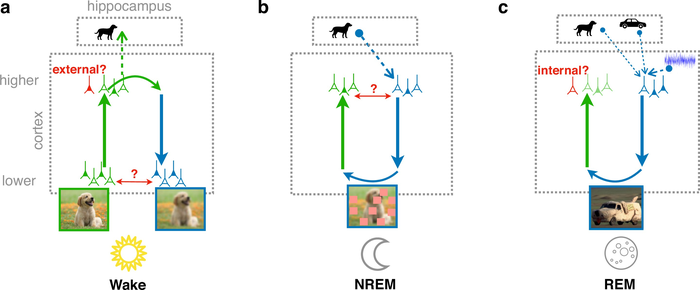
The researchers then simulated the cortex during three distinct states: wakefulness, non-REM sleep, and REM sleep. During wakefulness, the model is exposed to pictures of boats, cars, dogs, and other objects. In non-REM sleep, the model replays the sensory inputs with some occlusions. REM sleep creates new sensory inputs through the GANs, generating twisted but realistic versions and combinations of boats, cars, dogs, etc. To test the performance of the model, a simple classifier evaluates how easily the identity of the object (boat, dog, car, etc.) can be read from the cortical representations.
“Non-REM and REM dreams become more realistic as our model learns,” explains Jakob Jordan, senior author, and leader of the research team. “While non-REM dreams resemble waking experiences quite closely, REM dreams tend to creatively combine these experiences.” Interestingly, it was when the REM sleep phase was suppressed in the model, or when these dreams were made less creative, that the accuracy of the classifier decreased. When the NREM sleep phase was removed, these representations tended to be more sensitive to sensory perturbations (here, occlusions).
Complementary Functions of Wakefulness, Non-REM, and REM
According to this study, wakefulness, non-REM, and REM sleep appear to have complementary functions for learning: experiencing the stimulus, solidifying that experience, and discovering semantic concepts. “We think these findings suggest a simple evolutionary role for dreams, without interpreting their exact meaning,” says Deperrois. “It shouldn’t be surprising that dreams are bizarre: this bizarreness serves a purpose. The next time you’re having crazy dreams, maybe don’t try to find a deeper meaning – your brain may be simply organizing your experiences.”
Reference: “Learning cortical representations through perturbed and adversarial dreaming” by Nicolas Deperrois, Mihai A Petrovici, Walter Senn and Jakob Jordan, 6 April 2022, eLife.
DOI: 10.7554/eLife.76384
Never miss a breakthrough: Join the SciTechDaily newsletter.
Follow us on Google and Google News.