
Close Menu
    Facebook X (Twitter) Instagram
    SciTechDaily
    • Biology
    • Chemistry
    • Earth
    • Health
    • Physics
    • Science
    • Space
    • Technology
    Facebook X (Twitter) Pinterest YouTube RSS
    SciTechDaily
    Home»Space»Herschel and Hubble View the Crab Nebula
    Space

    Herschel and Hubble View the Crab Nebula

    By NASADecember 13, 20132 Comments2 Mins Read
    Facebook Twitter Pinterest Telegram LinkedIn WhatsApp Email Reddit
    Share
    Facebook Twitter LinkedIn Pinterest Telegram Email Reddit


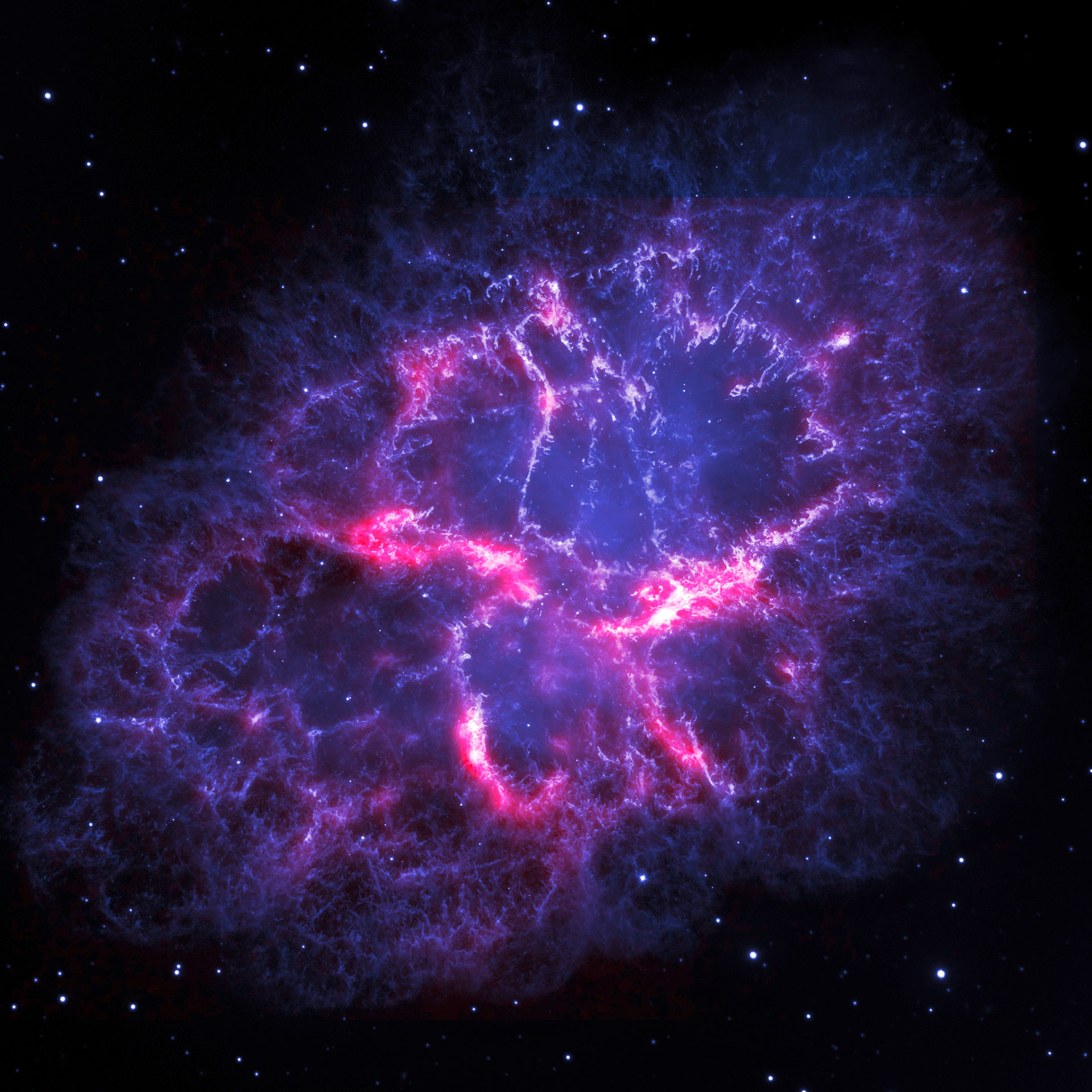
    New Image of the Crab Nebula as Seen by Herschel and Hubble
    New image of the Crab Nebula as seen by Herschel and Hubble. Credit: ESA/Herschel/PACS/MESS Key Programme Supernova Remnant Team; NASA, ESA and Allison Loll/Jeff Hester (Arizona State University)

    In this newly released image, Hubble and Herschel view the Crab Nebula.

    This image shows a composite view of the Crab Nebula, an iconic supernova remnant in our Milky Way galaxy, as viewed by the Herschel Space Observatory and the Hubble Space Telescope. Herschel is a European Space Agency (ESA) mission with important NASA contributions, and Hubble is a NASA mission with important ESA contributions.

    A wispy and filamentary cloud of gas and dust, the Crab Nebula is the remnant of a supernova explosion that was observed by Chinese astronomers in the year 1054.

    The image combines Hubble’s view of the nebula at visible wavelengths, obtained using three different filters sensitive to the emission from oxygen and sulfur ions, and is shown here in blue. Herschel’s far-infrared image reveals the emission from dust in the nebula and is shown here in red.

    While studying the dust content of the Crab Nebula with Herschel, a team of astronomers have detected emission lines from argon hydride, a molecular ion containing the noble gas argon. This is the first detection of a noble-gas based compound in space.

    The Herschel image is based on data taken with the Photoconductor Array Camera and Spectrometer (PACS) instrument at a wavelength of 70 microns; the Hubble image is based on archival data from the Wide Field and Planetary Camera 2 (WFPC2).


    Never miss a breakthrough: Join the SciTechDaily newsletter.
    Follow us on Google and Google News.

    Astronomy Astrophysics Herschel Space Observatory NASA
    Share. Facebook Twitter Pinterest LinkedIn Email Reddit

    Related Articles

    A Cosmic Tale of Death & Dust Revealed in Orion Constellation

    NASA Probes Peculiar Age-Defying Star IRAS 19312+1950

    Herschel Space Observatory Reveals Massive Cold Clumps in NGC 7538

    Astronomers Discover Some of the Youngest Stars Ever Seen

    New Technique Leads to the Discovery of 5 New Pulsars

    Supernova Shock Wave Breaks Through a Cocoon of Gas

    The Bolshoi Simulation: Boxing the Universe

    NASA’s Kepler Mission Discovers 11 New Extrasolar Systems with 26 Exoplanets

    Hubble Observes Rare Blue Stars in Andromeda’s Core

    2 Comments

    1. Lisa emmerson on December 2, 2015 7:55 am

      How can I purchase a copy of the Crab Nebula picture?

      Reply
      • Staff on December 2, 2015 8:00 am

        Not sure where you can purchase it, but you can download it for free from Nasa.gov.

        Reply
    Leave A Reply Cancel Reply

    • Facebook
    • Twitter
    • Pinterest
    • YouTube

    Don't Miss a Discovery

    Subscribe for the Latest in Science & Tech!

    Trending News

    Millions Take These IBS Drugs, But a New Study Finds Serious Risks

    Scientists Unlock Hidden Secrets of 2,300-Year-Old Mummies Using Cutting-Edge CT Scanner

    Bread Might Be Making You Gain Weight Even Without Eating More Calories

    Scientists Discover Massive Magma Reservoir Beneath Tuscany

    Europe’s Most Active Volcano Just Got Stranger – Here’s Why Scientists Are Rethinking It

    Alzheimer’s Symptoms May Start Outside the Brain, Study Finds

    Millions Take This Popular Supplement – Scientists Discover a Concerning Link to Heart Failure

    The Universe Is Expanding Too Fast and Scientists Can’t Explain Why

    Follow SciTechDaily
    • Facebook
    • Twitter
    • YouTube
    • Pinterest
    • Newsletter
    • RSS
    SciTech News
    • Biology News
    • Chemistry News
    • Earth News
    • Health News
    • Physics News
    • Science News
    • Space News
    • Technology News
    Recent Posts
    • Doctors Surprised by the Power of a Simple Drug Against Colon Cancer
    • Why Popular Diabetes Drugs Like Ozempic Don’t Work for Everyone: The “Genetic Glitch”
    • Scientists Create Improved Insulin Cells That Reverse Diabetes in Mice
    • Scientists Stunned After Finding Plant Thought Extinct for 60 Years
    • A Common Diabetes Drug May Hold the Key to Stopping HIV From Coming Back
    Copyright © 1998 - 2026 SciTechDaily. All Rights Reserved.
    • Science News
    • About
    • Contact
    • Editorial Board
    • Privacy Policy
    • Terms of Use

    Type above and press Enter to search. Press Esc to cancel.