
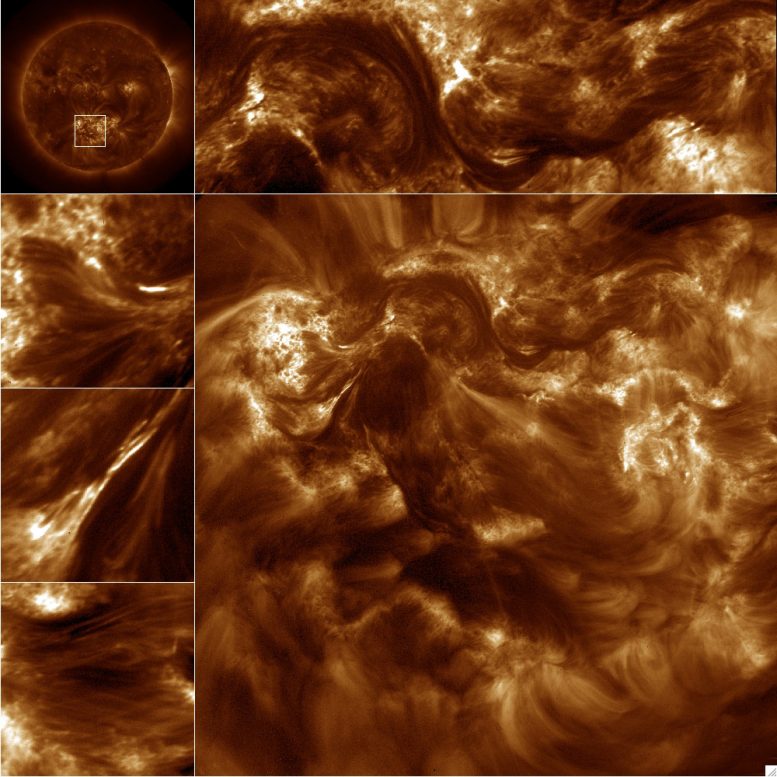
Using a resolution five times higher than previous imagers, NASA’s High Resolution Coronal Imager (Hi-C) captured the highest-resolution images ever taken of the sun’s million-degree solar corona.
The optics engineering expertise at the NASA’s Marshall Space Flight Center in Huntsville, Alabama, made it possible for a group of solar scientist to see into the sun’s corona in unprecedented detail. The final mirror configuration was completed with inputs from partners at the Smithsonian Astrophysical Observatory, or SAO, in Cambridge, Massachusetts, and a new manufacturing technique developed in coordination with L-3Com/Tinsley Laboratories of Richmond, California.
The High Resolution Coronal Imager, or Hi-C, captured the highest-resolution images ever taken of the million-degree solar corona using a resolution five times higher than previous imagers. The corona is hotter than the solar surface and is the location where solar flares occur and energy is released that drive solar storms that can impact Earth.
Weighing 464 pounds (210 kilograms), the 6-foot-long (1.8-meter-long) Hi-C telescope took 165 images during its brief 620-second sounding rocket flight on July 11. The telescope focused on a large active region on the sun, with some images revealing the dynamic structure of the solar atmosphere in fine detail. When combined with the full sun images from NASA’s Solar Dynamics Observatory, SDO, a new picture of the solar corona is now emerging.
The movie starts with the full sun AIA images taken during the Hi-C flight and zooms into the Hi-C field of full field of view. Comparisons of the Hi-C data, show in the panel on the right, are compared to data taken by AIA, shown on left. Hi-C is five times higher spatial resolution than AIA and the cadence of the Hi-C observations is 5 seconds. Credit: NASA
Hi-C’s mirrors are approximately 9.5 inches across, roughly the same size as the SDO, instrument’s mirrors. However, due to a set of innovations on Hi-C’s optics array, the nimble telescope was able to peer deeper into the sun’s corona in the extreme ultraviolet wavelength.
“These mirrors were to be the finest pieces of glass ever fabricated for solar astrophysics,” said Marshall heliophysicist Dr. Jonathan Cirtain, principal investigator on the Hi-C mission. “We had never attempted such a program before and had to develop new techniques for grinding the optics and polishing the surfaces, not to mention figuring out how to mount them without diminishing the performance. The final mirror surface is so smooth that it only deviates from being perfectly smooth by a few angstroms over the 24 cm optic.”
Using these quality optics, images were acquired at a rate of approximately one every five seconds and provided proof of a long-standing theory to explain solar coronal dynamics.
The optical design was provided by scientists and engineers from Marshall’s Science and Technology Office as well as SAO personnel. “Dr. Cirtain asked us to develop the mirrors initially to see how well we could make them,” said John Calhoun, Lead for Optics at Marshall. “The initial specifications were only a goal; however, we made such excellent progress on them that Dr. Cirtain was able to get the funding for his flight demonstration. The credit belongs to the superb work performed by our senior opticians, although their initial response to the very challenging fabrication was to refer to the optics as the “oh, my god” mirrors.”
Scientists at Lededev Physical Institute in Moscow, Russia developed the filters for the instrument’s front aperture plate. These whisper-thin filters reject the unwanted wavelengths of light and only transmit the extreme ultraviolet spectrum.
The high-quality optics were aligned with extreme accuracy. Mounting of the mirrors in the telescope was done using a new method that significantly reduced the impact of the process on the shape of the mirrors. Scientists and engineers from SAO, along with Marshall and the University of Alabama in Huntsville, worked to complete the alignment of the mirrors, maintaining optic spacing to within a few ten-thousandths of an inch. This innovative approach to aligning and installing the mirrors then had to be maintained so the instrument could survive the harsh vibration and thermal conditions during the launch and flight of the rocket.
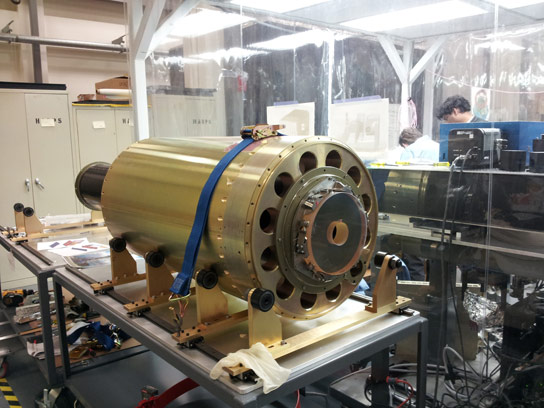
Scientists have worked for the better part of a decade designing and building test facilities, followed by development, fabrication, and testing of the optics.
“This flight represents the culmination of thirty years of effort to develop these exceptionally high-quality optics,” said Co-investigator Dr. Leon Golub of SAO.
Marshall scientists and engineers also partnered with engineers from the University of Central Lancashire and Apogee Imaging Systems in Richmond, CA to develop a large format camera detector (16 megapixels) with a high-speed image readout. The combination of the optics, the telescope, and the camera system combined to deliver the highest cadence and highest resolution image set yet collected for the solar million-degree atmosphere.
“As for the findings from Hi-C, the most important implication to me is the realization that at 150 km spatial resolution and an image cadence of five seconds, solar astrophysics can make multiple major advances in the science of how stars work and evolve,” said Cirtain. “That, I find, is breathtaking, especially for a sounding rocket to discover.”
Reference: “Energy release in the solar corona from spatially resolved magnetic braids” by J. W. Cirtain, L. Golub, A. R. Winebarger, B. De Pontieu, K. Kobayashi, R. L. Moore, R. W. Walsh, K. E. Korreck, M. Weber, P. McCauley, A. Title, S. Kuzin and C. E. DeForest, 23 January 2013, Nature.
DOI: 10.1038/nature11772
Partners associated with the development of the Hi-C telescope also include Lockheed Martin’s Solar Astrophysical Laboratory in Palo Alto, California; the University of Central Lancashire in Lancashire, England; the Lebedev Physical Institute of the Russian Academy of Sciences in Moscow; and the Southwest Research Institute in Boulder, Colorado.
Never miss a breakthrough: Join the SciTechDaily newsletter.
Follow us on Google and Google News.