
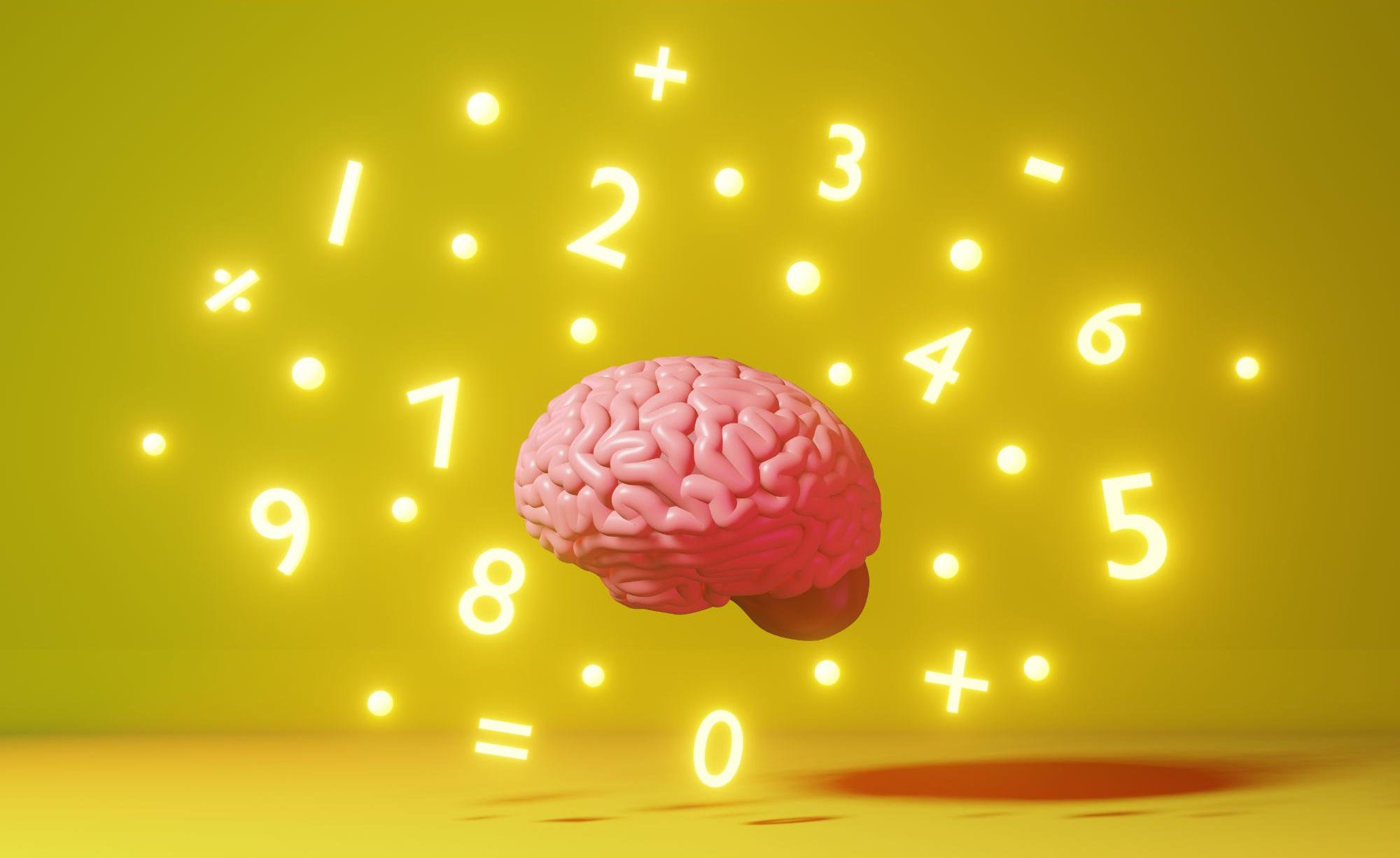
Thinking about numbers engages a brain region linked to fundamental functions, offering key insights for education and neurological procedures, researchers report.
New research suggests that the unique human ability to conceptualize numbers may be deeply embedded within the brain.
Further, the results of the study by Oregon Health & Science University involving neurosurgery patients suggest new possibilities for tapping into those areas to improve learning among people bedeviled by math.
“This work lays the foundation to deeper understanding of number, math, and symbol cognition — something that is uniquely human,” said senior author Ahmed Raslan, M.D., professor and chair of neurological surgery in the OHSU School of Medicine. “The implications are far-reaching.”
The study was published in the journal PLOS ONE.
Raslan and co-authors recruited 13 people with epilepsy who were undergoing a commonly used surgical intervention to map the exact location within their brains where seizures originate, a procedure known as stereotactic electroencephalography. During the procedure, researchers asked the patients a series of questions that prompted them to think about numbers as symbols (for example, 3), as words (“three”), and as concepts (a series of three dots).
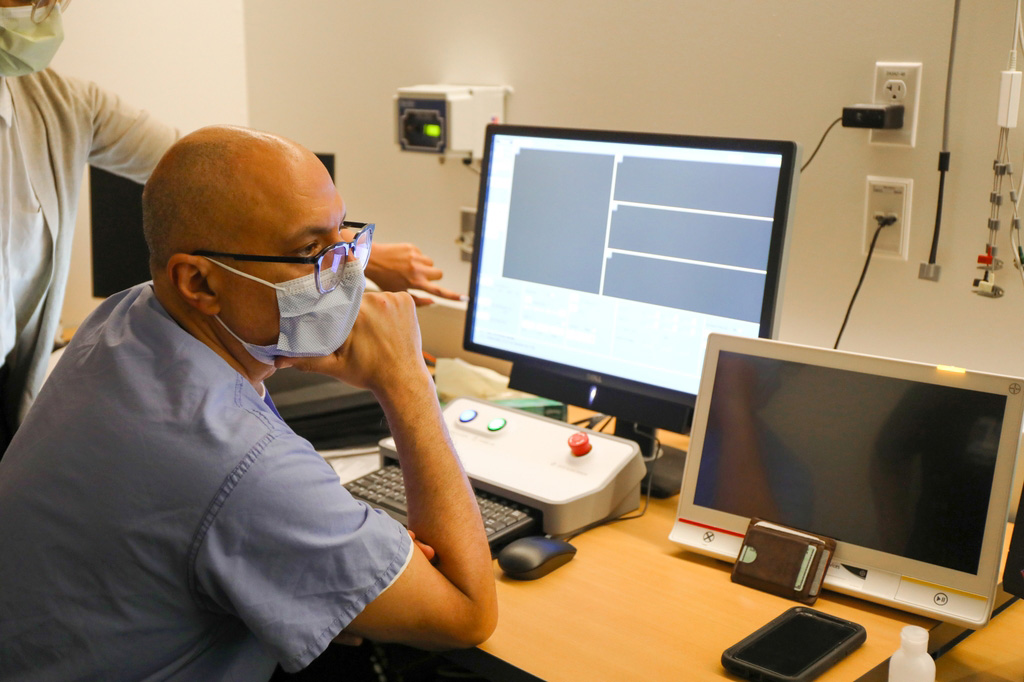
As the patients responded, researchers found activity in a surprising place: the putamen.
Located deep within the basal ganglia above the brain stem, the putamen is an area of the brain primarily associated with elemental functions, such as movement, and some cognitive function, but rarely with higher-order aspects of human intelligence like solving calculus. Neuroscientists typically ascribe consciousness and abstract thought to the cerebral cortex, which evolved later in human evolution and wraps around the brain’s outer layer in folded gray matter.
“That likely means the human ability to process numbers is something that we acquired early during evolution,” Raslan said. “There is something deeper in the brain that gives us this capacity to leap to where we are today.”
Broader Implications for Neurosurgery and Learning
Researchers also found activity as expected in regions of the brain that encode visual and auditory inputs, as well as the parietal lobe, which is known to be involved in numerical and calculation-related functions.
From a practical standpoint, the findings could prove useful in avoiding important areas during surgeries to remove tumors or epilepsy focal points, or in placing neurostimulators designed to stop seizures.
“Brain areas involved in processing numbers can be delineated and extra care taken to avoid damaging these areas during neurosurgical interventions,” said lead author Alexander Rockhill, Ph.D., a postdoctoral researcher in Raslan’s lab.
Researchers credited the patients involved in the study.
“We are extremely grateful to our epilepsy patients for their willingness to participate in this research,” said co-author Christian Lopez Ramos, M.D., a neurosurgical resident at OHSU. “Their involvement in answering our questions during surgery turned out to be the key to advancing scientific understanding about how our brain evolved in the deep past and how it works today.”
Indeed, the study follows previous lines of research involving the mapping of the human brain during surgery.
“I have access to the most valuable human data in nature,” Raslan said. “It would be a shame to miss an opportunity to understand how the brain and mind function. All we have to do is ask the right questions.”
In the next stage of this line of research, Raslan anticipates discerning areas of the brain capable of performing other higher-level functions.
Reference: “Investigating the Triple Code Model in numerical cognition using stereotactic electroencephalography” by Alexander P. Rockhill, Hao Tan, Christian G. Lopez Ramos, Caleb Nerison, Beck Shafie, Maryam N. Shahin, Adeline Fecker, Mostafa Ismail, Daniel R. Cleary, Kelly L. Collins and Ahmed M. Raslan, 3 December 2024, PLOS ONE.
DOI: 10.1371/journal.pone.0313155
In addition to Raslan, Rockhill and Lopez Ramos, co-authors include Hao Tan, M.D., Beck Shafie, Maryam Shahin, M.D., Adeline Fecker, Mostafa Ismail, Daniel Cleary, M.D., and Kelly Collins, M.D., of OHSU; and Caleb Nerison, D.O., now of Lexington Medical Center in South Carolina.
The research was supported by a grant from the National Institutes of Health’s BRAIN Initiative in support of Rockhill, award 1UG3NS123723-01. The content is solely the responsibility of the authors and does not necessarily represent the official views of the NIH.
Never miss a breakthrough: Join the SciTechDaily newsletter.
Follow us on Google and Google News.