
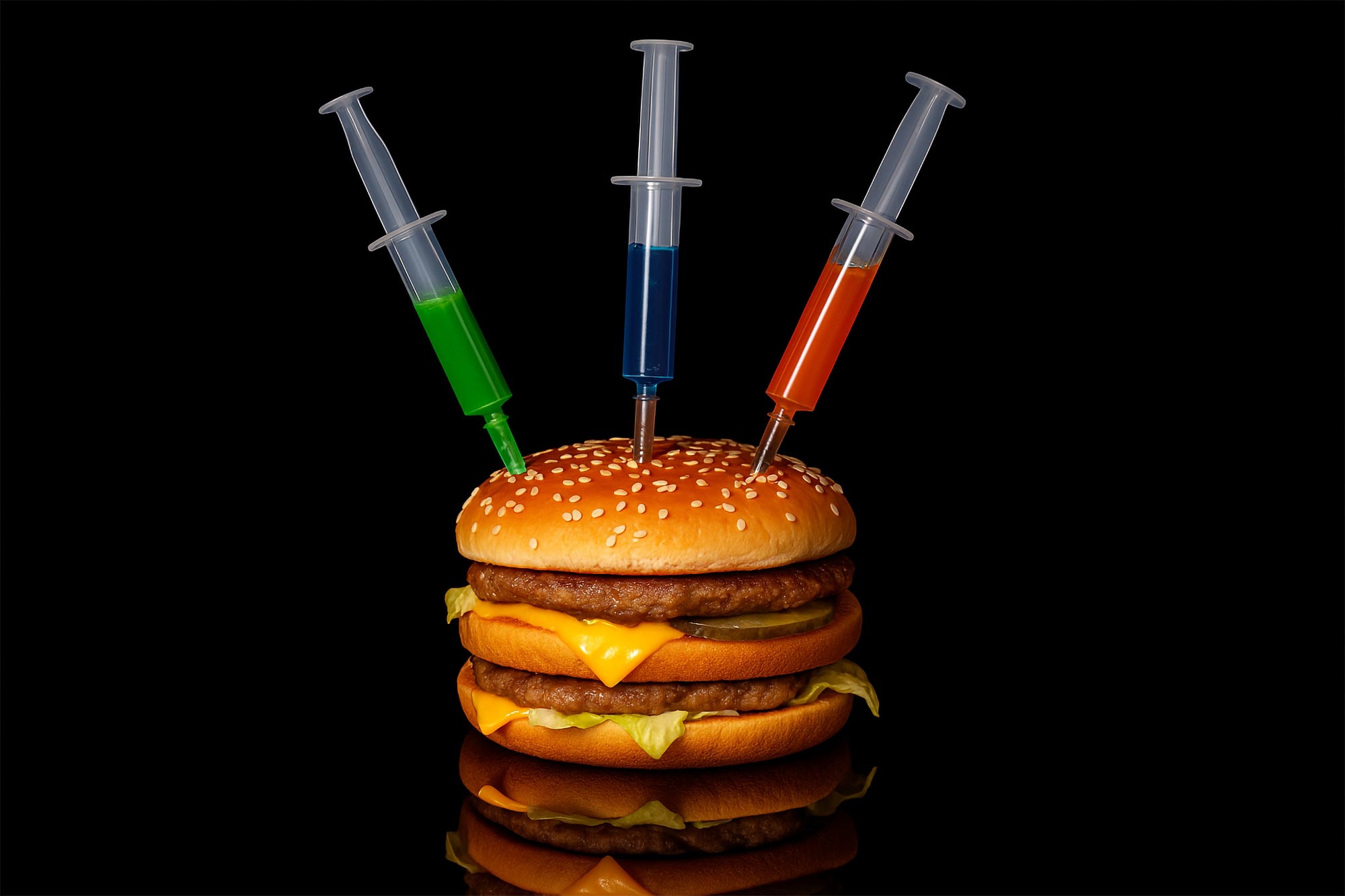
Hidden dangers may be lurking in your everyday food choices. Researchers analyzed dietary data from over 100,000 people and discovered that specific combinations of common food additives — especially those in ultra-processed foods and artificially sweetened drinks — were linked to a higher risk of developing type 2 diabetes.
Mixtures of food additives are a routine part of our diets, especially through the consumption of ultra-processed foods. Until now, safety assessments have focused on individual additives, largely because of limited data on the effects of consuming them in combination.
In a new study, researchers from Inserm, INRAE, Sorbonne Paris Nord University, Paris Cité University, and Cnam—working within the Nutritional Epidemiology Research Team (CRESS-EREN)—investigated whether exposure to commonly consumed additive mixtures might be linked to the development of type 2 diabetes. They analyzed health and dietary data from over 100,000 adults in the French NutriNet-Santé cohort.
The study identified five main additive mixtures, two of which were associated with a higher risk of type 2 diabetes. One of these mixtures included emulsifiers such as carrageenans, modified starches, and other additives typically found in products like stocks, milky desserts, fats, and sauces. The other contained a combination of sweeteners, colorants, and acidifiers commonly used in artificially sweetened drinks and sodas. The results were published in PLOS Medicine.
Concerns Around Common Food Additives
Food additives are widely used by the agri-food industry and are especially common in ultra-processed products found in supermarkets. Scientific research has linked the regular consumption of several of these additives to potential health issues, including metabolic disorders, chronic inflammation, and imbalances in the gut microbiome. Recent findings from the NutriNet-Santé cohort have also associated certain food additives with an increased risk of type 2 diabetes, cancer, and cardiovascular disease.
While previous studies have examined the effects of individual additives, none have looked at the potential health impact of consuming them in combination. This is important because ultra-processed foods often contain multiple additives with different functions, such as preservatives, colorants, flavor enhancers, and texture agents.
A Closer Look at 100,000+ Participants
To explore the possible effects of these additive mixtures, a research team led by Mathilde Touvier, research director at Inserm, analyzed health data from 108,643 adults in the NutriNet-Santé cohort, following participants for an average of 7.7 years.
The participants completed at least two days (up to 15 days) of online dietary records of all food and drinks consumed and their brands.

How Additive Mixtures Were Identified
In order to obtain a reliable estimate of the exposure to additives and to focus on those with a potentially significant health impact, only those additives consumed by at least 5% of the cohort were included in mixture modeling. The presence or absence of each additive in each food was determined by cross-referencing several databases, taking into account the date of consumption (to incorporate any reformulations over time), as well as some laboratory assays of quantitative levels of additives in the food.
Five main mixtures of additives were identified, representing groups of substances frequently ingested together (due to their joint presence in industrially processed products or resulting from the co-ingestion of foods often consumed together).
Two Mixtures Linked to Type 2 Diabetes
The results show two of these mixtures to be associated with a higher incidence of type 2 diabetes, regardless of the nutritional quality of the diet (intake of sugar, calories, fiber, saturated fat, etc.) and sociodemographic and lifestyle factors. No associations were found for the other three mixtures.
The first mixture incriminated was primarily composed of several emulsifiers (modified starches, pectin, guar gum, carrageenans, polyphosphates, xanthan gum), a preservative (potassium sorbate), and a coloring agent (curcumin). These additives are typically found in a variety of ultra-processed foods, such as stocks, milky desserts, fats, and sauces.
The Sweetened Drink Connection
The other mixture implicated was primarily composed of additives found in artificially sweetened drinks and sodas. It contained acidifiers and acidity regulators (citric acid, sodium citrates, phosphoric acid, malic acid), coloring agents (sulfite ammonia caramel, anthocyanins, paprika extract), sweeteners (acesulfame-K, aspartame, sucralose), emulsifiers (gum arabic, pectin, guar gum) and a coating agent (carnauba wax).
In this study, interactions between the additives of these mixtures were detected suggesting that some could interact with each other, either by enhancing their effects (synergy) or by attenuating them (antagonism).
A New Frontier in Diabetes Prevention?
“This study is the first to estimate exposure to food additive mixtures in a large cohort of the general population and to analyze their link to the incidence of type 2 diabetes. The findings suggest that several emblematic additives present in many products are often consumed together and that certain mixtures are associated with a higher risk of this disease. These substances may therefore represent a modifiable risk factor, paving the way for strategies to prevent type 2 diabetes,” explains Marie Payen de la Garanderie, PhD student at Inserm and first author of this research.
“Further studies are needed to elucidate the underlying mechanisms and deepen the understanding of the potential synergies and antagonisms between these substances. This observational study alone is not sufficient to establish a causal link. However, our findings are in line with recent in vitro experimental work suggesting possible cocktail effects.[1] They indicate that the evaluation of additives should take into account their interactions and support public health recommendations that advise limiting non-essential food additives,” explains Dr. Touvier.
Notes
- “Evaluation of the toxic effects of food additives, alone or in mixture, in four human cell models” by Cynthia Recoules, Mathilde Touvier, Fabrice Pierre and Marc Audebert, 14 December 2024, Food and Chemical Toxicology.
DOI: 10.1016/j.fct.2024.115198
Reference: “Food additive mixtures and type 2 diabetes incidence: Results from the NutriNet-Santé prospective cohort” by Marie Payen de la Garanderie, Anaïs Hasenbohler, Nicolas Dechamp, Guillaume Javaux, Fabien Szabo de Edelenyi, Cédric Agaësse, Alexandre De Sa, Laurent Bourhis, Raphaël Porcher, Fabrice Pierre, Xavier Coumoul, Emmanuelle Kesse-Guyot, Benjamin Allès, Léopold K. Fezeu, Emmanuel Cosson, Sopio Tatulashvili, Inge Huybrechts, Serge Hercberg, Mélanie Deschasaux-Tanguy, Benoit Chassaing, Héloïse Rytter, Bernard Srour and Mathilde Touvier, 8 April 2025, PLOS Medicine.
DOI: 10.1371/journal.pmed.1004570
NutriNet-Santé is a public health study coordinated by the Nutritional Epidemiology Research Team (CRESS-EREN, Inserm/INRAE/Cnam/Sorbonne Paris Nord University/Paris Cité University) which, thanks to the commitment and loyalty of over 180 000 participants (known as Nutrinautes), advances research into the links between nutrition (diet, physical activity, nutritional status) and health. Launched in 2009, the study has already given rise to over 300 international scientific publications. In France, a drive to recruit new participants is still ongoing in order to continue to advance public research into the relationship between nutrition and health.
By devoting a few minutes per month to answering questionnaires on diet, physical activity, and health through the secure online platform etude-nutrinet-sante.fr, the participants contribute to furthering knowledge towards a healthier and more sustainable diet.
Never miss a breakthrough: Join the SciTechDaily newsletter.
Follow us on Google and Google News.
3 Comments
Who is funding this study? Is coca-cola in on it because it sounds like the sugar industry is trying to blame other people for their poison. I won’t believe anything in this study until I know who funds it.
Study Funding: The NutriNet-Santé study was supported by the following public institutions : Ministère de la Santé, Santé Publique France, Institut National de la Santé et de la Recherche Médicale (INSERM), Institut National de la Recherche pour l’agriculture, l’alimentation et l’environnement (INRAE), Conservatoire National des Arts et Métiers (CNAM), and University Sorbonne Paris Nord. This project has received funding from the European Research Council (ERC) under the European Union’s Horizon 2020 research and innovation program (grant agreement No 864219, ADDITIVES), the French National Cancer Institute (INCa_14059), the French Ministry of Health (arrêté 29.11.19) and the IdEx Université de Paris (ANR-18-IDEX-0001), and a Bettencourt-Schueller Foundation Research Prize 2021. This project was awarded the NACRe (Network for Nutrition and Cancer Research) Partnership Label. BC’s laboratory is supported by a Starting Grant from the European Research Council (ERC) under the European Union’s Horizon 2020 research and innovation program (grant agreement No. ERC-2018-StG- 804135 INVADERS), and the national program “Microbiote” from INSERM. This work only reflects the authors’ view, and the funders are not responsible for any use that may be made of the information it contains. Researchers were independent from funders. The funders had no role in study design, data collection and analysis, decision to publish, or preparation of the manuscript.
when did these foods become everyday foods?
and there are healthy “fast food” options. better lifestyle choices people.