
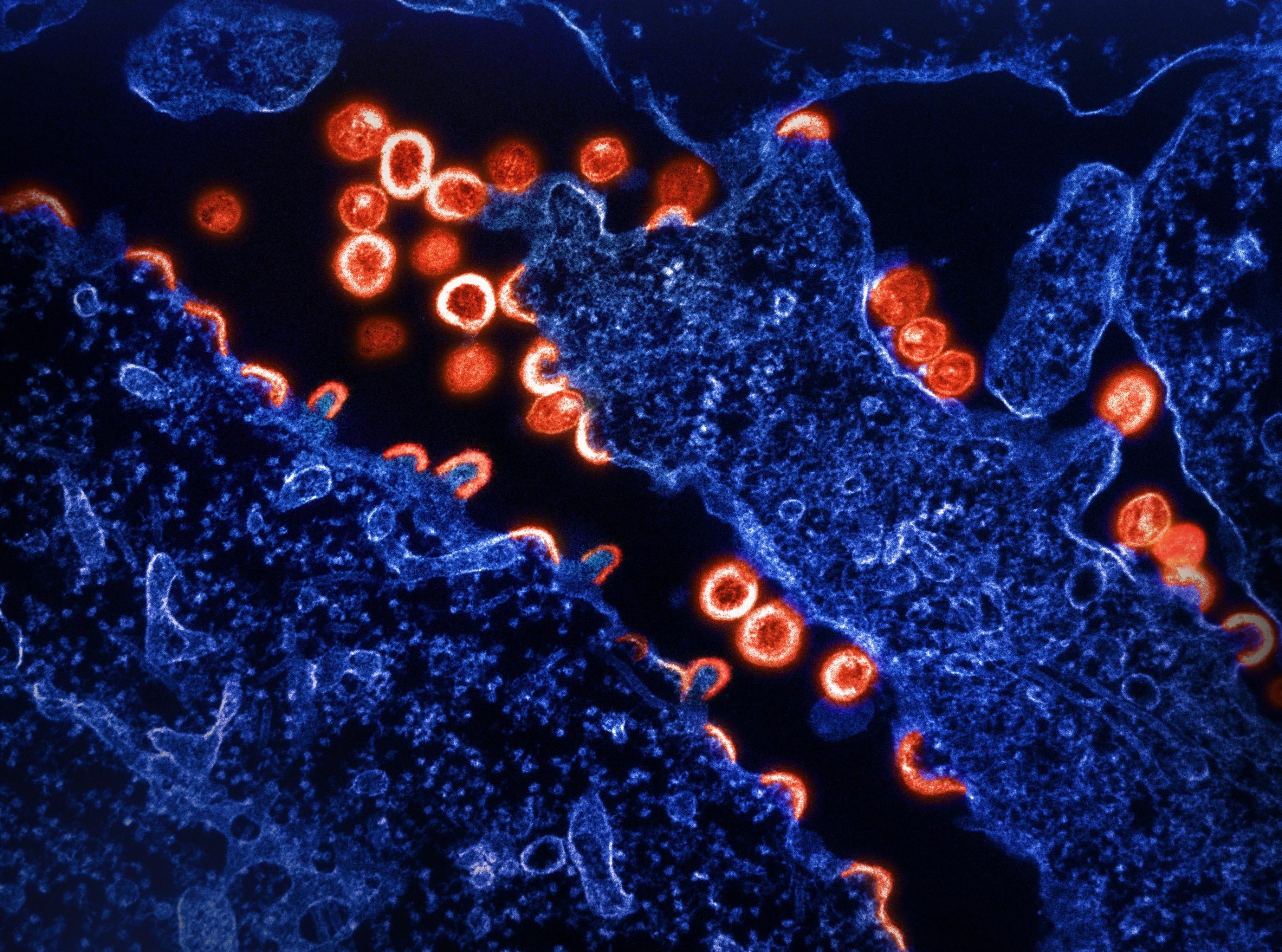
Researchers have found that three different HIV antibodies targeting the fusion peptide can protect monkeys from simian-HIV, offering promising insights for the development of an HIV vaccine.
Three different HIV antibodies each independently protected monkeys from acquiring simian-HIV (SHIV) in a placebo-controlled proof-of-concept study intended to inform development of a preventive HIV vaccine for people. The antibodies—a human broadly neutralizing antibody and two antibodies isolated from previously vaccinated monkeys—target the fusion peptide, a site on an HIV surface protein that helps the virus fuse with and enter cells.
The study, published in Science Translational Medicine, was led by the Vaccine Research Center (VRC) at the National Institute of Allergy and Infectious Diseases (NIAID), part of the National Institutes of Health.
Fusion Peptide-Directed Antibodies: A New Hope
Antibodies that target the fusion peptide can neutralize diverse strains of HIV in vitro, that is, in a test tube or culture dish outside of a living organism. The NIAID VRC isolated a fusion peptide-directed human antibody, called VRC34.01, from a person living with HIV who donated blood samples for research. They also isolated two antibodies from rhesus macaques—a species of monkey with immune systems like humans’—who previously had received a vaccine regimen designed to generate fusion peptide-directed antibodies.
Demonstrating that these antibodies protect animals would validate the fusion peptide as a target for human vaccine design. SHIV challenge—administering an infective dose of SHIV—to rhesus macaques is a widely used animal model for assessing the performance of HIV antibodies and vaccines.
Experimental Findings and Implications
In this study, rhesus macaques in each of four groups received a single intravenous infusion of one type of antibody—a 2.5 or 10 mg/kg of bodyweight dose of VRC34.01, or one of the two vaccine-elicited rhesus macaque antibodies—and other monkeys received a placebo infusion. To determine the protective effect of the antibodies, each monkey was challenged five days after infusion with a strain of SHIV known to be sensitive to fusion peptide-directed antibodies.
All monkeys that received a placebo infusion acquired SHIV following the challenge. Among monkeys that received VRC34.01 infusions, none receiving the 10 mg/kg dose and 25% of those receiving the 2.5 mg/kg dose acquired SHIV. Of those that received the vaccine-elicited rhesus macaque antibodies, no monkeys receiving the antibody called DFPH-a.15 acquired SHIV, and 25% of those receiving the antibody called DF1W-a.01 acquired SHIV. Over time, the concentration of antibodies in the blood of animals that received DFPH-a.15 declined. Those animals were re-challenged 30 days later to see if the lower concentration of antibodies had a decreased protective effect, and half of them acquired SHIV.
The three antibodies studied each provided statistically significant protection from SHIV, and the effect was dose dependent, that is, highest in monkeys with greater antibody concentrations in their blood.
Conclusion: Towards an Effective HIV Vaccine
According to the authors, these findings represent the proof-of-concept that fusion peptide-directed antibodies can provide protection against SHIV and help determine the concentration of antibodies a vaccine would need to generate to be protective. They suggest that their findings on vaccine-elicited antibodies in some animals support further work to design preventive HIV vaccine concepts targeting the fusion peptide.
The researchers conclude that an effective HIV vaccine targeting the HIV fusion peptide likely will need to expand upon the concepts used in this study, by generating multiple varieties of fusion peptide-directed antibodies. This would increase the likelihood that the vaccine could maintain a preventive effect across the vastly diverse HIV variants in circulation.
Reference: “Antibodies targeting the fusion peptide on the HIV envelope provide protection to rhesus macaques against mucosal SHIV challenge” by Amarendra Pegu, Sarah E. Lovelace, Megan E. DeMouth, Michelle D. Cully, Daniel J. Morris, Yingying Li, Keyun Wang, Stephen D. Schmidt, Misook Choe, Cuiping Liu, Xuejun Chen, Elise Viox, Ariana Rowshan, Justin D. Taft, Baoshan Zhang, Kai Xu, Hongying Duan, Li Ou, John-Paul Todd, Rui Kong, Hui Li, George M. Shaw, Nicole A. Doria-Rose, Peter D. Kwong, Richard A. Koup and John R. Mascola, 17 January 2024, Science Translational Medicine.
DOI: 10.1126/scitranslmed.adh9039
Never miss a breakthrough: Join the SciTechDaily newsletter.
Follow us on Google and Google News.