
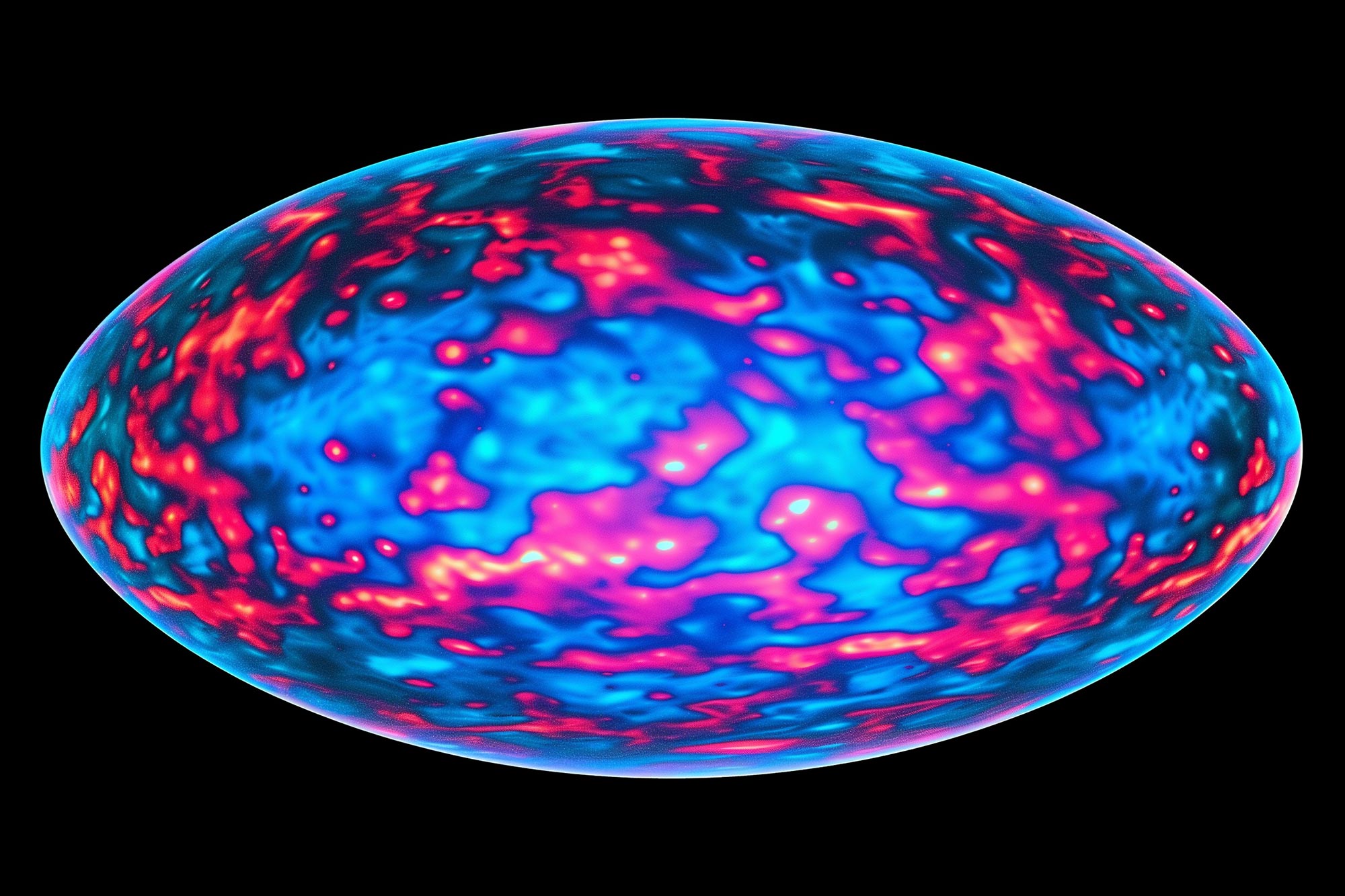
Following the accelerated expansion discovery of the Universe, scientists introduced dark energy concepts, which faced issues like the cosmological constant problem.
Researchers at IKBFU developed a holographic dark energy model based on quantum gravity, which views the Universe as a hologram. This model, initially unstable, was refined to treat dark energy as perturbations, stabilizing it. It is now being tested against observational data for accuracy.
Discovery of Accelerated Universe Expansion
In 1998, scientists made the groundbreaking discovery that the Universe is expanding at an accelerating rate. To account for this phenomenon, they introduced the concept of dark energy—a mysterious form of energy that permeates all of space-time yet remains undetectable through direct observation. While dark energy is incorporated into the standard cosmological model, researchers have identified several unresolved issues, such as the cosmological constant problem and the fine-tuning dilemma, that this model cannot fully explain. Consequently, scientists are developing new models aimed at coherently describing the Universe’s accelerated expansion.
Exploring Holographic Dark Energy
Scientists at Immanuel Kant Baltic Federal University (IKBFU) in Kaliningrad considered an alternative model — a holographic dark energy model — and have proven its viability. The results of the research have been published in Physics Letters B.
“It’s a slightly different way of looking at the nature of accelerated expansion of the Universe. It stems from the holographic principle which follows from quantum gravity and string theory. According to it, all values inside a certain amount of volume can be described by parameters that are observed on its boundary. In other words, the Universe can be represented in the form of some hologram, and it can be described by the parameters on its boundaries,” says Alexander Tepliakov, junior researcher at the laboratory for mathematical modeling of complex and non-linear systems at IKBFU.
Revising Dark Energy Models
A new model of holographic dark energy was suggested within the holographical principle in 2004. However, the new model also had a drawback. The thing is, the dark energy is usually represented as some kind of liquid that homogenously and evenly fills the Universe. A special parameter called square of the sound velocity is used to analyze the fluctuations inside this liquid. If it turns out to be negative as a result of calculations, the model is considered unstable. Previous studies carried out as part of a holographic dark energy model had a negative sound speed square.
Verifying Model Accuracy With Observational Data
The researchers suggested that the holographic dark energy shouldn’t be seen as a liquid. Instead, it must be considered as dark energy perturbations, taking into account its metric properties. They concluded that the model is in fact stable, meaning it’s realistic.
“Now, we need to understand to what extent our model corresponds to observation data provided by space-based telescopes. In 2024 precise data became available for analysis: relationship between red shift for Type Ia supernovae, baryon acoustic oscillations. By comparing the proposed cosmological model with this data we are able to assess whether it describes the real Universe,” summarizes Alexander Tepliakov.
Reference: “Evolution of perturbations in the model of Tsallis holographic dark energy” by Artyom V. Astashenok and Alexander S. Tepliakov, 4 June 2024, Physics Letters B.
DOI: 10.1016/j.physletb.2024.138767
Never miss a breakthrough: Join the SciTechDaily newsletter.
Follow us on Google and Google News.
4 Comments
Memo 2410030311
The dark energy of my cosmology is the qms.qvix.tssp.boson of Spermion
This is the qpeoms region. If this is the square of BAO, this could be where msbase appeared.
-I escaped from a strange dream early this morning. Contrary to what we worried about the sea as a way to escape from the pursuit, it was a wide and thin stream of land with a dark and faint bright spot. As the number of people increased, I thought a new land of conquest would appear with the sunshine. The bold choice of leadership in my adventure, which chose the unknown from the dream, always seemed to give us expectation and hope. Uh-huh.
Source 1.Edit, Modifying Dark Energy Model
In 2004, a new holographic dark energy model was proposed within the holographic principle. However, the new model also had its drawbacks. The problem is that dark energy is usually expressed as a kind of liquid that fills the universe homogeneously and evenly.
*The square of ‘bao’, special parameters are used to analyze the fluctuations inside the liquid. If the calculations turn out to be negative, the model is considered unstable. Previous studies conducted as part of the holographic dark energy model had negative sound speed squares.
*In cosmology, baryon acoustic oscillations (BAO) are variations in the density of baryon matter (normal matter) in the universe, resulting from acoustic density waves in primordial plasma in the early universe.
The researchers suggested that ‘hologram dark energy cannot be viewed as a liquid’. Instead, it should be considered a dark energy perturbation, and its quantitative properties should be taken into account. They concluded that the model is actually stable, that is, realistic.
1.
The sound speed squared? qms.-a-b=+ab.tsp is not negative. It is the amount of stable complex unit fermion scalar perturbation. That is, the permion. As a supersymmetric pair of Fermi particles, smsoms.ain has zero spin.
According to the standard model extended to supersymmetry, the particles have super-particles whose spins differ in the 1/2 symmetry structure. In the standard model the spin of fermions is half, but the spin of fermions is qms.qvix is boson 0,n. Thus, baryon acoustic oscillations have become parameters of msbase.qpeoms superposition. Huh.
ㅡㅡㅡㅡㅡㅡㅡㅡㅡㅡㅡㅡ
Source 1.
https://scitechdaily.com/holographic-dark-energy-a-new-model-for-understanding-the-universes-expansion/
Hologram Dark Energy: A New Model for Understanding the Expansion of the Universe
Looks like they’re scraping the bottom of the barrel now… at our expense.
Say, whatever happened to “antimatter”? No one seems to be bringing that one up these days…
Not that it really matters, astrophysics is something of the same sort of mind game as playing chess; it’s all in the mind.
I didn’t mean to totally dismiss the concept of the hologram; it is true, but to “go there”, in its collocial meaning, is to tread lightly upon the metaphysical; the more I read and think about it some more, the more I think that everything even mass itself, is little more than an illusion, or to state it otherwise; mass, and therefore energy as well, is a form of time; condensed time? If we think of the moment before the “big bang”, as the zero dimension, possessing only infinite time, then as we progress up the chain of ever higher spatial dimensions, then as we approach an infinity large number of spatial dimensions, the dimension of time becomes insignificant, so if we were creatures of that universe, we would approach being all things and everywhere, but at no time would that actually be true, because time itself would be essentially non existent. Just a hilarious thought experiment, but if that were even possible, and it would take eternity to experience all those dimensions; wouldn’t we be like Gods ourselves; being as it were; all things, everywhere and at all times? A childhood dream to answer the question of; if infinity was a number; the largest possible number, if that number was even possible; that number multiplied by zero; would be one? Meaning, “I am”? Wouldn’t that also be God? God being entropy? Or lack thereof? A very childish take on my reality of my own existence in this universe; but only because I had an early memory of having passed through a universe of nothing but numbers and equations just moments before my conception. A very funny story of my thoughts as a child, and relating that story, is what has made this comment so fulfilling for me, because it’s the commentation of my entire life to have been able to present this hypothesis to others as a possible explanation of how and why the universe presents itself to our consciousness.