
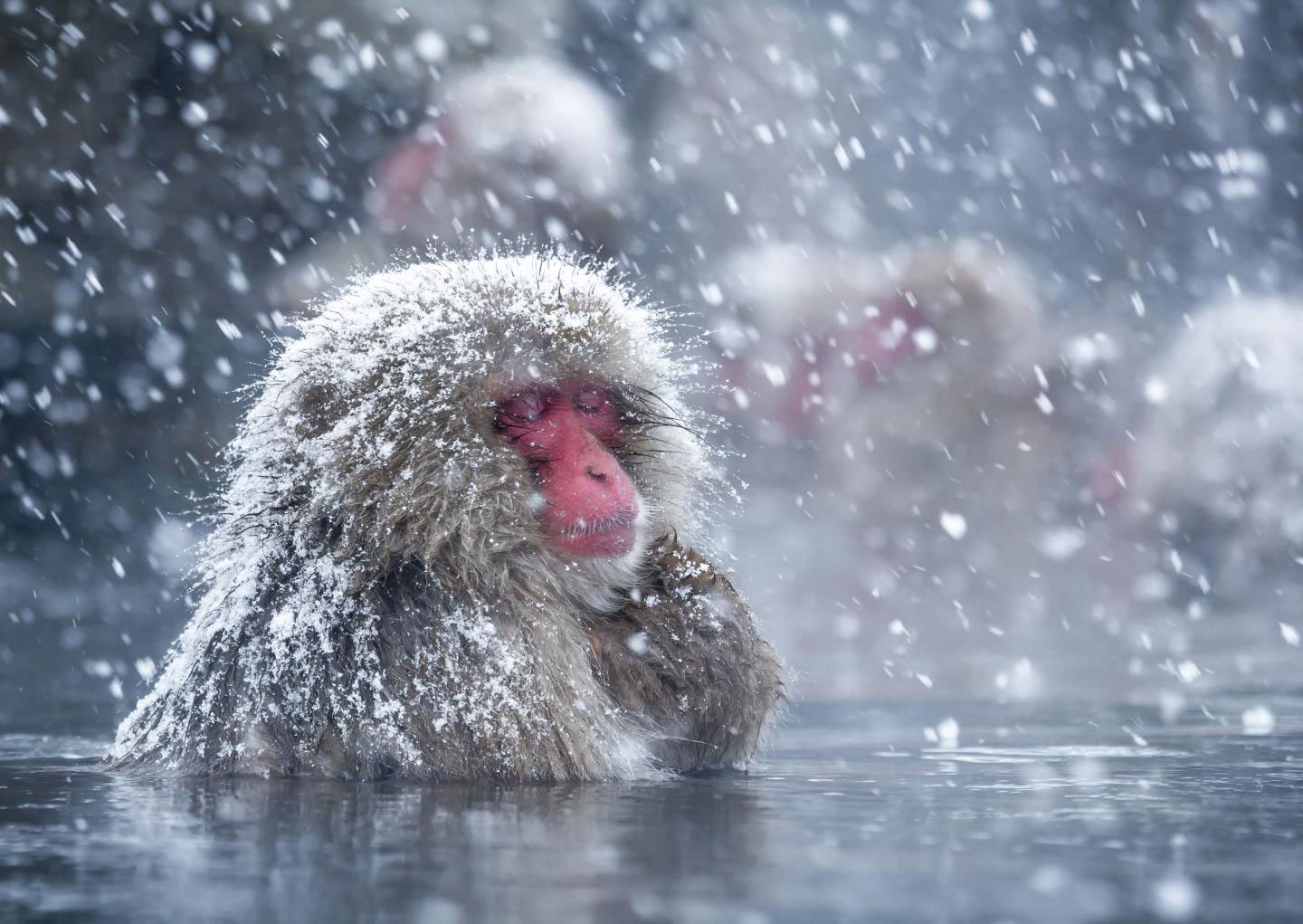
Japanese macaques, also known as snow monkeys, have been enjoying regular baths in the hot spring at Jigokudani in Japan for decades – and have even become a popular tourist attraction. A team of researchers led by Rafaela Takeshita of Kyoto University in Japan have now published the first study to scientifically validate the benefits of this behavior. These findings indicate how behavioral flexibility can help counter cold-climate stress and have likely implications for reproduction and survival. The study is available in Primates, the official journal of the Japan Monkey Center, which is published by Springer.
Japanese macaques (Macaca fuscata) are the most northerly species of nonhuman primates in the world, and have adapted to extremely cold winters. Researchers believed that those living in the Jigokudani Monkey Park in Nagano maintain their normal body temperature due to having thicker and longer fur during winter. These primates are also the only group of monkeys known to take hot spring baths, a behavior that was first observed in 1963 when a young female was seen in an outdoor hot spring belonging to a nearby hotel one snowy day. Other monkeys soon copied this behavior, and for hygienic purposes, the park management has since built a hot spring for the exclusive use of the monkeys. By 2003, one in every three females in the group bathed regularly in winter.
Although the fact that snow monkeys bathe more often during winter suggests that they use the hot spring to stay warm, to date no physiological data had been collected to support this idea. Takeshita and her colleagues studied twelve adult females during the spring birth season, from April to June, and winter mating season, from October to December. They determined how much time the monkeys spent in the hot springs, and which monkeys bathed the most. The researchers also collected fecal samples during times of extreme cold and analysed the concentration of fecal glucocorticoid (fGC) metabolite present. This was done because thermoregulatory stress and the management of a body temperature is known to influence concentrations of glucocorticoids, which belong to the family of steroid hormones.
The results confirmed that female snow monkeys use the hot spring more often in winter than in spring, and especially during colder weeks. Dominant females benefited from their status and spent longer time bathing, but they were also involved in more aggressive conflicts, resulting in higher energy expenditure than subordinate females. But taking a spa reduced stress hormone levels in those females. So high social status in this group of snow monkeys has a trade-off between the costs of high-rank position and the benefits from a hot spring, which is advantageous for conserving energy by reducing loss of body heat, and lowering stress levels.
“This indicates that, as in humans, the hot spring has a stress-reducing effect in snow monkeys,” says Takeshita, who believes that further investigation using serum or saliva samples might be useful to detect whether there are any further short-term changes in stress levels. “This unique habit of hot spring bathing by snow monkeys illustrates how behavioral flexibility can help counter cold-climate stress, with likely implications for reproduction and survival.”
In addition, Takeshita and her colleagues found that the around 500 visitors per day, who watch the snow monkeys bathe, had no effect on the levels of stress hormones released.
Reference: “Beneficial effect of hot spring bathing on stress levels in Japanese macaques” by Rafaela S. C. Takeshita, Fred B. Bercovitch, Kodzue Kinoshita and Michael A. Huffman, 3 April 2018, Primates.
DOI: 10.1007/s10329-018-0655-x
Never miss a breakthrough: Join the SciTechDaily newsletter.
Follow us on Google and Google News.