
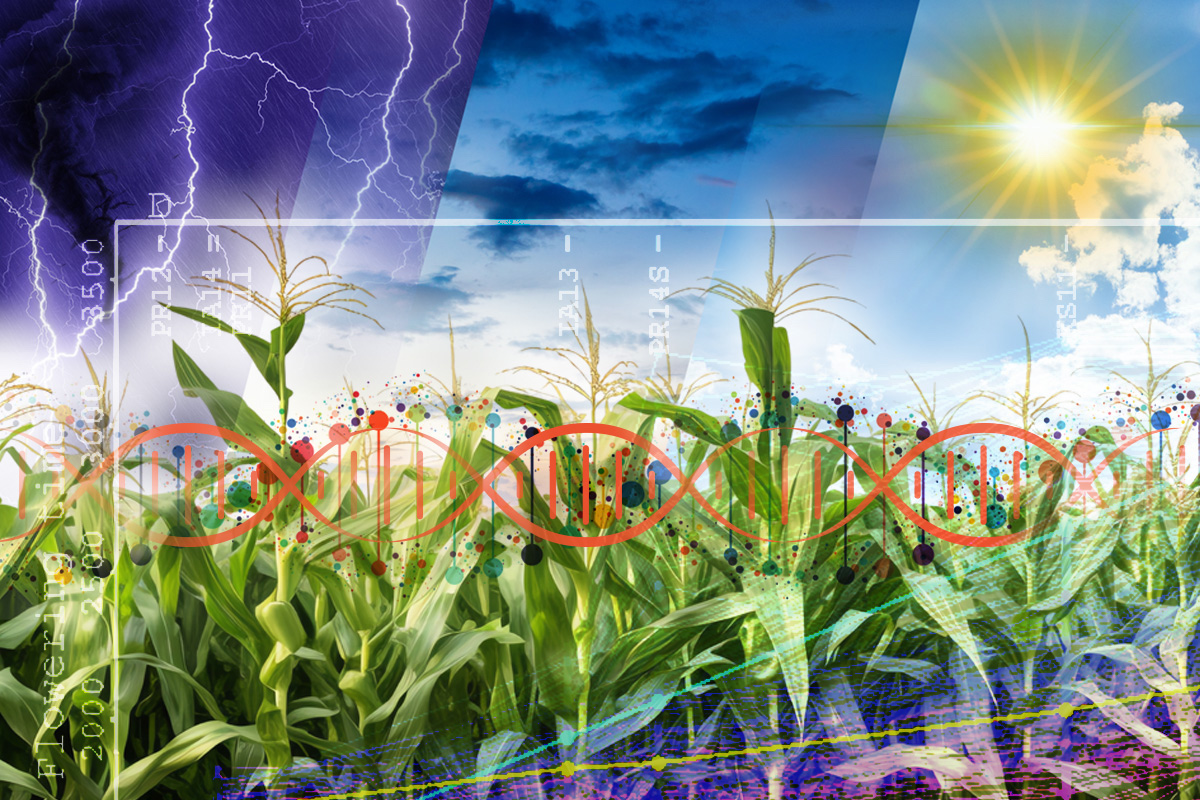
A research team has developed a framework to study phenotypic plasticity, linking crop traits, genetics, and weather. The method predicts corn traits like flowering time with high accuracy, offering a data-driven approach for breeding climate-resilient crops.
Understanding the influence of both environmental factors and genetic traits on crops is crucial for developing more resilient and productive varieties.
But the intricate interplay between weather and genes is difficult to untangle, in part because plants with the same genotype can respond in different ways to varying conditions. That dynamic is called phenotypic plasticity, and it’s the main research interest of Jianming Yu, an agronomy professor at Iowa State University.
Crop breeders have considered phenotypic plasticity too densely intertwined to be a useful focus in improving performance, Yu said. A new study from his research team and collaborators aims to increase the emphasis on plasticity by showing a systematic approach for wringing insight from data that links crop traits, genetics, and weather conditions.
Building a Framework for Phenotypic Plasticity
“We built a quantitative framework for breeders and geneticists to understand plasticity and study all the relevant aspects at the same time,” said Yu, the Pioneer Distinguished Chair in Maize Breeding and director of the Raymond F. Baker Center for Plant Breeding.
The findings by Yu’s team, described in a recent article in Genome Research, leverages previous research based on a large set of corn plants that have been well-studied over the past two decades. The maize nested association mapping population includes 5,000 lines of corn grown at 11 locations, and genetic and physical trait data on the plants are widely used by researchers. A team led by Iowa State’s Matthew Hufford, a professor of ecology, evolution, and organismal biology, published a study in 2021 sequencing the genomes of the 26 founders used to breed the 5,000-line population.
The new research led by Yu integrates the founder genomics with trait observations and historical weather data, searching more than 20 million genetic markers for the basis of 19 corn plant characteristics in varying environmental conditions throughout corn’s developmental cycle.
“It is amazing to be able to identify the primary environmental factor at the critical growth stage shaping the plastic response pattern of the maize population, and to connect with the genome-wide genetic variants,” he said.
The long-term goal is to guide breeding efforts, making it easier to predict how to develop corn that has higher yields or a greater capacity to withstand extreme conditions. A statistical analysis the researchers described in their paper, for instance, used the data to predict the flowering time of untested genotypes grown in untested environments more than 90% of the time. Predictions of plant architecture and yield component traits weren’t as accurate in untested genotypes and environments, though some individual traits in both categories topped 50%.
Implications for Climate-Resilient Crops
Coaxing further improvements from corn and other crops will be increasingly important as climates change, and breeding advancements that take big-picture approaches – large data sets incorporating real-life settings – hold the most promise, Yu said.
“We believe that most of the time when people do studies of the details using high technology, they’re only looking at a small subset of the material,” he said. “To solve large problems, you need the complexity of natural field conditions. That’s where we will get our production.”
Yu’s team shared their complied findings on MaizeGDB, a publicly accessible website for corn genomics, so other researchers can build on the work. Yu hopes their techniques for assembling and analyzing data that sheds light on phenotypic plasticity will be used by scientists who work with other plants. Large breeding companies also are interested in the approach, he said.
“It’s more the method than the specific findings. This is an interesting and valuable way to look at the data,” he said.
Reference: “Comprehensive identification of genomic and environmental determinants of phenotypic plasticity in maize” by Laura E. Tibbs-Cortes, Tingting Guo, Carson M. Andorf, Xianran Li and Jianming Yu, 6 August 2024, Genome Research.
DOI: 10.1101/gr.279027.124
The research was supported by the U.S. Department of Agriculture, the National Science Foundation, and Iowa State University’s Plant Sciences Institute and Raymond F. Baker Center for Plant Breeding.
Never miss a breakthrough: Join the SciTechDaily newsletter.
Follow us on Google and Google News.