
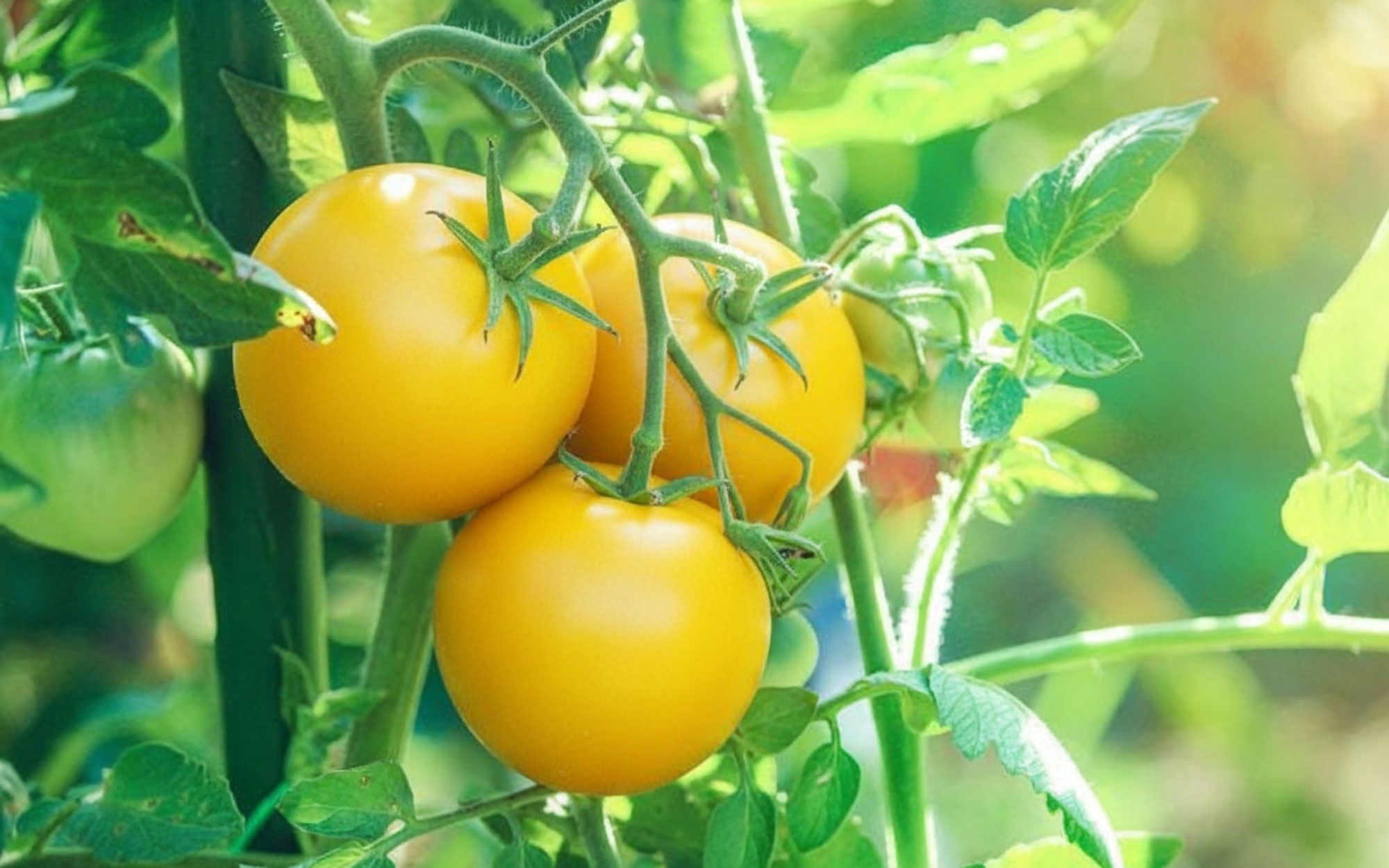
A single mutation in the YFT3 gene turns tomatoes yellow by disrupting a crucial pigment-producing enzyme.
Researchers have discovered that a single genetic change in the YFT3 gene disrupts a vital enzyme involved in producing carotenoids, the pigments responsible for tomato coloration. The gene encodes the isopentenyl diphosphate isomerase enzyme, which maintains the delicate balance between IPP and DMAPP, two essential C5 molecules in isoprenoid synthesis.
When one amino acid (Serine) is replaced by another (Arginine) at position 126, this balance is thrown off, weakening enzyme performance, hindering chromoplast formation, and drastically reducing lycopene, the red pigment that gives tomatoes their color. The findings uncover a key molecular mechanism behind tomato pigmentation and pinpoint Ser126 as a critical site for enzyme function, suggesting new possibilities for enhancing fruit quality through genetic approaches.
The color of a tomato depends heavily on the buildup of carotenoids, natural pigments that support both plant reproduction and human health. These pigments form through the isoprenoid pathway, which relies on the precise conversion between two molecular building blocks, isopentenyl pyrophosphate (IPP) and dimethylallyl pyrophosphate (DMAPP). This conversion is carried out by the enzyme IDI1, ensuring a steady flow of metabolites for pigment production.
When this process is disrupted, it can alter chromoplast development and pigment levels, changing both the fruit’s color and its nutritional value. Although scientists have made great progress in decoding carotenoid biosynthesis, the specific amino acids that govern IDI1’s activity have been difficult to identify, prompting a closer look at how YFT3 contributes to this essential pathway.
Identification of the YFT3 Mutation
A research team from Shanghai Jiao Tong University has identified a single-point mutation in the YFT3 gene responsible for yellow fruit coloration in tomatoes. Their findings, published in the journal Horticulture Research, reveal that the mutation disrupts a critical enzyme in the isoprenoid pathway, impairing carotenoid accumulation. Through map-based cloning, molecular assays, and in vivo functional analyses, the team demonstrated that a Ser126Arg substitution in YFT3 undermines its enzymatic activity, providing new insight into the molecular control of fruit pigmentation.
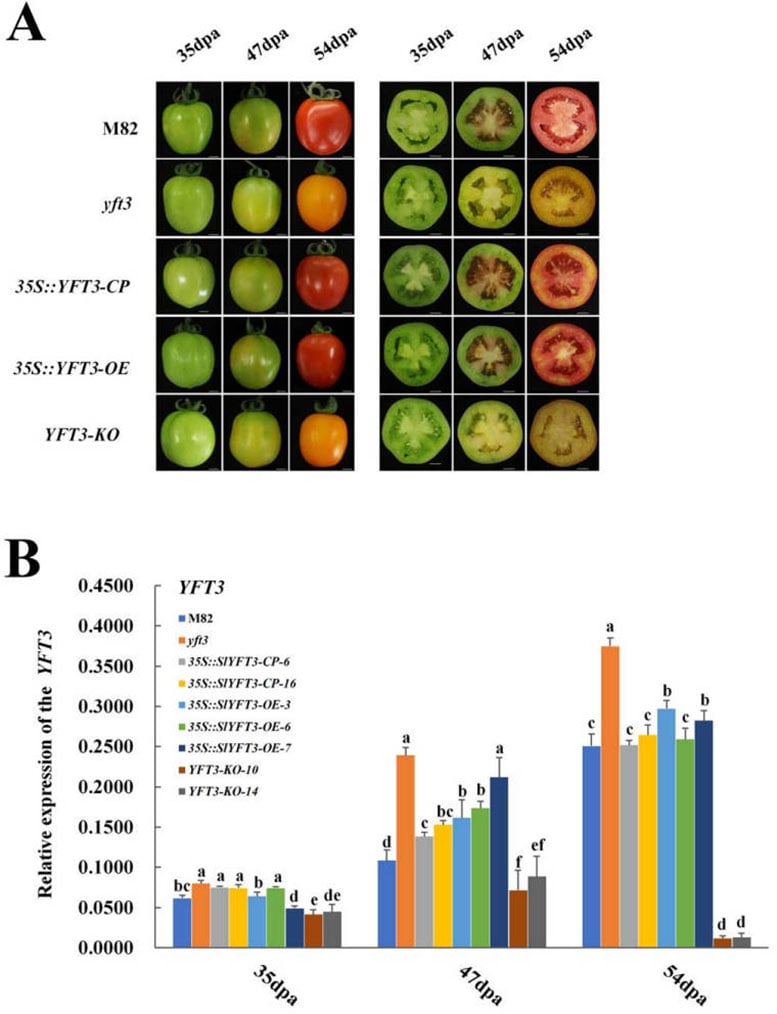
The researchers discovered that the yellow-fruited tomato mutant (yft3) carries a recessive allele of YFT3, encoding a mutated version of SlIDI1, a plastid-localized isomerase responsible for converting IPP to DMAPP. The mutation—an A→C transversion at nucleotide 2117—leads to a Ser126Arg substitution. Despite unchanged protein levels and plastid localization, enzymatic activity was drastically reduced. Functional complementation restored red color, while knockout lines mimicked the yellow phenotype, confirming YFT3’s essential role.
Molecular and Structural Insights
Detailed expression analyses showed upregulation of carotenoid pathway genes (DXS, DXR, HDR, PSY1, CRTISO, CYCB, CYP97A, NCED) in yft3 and CRISPR knockout lines. However, biochemical assays revealed severely reduced lycopene and total carotenoid levels, indicating that the gene upregulation could not compensate for enzymatic deficiency. Molecular docking revealed that the Ser126 mutation alters the active site conformation, impairs Mg²⁺ cofactor binding, and diminishes catalytic efficiency. These findings suggest Ser126 is critical for the correct positioning and function of substrate-enzyme interactions in carotenoid biosynthesis. Moreover, the impaired chromoplast ultrastructure in yft3 and YFT3-KO lines further underscores YFT3‘s role in fruit color development and quality.
“This study elegantly connects a single amino acid change to large-scale phenotypic effects,” said Dr. Lingxia Zhao, senior author of the paper. “By dissecting the enzymatic mechanism of YFT3 and demonstrating its crucial role in balancing IPP and DMAPP in plastids, we’ve uncovered a molecular bottleneck that determines tomato color. The identification of Ser126 as a key catalytic residue opens the door to targeted manipulation of carotenoid content in fruit. It’s a promising target not only for improving aesthetic and nutritional value in tomatoes but also for broader isoprenoid-related crop traits.”
This discovery holds significant potential for agricultural biotechnology and breeding programs. Understanding the role of YFT3 in regulating the isoprenoid pathway offers breeders a precise genetic handle to enhance fruit pigmentation and carotenoid content—key traits for market appeal and nutrition. Beyond tomato, these insights may extend to other carotenoid-rich crops, aiding efforts to fortify foods with pro-vitamin A compounds. Future work could explore gene editing strategies to modulate YFT3 activity or optimize isomerase function in different metabolic contexts. Ultimately, this research lays the groundwork for metabolic engineering approaches that balance yield, visual appeal, and nutritional quality in fruit crops.
Reference: “Mutation of YFT3, an isomerase in the isoprenoid biosynthetic pathway, impairs its catalytic activity and carotenoid accumulation in tomato fruit” by Wenzhen Li, Lulu Chen, Weihua Zhao, Yuhang Li, Ying Chen, Tengjian Wen, Zhengjun Liu, Chao Huang, Lida Zhang and Lingxia Zhao, 24 July 2024, Horticulture Research.
DOI: 10.1093/hr/uhae202
This work was supported by the National Natural Science Foundation of China (32072583, 32372694), Shanghai Collaborative Innovation Center of Agri-Seeds Foundation (ZXWH2150201/010), Shanghai and Kunshan Creation Center of Tomato Novel Germplasm Foundation (SJYY2022-T001), and Collection and Conservation of the Characteristic Crop Germplasm Resource in Kunshan City (Kunshan-AGR-001).
Never miss a breakthrough: Join the SciTechDaily newsletter.
Follow us on Google and Google News.