
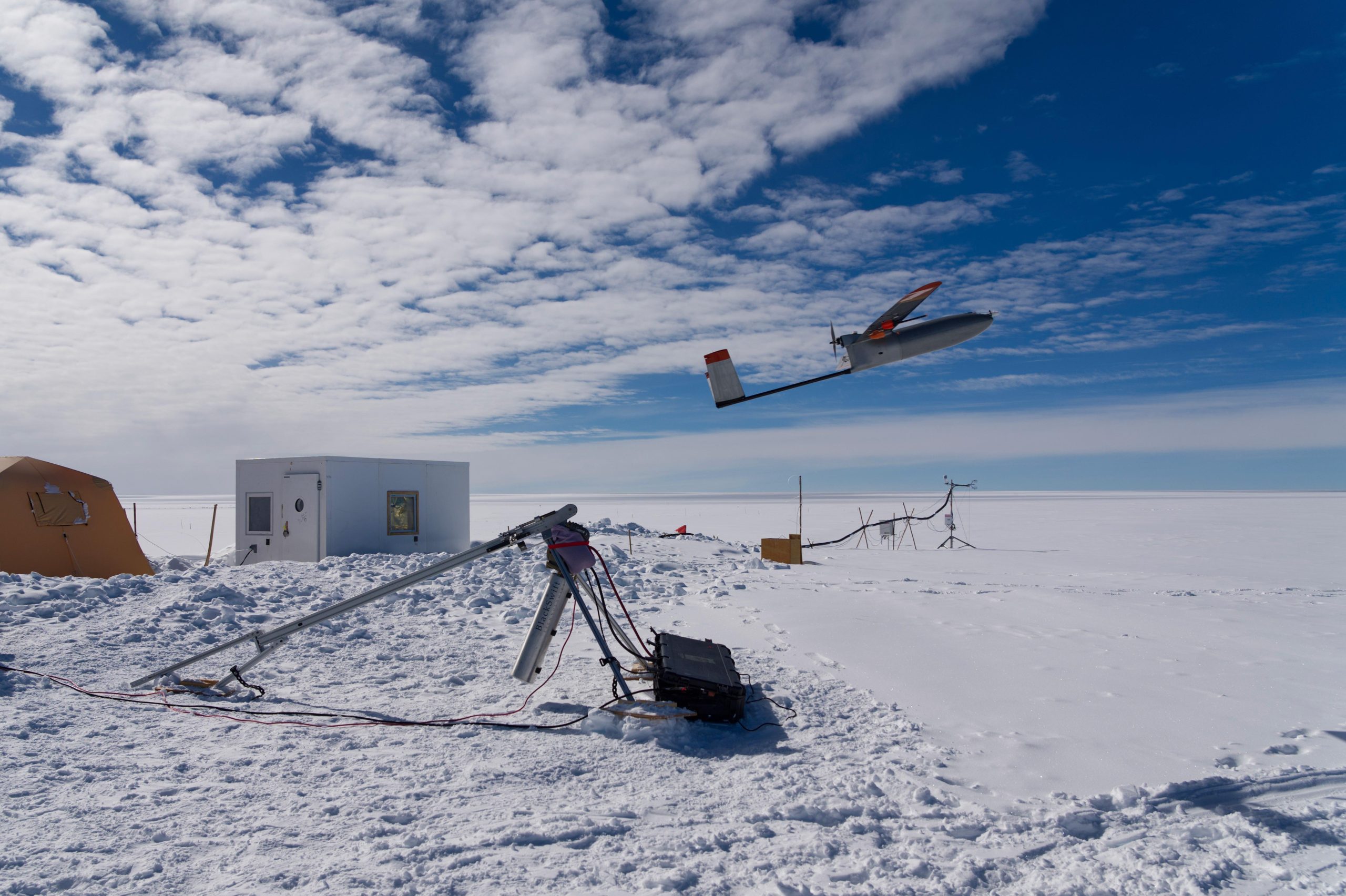
Drone-based data on Greenland’s water vapor is improving climate models and understanding of future ice loss.
For the first time, researchers have gathered precise measurements of water vapor in the upper atmosphere above the Greenland ice sheet. Using a custom-built drone, their work could lead to more accurate estimates of ice loss in the rapidly warming polar regions.
“We will be able to understand how water moves in and out of Greenland in the next few years,” said first author Kevin Rozmiarek, a doctoral student at the Institute of Arctic and Alpine Research (INSTAAR) at CU Boulder. “As a major freshwater reservoir, we need to understand how Greenland’s environment is going to change in the future.”
The findings were published on March 14 in JGR Atmospheres.
According to the National Oceanic and Atmospheric Administration (NOAA), Greenland lost approximately 55 gigatons of ice and snow between fall 2023 and fall 2024. This marks the 28th consecutive year of ice loss. Since 1992, scientists estimate that Greenland has lost more than 5 trillion tons of ice.
The Greenland ice sheet holds about 8% of the world’s freshwater. As it melts, it contributes to global sea level rise and could disrupt ocean circulation and ecosystems around the world.
The majority of ice loss comes from large ice chunks breaking off from glaciers and the melting of surface ice and snow. Sublimation, the process of solids turning into gases without turning into liquids first, may also play a role. Prior studies have suggested that in some parts of Greenland, about 30% of summer surface snow could sublimate to water vapor.
Tracking water in the sky
It is unclear where the water vapor goes, said Rozmiarek. Some might fall back down as snow or recondense on the surface later, but some could leave Greenland’s water system entirely.
Collecting air samples in the Arctic is an expensive and technically challenging task, because it traditionally involves flying a plane to the middle of an ice sheet in harsh weather and carrying air samples back to the laboratory.
Rozmiarek and his team overcame the challenges by loading air sampling equipment on a large drone with a 10-foot wingspan.
Throughout the summer of 2022, the team flew the drone 104 times from the East Greenland Ice-Core Project camp—managed by the University of Copenhagen— in the island’s interior. The drone collected air samples at different heights of up to nearly 5,000 feet above the ground.
The team aimed to look into the type of hydrogen and oxygen atoms in the air’s water vapor. Water molecules from different sources contain distinct combinations of hydrogen and oxygen. Scientists call these variations in isotopes.
“Isotopes are water’s fingerprints. By following these fingerprints, we can trace back to the source where the water vapor came from,” Rozmiarek said. Scientists have collected high-quality data on the source of water in Greenland, including water that flows from the tropics, and the sink, which is the surface snow on the Greenland ice sheet. “But we don’t know much about the isotopic composition of water in motion, which is the vapor between the source and sink,” he added.
When the team compared their drone-based measurements with an existing computer simulation that models the Arctic water cycle, they found the simulation underestimated the amount of precipitation that fell on Greenland. By incorporating the isotopic data observed in the simulation, the model rendered an accurate prediction of how water moves over Greenland.
“It’s really important to be able to predict what’s going to happen to Greenland in the warming world as accurately as possible,” Rozmiarek said. “We demonstrated how useful water vapor isotope data is by successfully improving an existing model.”
Melting ice sheet
About 125,000 years ago, when Earth was warmer than preindustrial levels, Greenland was covered by a significantly smaller ice sheet, and the sea level was as much as 19 feet higher than today. As the planet continues to warm, the Greenland ice sheet could see dramatic changes and even shrink to its size back then, Rozmiarek said.
The Greenland ice sheet contains a massive amount of freshwater, and that water, if leaving the system, could lead to significant increases in global sea level. The United Nations estimated that rising sea levels caused by climate change currently impact 1 billion people worldwide.
Rozmiarek hopes to return to Greenland and other parts of the Arctic to conduct more flights and gather additional data.
“It’s like we just figured out how to discover fingerprints at a crime scene. This is a concrete step forward in understanding where water is going and where it is coming from in this important system at a time when we need it most,” he said.
Reference: “Atmosphere to Surface Profiles of Water-Vapor Isotopes and Meteorological Conditions Over the Northeast Greenland Ice Sheet” by Kevin S. Rozmiarek, Laura J. Dietrich, Bruce H. Vaughn, Michael S. Town, Bradley R. Markle, Valerie Morris, Hans Christian Steen-Larsen, Xavier Fettweis, Chloe A. Brashear, Hayley Bennett and Tyler R. Jones, 14 March 2025, Journal of Geophysical Research: Atmospheres.
DOI: 10.1029/2024JD042719
Never miss a breakthrough: Join the SciTechDaily newsletter.
Follow us on Google and Google News.