
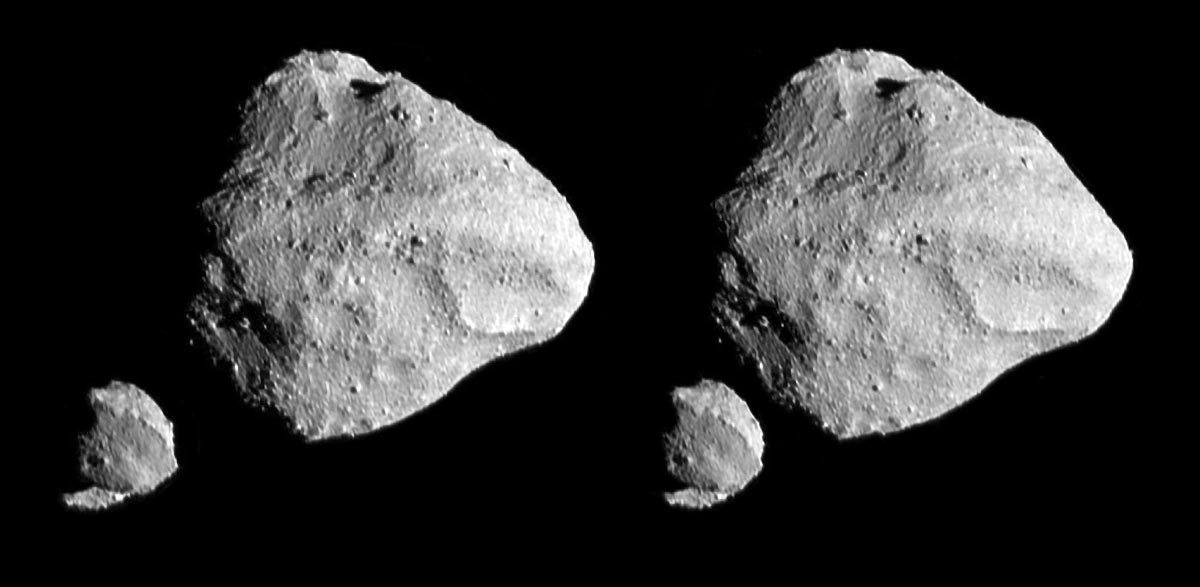
Researchers at Cornell University have developed a new method for estimating the age of asteroids using dynamics, demonstrating this approach on the asteroid Selam, found to be around 2-3 million years old.
An asteroid discovered last November is in fact a solar system toddler – just 2-3 million years old, a Cornell University-led research team estimates using novel statistical calculations.
The team derived the age of Selam, a “moonlet” circling the small asteroid Dinkinesh in the main asteroid belt between Mars and Jupiter, based only on dynamics, or how the pair moves in space. Their calculation agrees with one by NASA’s Lucy mission based on an analysis of surface craters, the more traditional method for dating asteroids.
Advantages of the New Method
The new method complements that work and has some advantages: It doesn’t require an expensive spacecraft to capture close-up images; could be more accurate in cases where asteroid surfaces have undergone recent changes; and can be applied to the secondary bodies in dozens of other known binary systems, which account for 15% of near-Earth asteroids, the researchers said.
“Finding the ages of asteroids is important to understanding them, and this one is remarkably young when compared to the age of the solar system, meaning it formed somewhat recently,” said Colby Merrill, a doctoral student in the field of aerospace engineering. “Obtaining the age of this one body can help us to understand the population as a whole.”
Merrill is the first author of “Age of (152830) Dinkinesh-Selam Constrained by Secular Tidal-BYORP Theory,” published in Astronomy & Astrophysics.
Unique Characteristics and Future Applications
Merrill, a dynamics expert who was part of NASA’s Double Asteroid Redirection Test (DART) mission, was watching closely when the Lucy spacecraft flew by Dinkinesh on November 1, 2023, and unexpectedly found Selam. The latter turned out to be “an extraordinarily unique and complex body,” Merrill said – a so-called “contact binary” consisting of two lobes that are essentially rubble piles stuck together, and the first of its kind seen orbiting another asteroid.
Binary asteroids are dynamically complex and fascinating objects that are engaged in a sort of tug of war, the researchers said. Gravity acting on the objects causes them to physically bulge and results in tides, which slowly reduce the system’s energy. Meanwhile, the sun’s radiation also alters the binary system’s energy with an effect termed the Binary Yarkovsky-O’Keefe-Radzievskii-Paddack (BYORP) effect. Eventually, the system will reach an equilibrium where tides and BYORP are equally strong – a stalemate in the tug of war.
Assuming those forces were in equilibrium and plugging in asteroid data shared publicly by the Lucy mission, the researchers calculated how long it would have taken for Selam to reach its current state after forming from surface material ejected by a rapidly spinning Dinkinesh. Along the way, the team said it improved upon preexisting equations that assumed both bodies were equally dense and ignored the secondary body’s mass. Running roughly 1 million calculations with varying parameters, the results produced a median age for Selam of 3 million years old, with 2 million being the most likely result.
Researchers hope to apply their new aging method to other binary systems where dynamics have been well characterized, even without close flybys.
“Used in tandem with crater counting, this method could help better constrain a system’s age,” said Alexia Kubas, a doctoral student in the field of astronomy and space sciences and paper co-author. “If we use two methods and they agree with each other, we can be more confident that we’re getting a meaningful age that describes the current state of the system.”
Reference: “Age of (152830) Dinkinesh I Selam constrained by secular tidal-BYORP theory” by C. C. Merrill, A. R. Kubas, A. J. Meyer and S. D. Raducan, 19 April 2024, Astronomy & Astrophysics.
DOI: 10.1051/0004-6361/202449716
Never miss a breakthrough: Join the SciTechDaily newsletter.
Follow us on Google and Google News.