
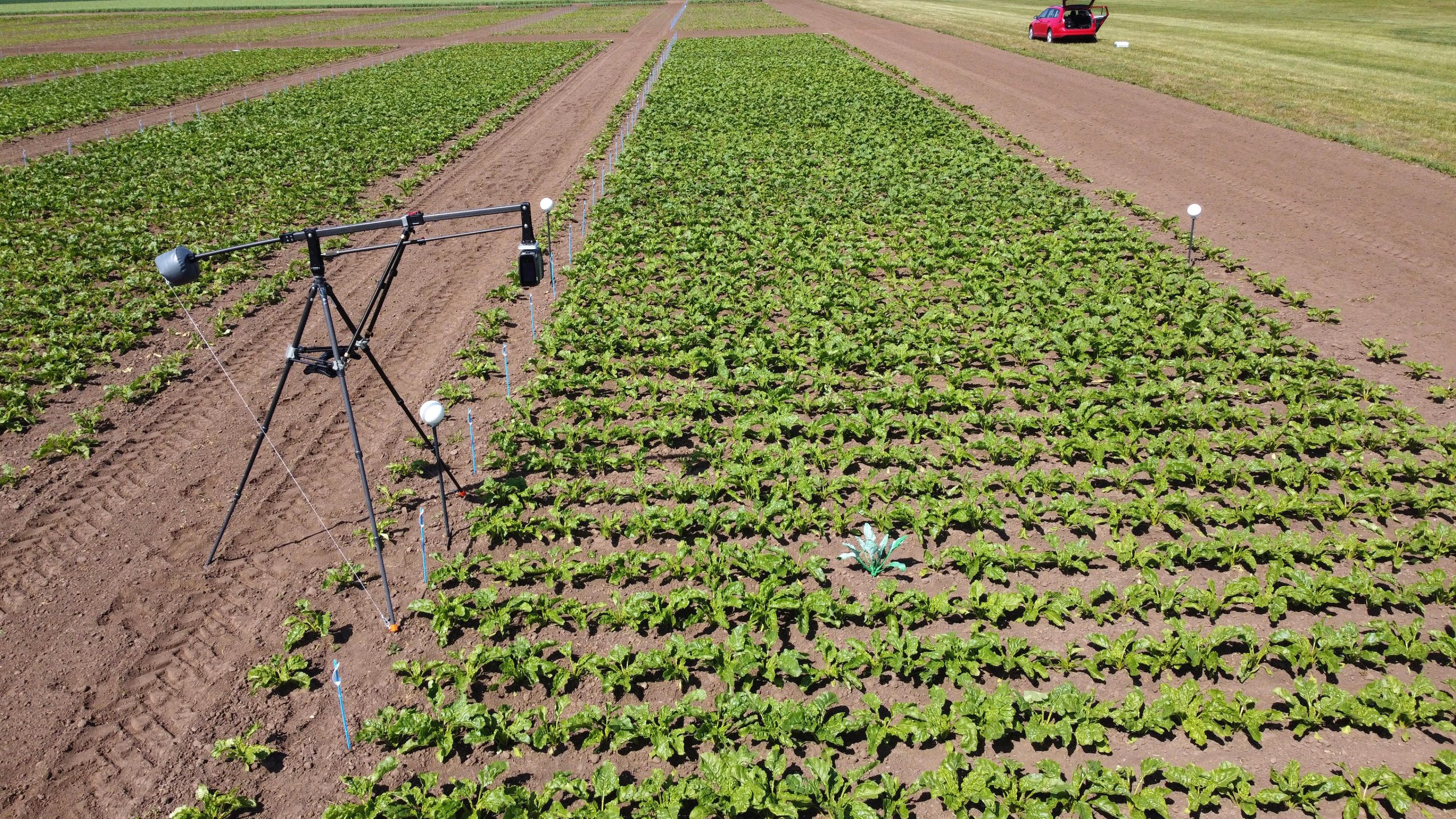
Scientists use laser scanning to generate 3D models of the above-ground parts of the sugar beet plant from a crop field, providing a step forward in developing AI-assisted crop pipeline improvement.
A demonstration of how new technologies can be used in 21st-century crop breeding comes from newly published research that combines Laser Scanning and 3D printing to create a detailed 3D model of a sugar beet plant. Taking the next step beyond having genetic information to guide intelligent breeding, the 3D plant models here capture the essential characteristics of the above-ground parts of the sugar beet plant and can be used for AI-assisted crop improvement pipelines. The sugar beet plant models are reproducible and fit for field use. All the research information, data, methodology, as well as the 3D printing files are freely available. Crop management is gaining much needed tools, and, of course, everyone can now print their own 3D sugar beet plant! (Minimum maintenance required.)
Improving Crops With Laser Beams and 3D Printing
Modern plant breeding is a data-centric enterprise, involving machine learning algorithms and sophisticated imaging technology to select desirable traits. “Plant phenotyping”— the science of gathering precise information and measurements on plants — has seen massive improvements over the last few years.
In the past, phenotyping relied on measurements taken tediously by humans. Today, phenotyping pipelines are becoming more and more automated, using state-of-the-art sensor technology, often assisted by artificial intelligence. Measurements taken can include size, fruit quality, leaf shape and size, and other growth parameters. In addition to the efficiency gains of handing over the measurement work to automated pipelines, computer-assisted sensors can often capture complex information about a plant that would be very hard for humans to gather on a large scale.
Importance of Precise Reference Material
One crucial aspect in this new, sensor-driven world of crop breeding is the availability of precise reference material.
The sensors need to be presented with data on a “standard plant” that encompass all relevant characteristics, including also more complex, 3-dimensional traits such as the angle at which the leaves are oriented. Having an actual “artificial plant” as a real-size reference is therefore preferable to just having data in the computer, or a flat, 2D representation. An actual model can, for example, also be included as a reference and internal control within a greenhouse or test field among the real plants.
3D Printed Model for Research
The new 3D-printed model of a sugar beet plant was generated with these applications in mind and has the additional advantage that the printing files are available for free download and reuse. This allows other scientists (and any sugar beet enthusiast, really) to recreate an exact copy of the reference sugar beet, making research done by different labs in different parts of the world more comparable. The affordability of 3D printing also means the approach can be adapted in resource-poor settings, for example in developing countries.
Data Collection With LIDAR
To gather the precise data for their realistic model, the authors — Jonas Bömer and colleagues from the Institute of Sugar Beet Research (Göttingen) and the University of Bonn — used LIDAR (Light Detection and Ranging) technology.
In short, a real sugar beet plant was scanned by a laser to create 3D data from 12 different viewing angles. After processing steps, this data was then fed into a commercial-grade 3D printer to create the actual real-size model of the sugar beet. The authors then tested the model for its intended use as point of reference, in the lab and in the field.
Jonas Bömer explains: “In the field of three-dimensional plant phenotyping, the referencing of utilized sensor systems, computer algorithms, and captured morphological parameters represents a challenging yet fundamentally important task. The application of additive manufacturing technologies for the generation of reproducible reference models presents a novel opportunity to develop standardized methodologies for objective and precise referencing, thereby benefiting both scientific research and practical plant breeding.”
Future Applications and Benefits
The approach is not restricted to sugar beet of course, and the new GigaScience study demonstrates how the combination of artificial intelligence, 3D printing, and sensor technology can contribute to the plant breeding of the future — thus helping to feed the world’s population with healthy, delicious crops.
GigaScience data scientist Chris Armit adds: “The value in a printable 3D model is that you can print multiple copies, one per field of crops. As a low-cost phenotyping strategy, where the major cost is the LIDAR scanner, it would be fantastic to see this approach tested on other crops such as rice or African orphan crops, where there is a need for low-cost phenotyping solutions.”
References:
Reference: “A 3D printed plant model for accurate and reliable 3D plant phenotyping” by Jonas Bömer, Felix Esser, Elias Marks, Radu Alexandru Rosu, Sven Behnke, Lasse Klingbeil, Heiner Kuhlmann, Cyrill Stachniss, Anne-Katrin Mahlein and Stefan Paulus, 20 June 2024, GigaScience.
DOI: 10.1093/gigascience/giae035
“Supporting data for ‘A 3D printed plant model for accurate and reliable 3D plant phenotyping'” by Jonas Bömer, Felix Esser, Elias Marks, Radu Alexandru Rosu, Sven Behnke, Lasse Klingbeil, Heiner Kuhlmann, Cyrill Stachniss, Anne-Katrin Mahlein and Stefan Paulus, 22 May 2024, GigaScience Database.
DOI: 10.5524/102530
Never miss a breakthrough: Join the SciTechDaily newsletter.
Follow us on Google and Google News.
1 Comment
Heading towards Soylent Green, one step at a time.