
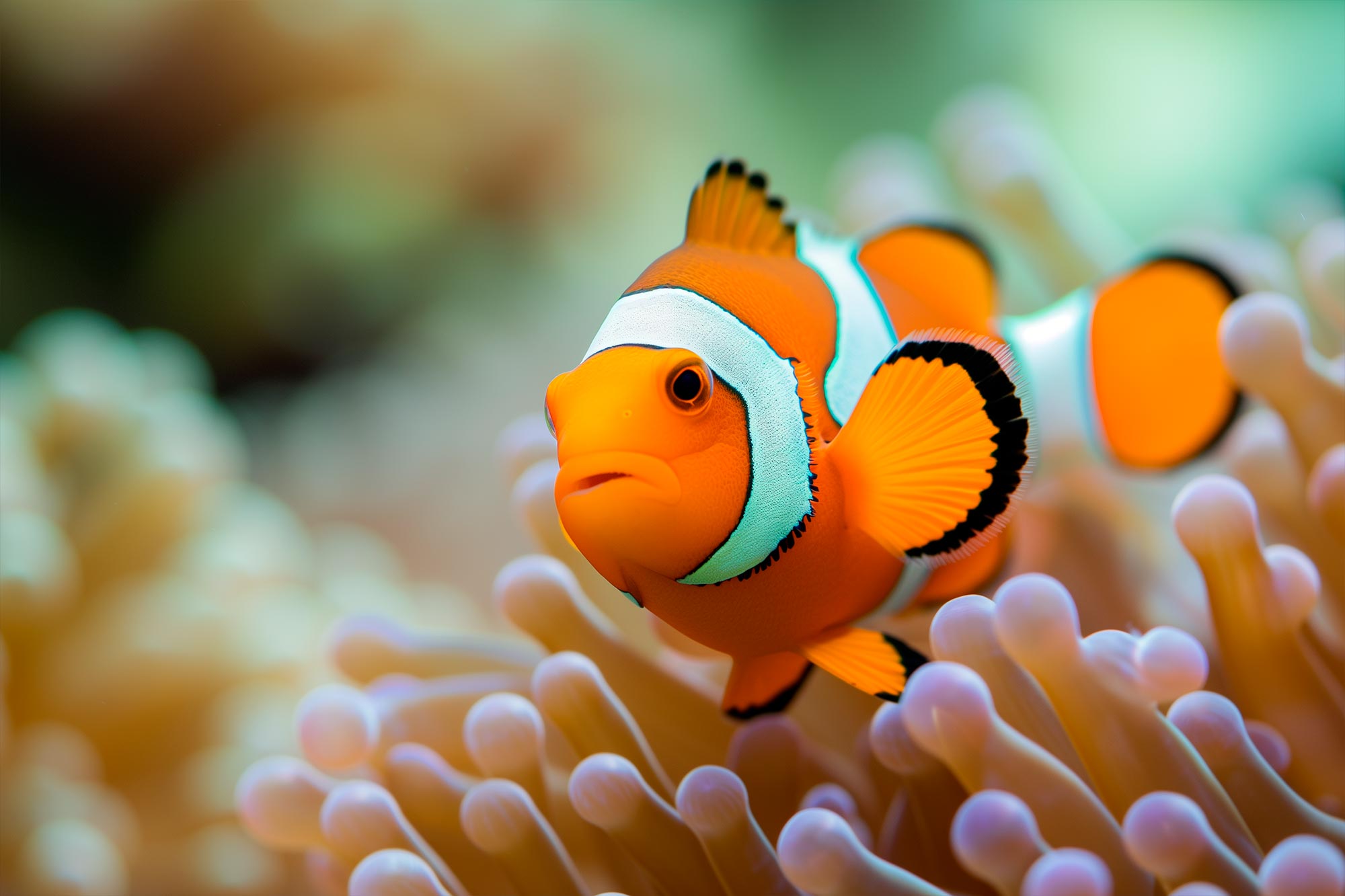
Clownfish count stripes to distinguish friend from foe.
Nemo, the small animated fish, is an icon, snuggled up with his father in an anemone. And Pixar would have you believe that anemonefish life is generally peaceful and tranquil. But the myth belies reality.
Anemonefish (also known as clownfish) are feisty little creatures, enthusiastically defending their anemone homes from intruders. And while it is sometimes fine to share with anemonefish of other species, it is never cool to cohabit with intruders of their own species: they always receive the frostiest reception.
So how do anemonefish tell members of their own species apart from other stripy fish?
According to Kina Hayashi from the Okinawa Institute of Science and Technology, Japan, anemonefish species that live in the same locations tend to have a wide range of stripy patterns – from three vertical white bars to none.
Might anemonefish be able to count the number of white bands on other fish’s bodies to distinguish friend from foe? Kina Hayashi and colleagues published the amazing discovery that common clownfish (Amphiprion ocellaris) can count in Journal of Experimental Biology.
Experimentation and Findings
To find out, Hayashi, Noah Locke and Vincent Laudet raised a school of young Nemos, common clownfish, from eggs, to ensure that the fish had never set eyes on other species of anemonefish.
Once the youngsters were ~6 months old, Hayashi filmed their reactions to other anemonefish species – including Clarke’s anemonefish (A. clarkii), orange skunk clownfish (A. sandaracinos) and saddleback clownfish (A. polymnus) – as well as intruders of their own species, to find out how they responded.
Sure enough, the common clownfish gave members of their own species, with three white bands, the hardest time, facing off against 80% of the fish for up to 3 s and even maintaining an 11 s standoff with one fish. In contrast, the intruders of other species had an easier time: the orange skunk clownfish – with no side bars and a white line along its back – got off the lightest and were barely confronted, while the Clarke’s clown fish and saddleback clownfish – with two and three white bars, respectively – were mildly bullied.
“Common clownfish… attacked their own species most frequently,” says Hayashi.
But how were the clownfish distinguishing between members of their own species and others?
This time, the team isolated small shoals (three fish) of young common clownfish in individual tanks and then filmed the fish’s reactions to either a plain orange fish model or models painted with one, two or three white bands, keeping a tally of how often the fish bit and chased the offending intruder.
Sure enough, the young clownfish paid little attention to the plain orange model, similar to the lack of interest they had shown in the orange skunk clownfish, whereas they nipped and pursued the model with a single bar from time to time.
However, they really turned up the pressure on the three-striped models; they did not like sharing space with the three-barred strangers that look like themselves. And the two-striped models also came in for a bullying.
Hayashi suggests that the clownfish’s aversion to fish with two bars could relate to their development. Common clownfish initially form two white stripes at ~11 days of age before gaining the third 3 days later. She suspects that clownfish that grow up with other two-striped youngsters could see fish with two white bars as competitors to be chased away.
Implications of Clownfish Behavior
So, young common clownfish that make their homes in anemones can distinguish species that pose a threat from those that do not based on the number of white bars on the fish’s sides. This allows them to defend their abode from intruders that might try to evict them, while paying less attention to fish of other species that have little interest in setting up home in their anemone residence.
Reference: “Counting Nemo: anemonefish Amphiprion ocellaris identify species by number of white bars” by Kina Hayashi, Noah J. M. Locke and Vincent Laudet, 1 February 2024, Journal of Experimental Biology.
DOI: 10.1242/jeb.246357
Never miss a breakthrough: Join the SciTechDaily newsletter.
Follow us on Google and Google News.