
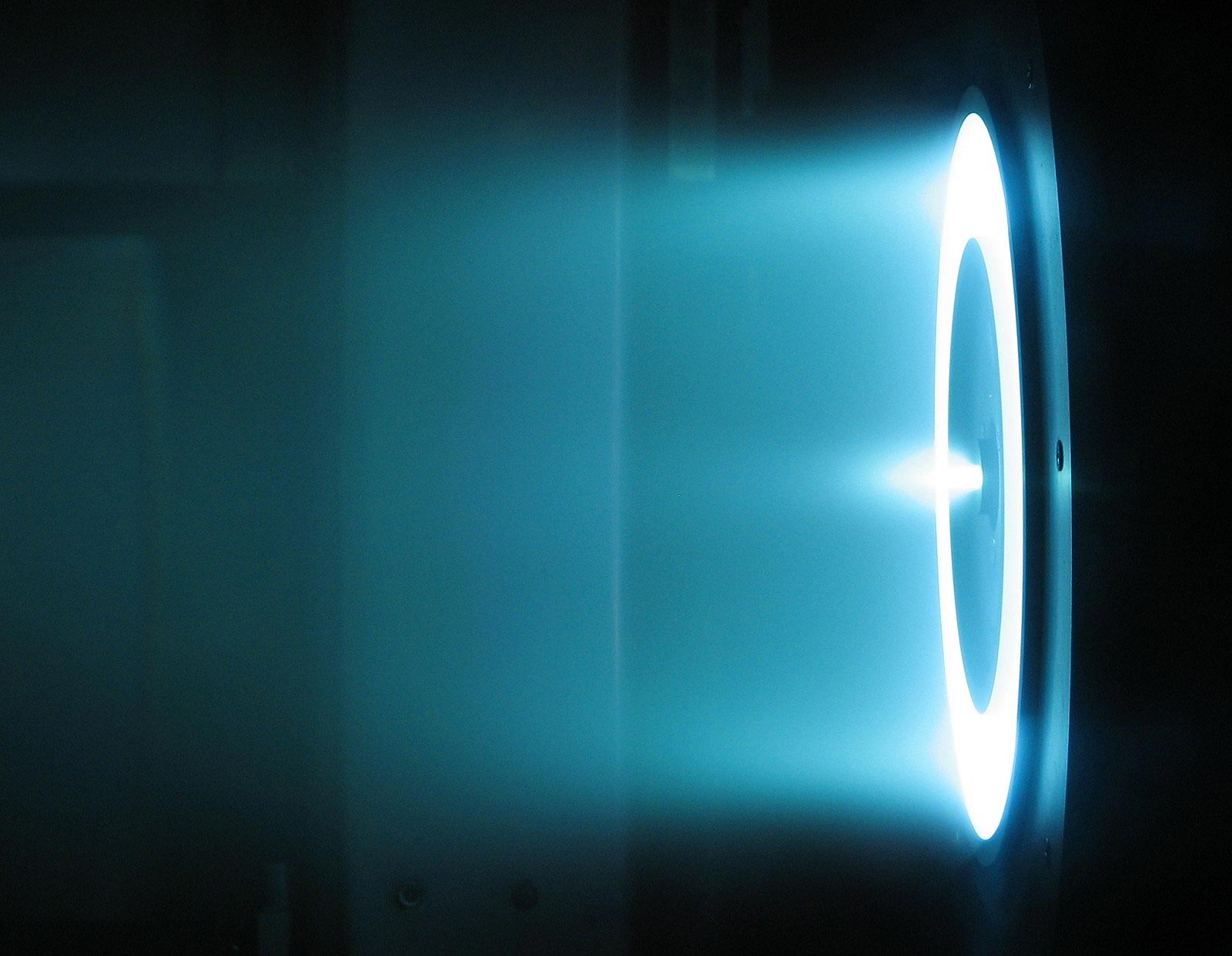
A research team at the University of Virginia is revolutionizing the future of space travel with groundbreaking studies on electric propulsion thrusters.
By delving into the behavior of electrons in plasma beams, their work promises to enhance spacecraft efficiency and safety, ensuring that missions like NASA’s Artemis program can venture further into space with reduced risks and greater sustainability.
Propulsion Innovations in Spacecraft Technology
Faster, farther, and more efficiently — that’s the mission driving spacecraft propulsion engineers like Chen Cui, an assistant professor at the University of Virginia’s School of Engineering and Applied Science. Cui focuses on advancing electric propulsion (EP) thrusters, a cornerstone technology for future space exploration.
“In order to ensure the technology remains viable for long-term missions, we need to optimize EP integration with spacecraft systems,” Cui explained.
Collaborating with his former adviser, University of Southern California professor Joseph Wang, Cui recently published groundbreaking research in Plasma Sources Science and Technology. Their work sheds new light on electron behavior in plasma beams, potentially shaping the next generation of space propulsion systems.

The Future of Space Exploration
Cui, who joined the Department of Mechanical and Aerospace Engineering in the fall, focuses his research on understanding how electrons — tiny, fast-moving charged particles — behave in the plasma beams emitted by EP thrusters.
“These particles may be small, but their movement and energy play an important role in determining the macroscopic dynamics of the plume emitted from the electric propulsion thruster,” he said.
By studying these microscopic interactions, Cui aims to better understand how the plume of plasma emitted interacts with the spacecraft itself.
“For missions that could last years, EP thrusters must operate smoothly and consistently over long periods of time.”
Electric propulsion works by ionizing a neutral gas, usually xenon, and then using electric fields to accelerate the resulting ions. The ions, now forming a high-speed plasma beam, push the spacecraft forward.
Compared to chemical rockets, EP systems are much more fuel-efficient, enabling spacecraft to travel farther while carrying less fuel. These systems are often powered by solar panels or small nuclear reactors, making them ideal for long missions in space, such as NASA’s Artemis program, which aims to return humans to the moon, and eventually send astronauts to Mars and beyond.

Challenges of Plasma Plumes
However, the plume emitted by the thrusters isn’t just exhaust — it’s the lifeline of the entire propulsion system. If not well understood, the plume can cause unexpected problems. Some particles may flow backward toward the spacecraft, potentially damaging important components on the craft, such as solar panels or communication antennas.
“For missions that could last years, EP thrusters must operate smoothly and consistently over long periods of time,” Cui said. This means scientists and engineers must have a deep understanding of how the plasma plume behaves in order to prevent any potential damage.
Revolutionizing Research with Advanced Simulations
Cui specializes in building advanced computer simulations to study how plasma behaves in EP thruster plasma flows. These aren’t just any simulations. They’re powered by modern supercomputers and use a method called Vlasov simulation, an advanced “noise-free” computational method.
The electrons in an EP beam don’t behave exactly as predicted by simple models. They perform differently at different temperatures and speeds, creating distinct patterns.
Being able to precisely see the complexity of electron interactions, while factoring out data that confuse the bigger picture, is key.
“The electrons are a lot like marbles packed into a tube. … However, if the ‘marbles’ roll out from the middle of the tube, they start to cool down.”
New Insights into Electron Behavior
“The electrons are a lot like marbles packed into a tube,” Cui said. “Inside the beam, the electrons are hot and move fast. Their temperature doesn’t change much if you go along the beam direction. However, if the ‘marbles’ roll out from the middle of the tube, they start to cool down. This cooling happens more in certain directions, the direction perpendicular to the beam’s direction.”
In their most recent paper, they found the electron velocity distribution shows a near-Maxwellian [bell-curve-like] shape in the beam direction and what they describe as a “top-hat” profile in the transverse direction of the beam.
Additionally, Cui and Wang discovered that electron heat flux — the major way thermal energy moves through the EP plasma beam — primarily occurs along the beam’s direction, with unique dynamics that had not been fully captured in previous models.
Reference: “Vlasov simulations of electric propulsion beam” by Chen Cui and Joseph Wang, 11 December 2024, Plasma Sources Science and Technology.
DOI: 10.1088/1361-6595/ad98c0
Never miss a breakthrough: Join the SciTechDaily newsletter.
Follow us on Google and Google News.
2 Comments
“…, they found the electron velocity distribution shows a near-Maxwellian [bell-curve-like] shape in the beam direction …”
I think that the author of this article is confusing the “near-Maxwellian” shape with a Gaussian shape. Gaussian is symmetrical about the mean, while the “near-Maxwellian” shape is asymmetrical.
Sounds like he is, yes. Well spotted.