
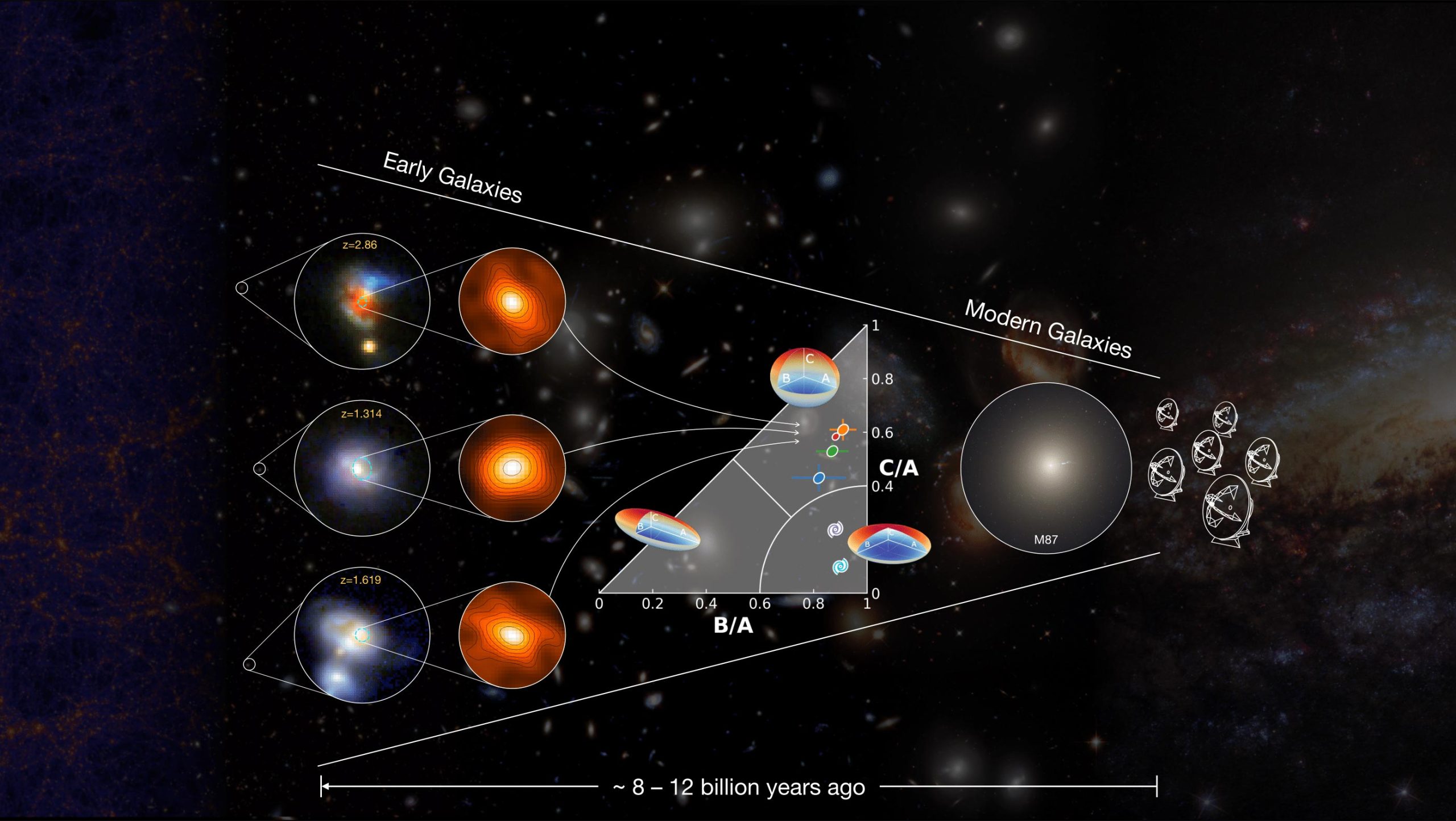
Researchers have discovered that old elliptical galaxies can form from intense star formation in early galaxy cores.
This finding, derived from data analyzed by the Atacama Large Millimeter/submillimeter Array, shows that these spheroidal galaxies, often considered static and inert, were once dynamic regions of intense star formation during the cosmic noon. This transformative view on galaxy evolution helps clarify the processes behind the formation of the universe’s most massive galaxies.
Groundbreaking Discovery in Galaxy Formation
An international team of researchers, including scientists from the University of Tokyo’s Kavli Institute for the Physics and Mathematics of the Universe (Kavli IPMU, WPI), has uncovered evidence that old elliptical galaxies can form through intense star formation in the cores of early galaxies. This groundbreaking discovery, published in Nature, offers new insights into the evolution of galaxies in the early Universe.
Today’s galaxies exhibit a wide range of shapes and structures, but they generally fall into two main categories. Younger, disk-like spiral galaxies, such as the Milky Way, are actively forming new stars. In contrast, older elliptical galaxies, characterized by a central bulge and a lack of star-forming gas, consist primarily of ancient stars. Despite their prevalence, the origins of these spheroidal galaxies have remained an open question—until now.
Breakthrough Observations From the Cosmic Noon Era
The discovery of the birth sites of giant, elliptical galaxies – announced in a paper published on December 4 in Nature – came from analyzing data from the Atacama Large Millimeter/submillimeter Array (ALMA) on over 100 Submillimeter Bright Galaxies (SMGs) with redshifts dating to the “Cosmic noon” era, when the universe was between around 1.6 and 5.9 billion years old and many galaxies were actively forming stars.
This study provides the first solid observational evidence that spheroids can form directly through intense star formation within the cores of highly luminous starburst galaxies in the early Universe, based on a new perspective from the submillimeter band. This breakthrough will significantly impact models of galaxy evolution and deepen our understanding of how galaxies form and evolve across the Universe.
New Insights Into Spheroidal Structures
In this study, researchers led by Chinese Academy of Sciences Purple Mountain Observatory Associate Researcher Qinghua Tan, and including Kavli IPMU Professor John Silverman, Project Researcher Boris Kalita, and graduate student Zhaoxuan Liu, used statistical analysis of the surface brightness distribution of dust emission in the submillimeter band, combined with a novel analysis technique.
They found that the submillimeter emission in most of sample galaxies are very compact, with surface brightness profiles deviating significantly from those of exponential disks. This suggests that the submillimeter emission typically comes from structures that are already spheroid-like.
Further evidence for this spheroidal shape comes from a detailed analysis of galaxies’ 3D geometry. Modeling based on the skewed-high axis-ratio distribution shows that the ratio of the shortest to the longest of their three axes is, on average, half and increases with spatial compactness. This indicates that most of these highly star-forming galaxies are intrinsically spherical rather than disk-shaped.
Supported by numerical simulations, this discovery has shown us that the main mechanism behind the formation of these tri-dimensional galaxies (spheroids) is the simultaneous action of cold gas accretion and galaxy interactions. This process is thought to have been quite common in the early Universe, during the period when most spheroids were forming. It could redefine how we understand galaxy formation.
Spheroidal Galaxies’ Structure Analyzed
This research was made possible thanks to the A3COSMOS and A3GOODSS archival projects, which enabled researchers to gather a large number of galaxies observed with a high enough signal-to-noise ratio for detailed analysis.
Future exploration of the wealth of ALMA observations accumulated over the years, along with new submillimeter and millimeter observations with higher resolution and sensitivity, will allow us to systematically study the cold gas in galaxies. This will offer unprecedented insight into the distribution and kinematics of the raw materials fueling star formation.
With the powerful capabilities of Euclid, the James Webb Space Telescope (JWST), and the China Space Station Telescope (CSST) to map the stellar components of galaxies, we will gain a more complete picture of early galaxy formation. Together, these insights will deepen our understanding of how the Universe as a whole has evolved over time.
For more on this discovery, see How Cosmic Collisions Created the Universe’s Biggest Galaxies.
Reference: “In situ spheroid formation in distant submillimetre-bright galaxies” by Qing-Hua Tan, Emanuele Daddi, Benjamin Magnelli, Camila A. Correa, Frédéric Bournaud, Sylvia Adscheid, Shao-Bo Zhang, David Elbaz, Carlos Gómez-Guijarro, Boris S. Kalita, Daizhong Liu, Zhaoxuan Liu, Jérôme Pety, Annagrazia Puglisi, Eva Schinnerer, John D. Silverman and Francesco Valentino, 4 December 2024, Nature.
DOI: 10.1038/s41586-024-08201-6
Never miss a breakthrough: Join the SciTechDaily newsletter.
Follow us on Google and Google News.
2 Comments
B note 2412100733 Source 1. Analysis_【】
1.
How did intense starbursts create a huge galaxy in the universe?
A schematic diagram shows how spheroid formation occurs in distant submillimeter-brightened galaxies, and how this process is linked to the evolution of giant elliptical galaxies in the universe today.
Researchers have found that intense star formation can occur at the center of early galaxies, leading to the formation of old elliptical galaxies.
The findings, analyzed from the Atacama Large Millimeter/Submillimeter Array, show that these spherical galaxies, often considered static and inert, were once the dynamic regions of intense star formation during cosmic midday. This transformational view of galaxy evolution helps to clarify the process behind the formation of the universe’s largest galaxies.
[1]We have found evidence that old elliptical galaxies can form through intense star formation in the nuclei of early galaxies. This groundbreaking discovery provides new insights into the evolution of galaxies in the early universe.
_[1]Old elliptical galaxies are msbase, likely chiral.hand trapped in br.ain.circle, and presumably they collided and formed stars. Like detailed sms.vix.ain exists under br.ain… as expected to form a deep structure of multi-layered galaxies. Huh.
2.
Although today’s galaxies come in various shapes and structures, they are typically divided into two main categories. Younger disk-shaped spiral galaxies, such as the Milky Way, are actively forming new stars. On the other hand, older elliptical galaxies, characterized by central expansions and a lack of star-forming gas, are predominantly composed of ancient stars. The origin of these spherical galaxies, despite being widespread, has thus far remained an open question.
Based on new perspectives in the submillimeter band, this work provides the first solid observational evidence that spheres can be formed directly through intense star formation within the nucleus of a very bright Starburst galaxy in the early universe. This groundbreaking discovery will have significant implications for models of galaxy evolution and deepen our understanding of how galaxies form and evolve throughout the universe.
They found that in most sample galaxies the submillimeter emission is very compact, and the surface brightness profile differs significantly from that of the exponential disk. This suggests that the submillimeter emission typically occurs in already spherical-like structures.
Further evidence of this spherical shape comes from a detailed analysis of the 3D geometry of galaxies. Modeling based on a tilted high-axis ratio distribution shows that the ratio of the shortest and longest of the three axes is, on average, half and increases with spatial density. This indicates that most of these highly star-forming galaxies are not disk-shaped but are essentially spherical.
This finding, supported by numerical simulations, showed that the main mechanism behind the formation of these three-dimensional galaxies (spheroidals) is the simultaneous action of the accumulation of cold gas and galactic interactions. This process is thought to have been very common in the early universe, the time when most spheroidals were forming. It could redefine the way we understand galaxy formation.
ㅡㅡㅡㅡㅡㅡㅡㅡㅡㅡㅡㅡ
Source 1.
https://scitechdaily.com/how-intense-starbursts-forged-the-universes-massive-galactic-giants/
How intense starbursts created a huge galaxy in the universe
Their Conversation piece have them say:
“Our analysis reveals that the simultaneous action of cold gas streams from surrounding galaxies along with galaxy interactions and mergers can drive gas and dust into compact, star-forming cores within these galaxies. The simulations also show us that this process was common in the early universe, providing a key explanation for the rapid formation of elliptical galaxies.”
[“We’ve found an answer to the puzzle of how the largest galaxies formed”, The Conversation]
It is interesting to juxtapose these finds with the recent “Firefly Sparkle” galaxy of Milky Way spiral galaxy progenitor formation:
“For the first time, NASA’s James Webb Space Telescope has detected and “weighed” a galaxy that not only existed around 600 million years after the big bang, but is also similar to what our Milky Way galaxy’s mass might have been at the same stage of development. Other galaxies Webb has detected at this time period are significantly more massive. Nicknamed the Firefly Sparkle, this galaxy is gleaming with star clusters — 10 in all — each of which researchers examined in great detail.”
“Firefly Sparkle is only 6,500 light-years away from its first companion, and its second companion is separated by 42,000 light-years. For context, the fully formed Milky Way is about 100,000 light-years across — all three would fit inside it. Not only are its companions very close, the researchers also think that they are orbiting one another.
Each time one galaxy passes another, gas condenses and cools, allowing new stars to form in clumps, adding to the galaxies’ masses. “It has long been predicted that galaxies in the early universe form through successive interactions and mergers with other tinier galaxies,” said Yoshihisa Asada, a co-author and doctoral student at Kyoto University in Japan. “We might be witnessing this process in action.””
[“Found: First Actively Forming Galaxy as Lightweight as Young Milky Way”, NASA]