
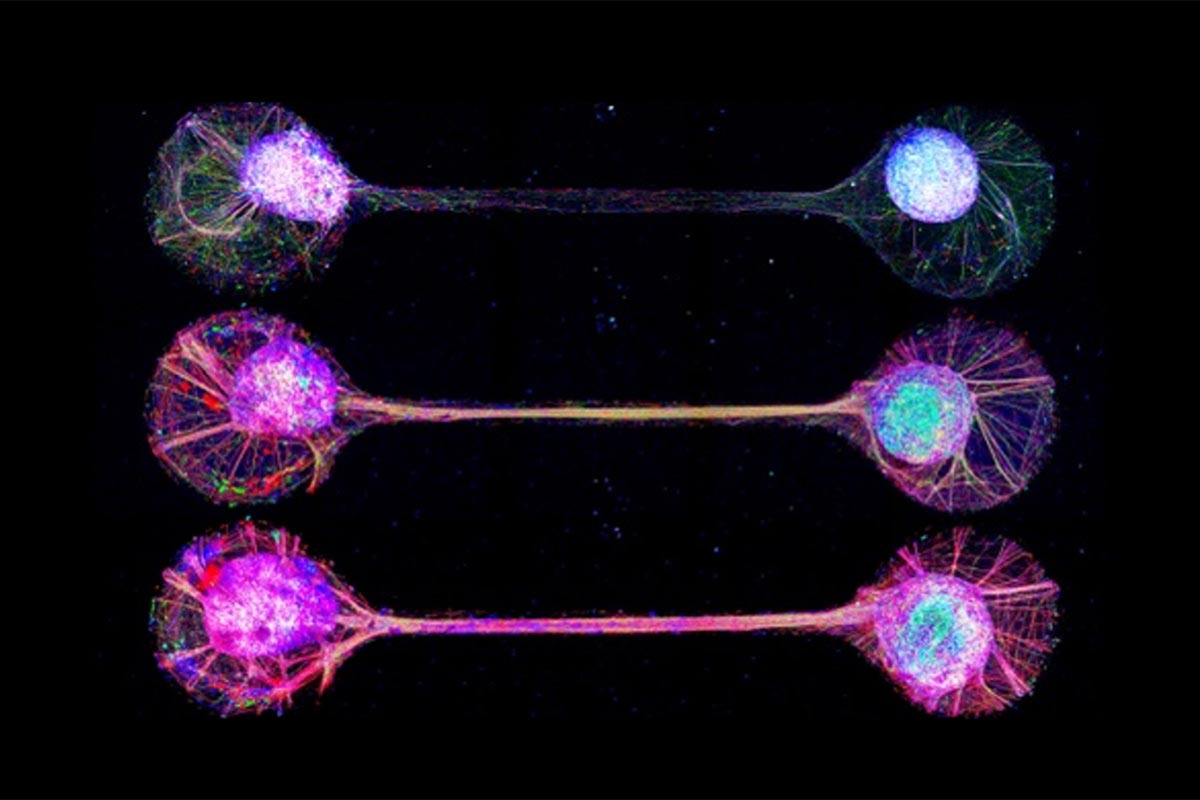
A collaborative research team has developed a method to connect lab-grown brain tissues, enhancing the understanding of brain development and functions, and paving the way for potential advancements in treating neurological conditions.
The idea of growing a functioning human brain-like tissues in a dish has always sounded pretty far-fetched, even to researchers in the field. Towards the future goal, a Japanese and French research team has developed a technique for connecting lab-grown brain-mimicking tissue in a way that resembles circuits in our brain.
Advancements in Neural Studies
It is challenging to study exact mechanisms of the brain development and functions. Animal studies are limited by differences between species in brain structure and function, and brain cells grown in the lab tend to lack the characteristic connections of cells in the human brain. What’s more, researchers are increasingly realizing that these interregional connections, and the circuits that they create, are important for many of the brain functions that define us as humans.
Previous studies have tried to create brain circuits under laboratory conditions, which have been advancing the field. Researchers from The University of Tokyo have recently found a way to create more physiological connections between lab-grown “neural organoids,” an experimental model tissue in which human stem cells are grown into three-dimensional developmental brain-mimicking structures. The team did this by linking the organoids via axonal bundles, which is similar to how regions are connected in the living human brain.
Enhanced Understanding Through Innovation
“In single-neural organoids grown under laboratory conditions, the cells start to display relatively simple electrical activity,” says co-lead author of the study Tomoya Duenki. “when we connected two neural organoids with axonal bundles, we were able to see how these bidirectional connections contributed to generating and synchronizing activity patterns between the organoids, showing some similarity to connections between two regions within the brain.”
The cerebral organoids that were connected with axonal bundles showed more complex activity than single organoids or those connected using previous techniques. In addition, when the research team stimulated the axonal bundles using a technique known as optogenetics, the organoid activity was altered accordingly and the organoids were affected by these changes for some time, in a process known as plasticity.
“These findings suggest that axonal bundle connections are important for developing complex networks,” explains Yoshiho Ikeuchi, senior author of the study. “Notably, complex brain networks are responsible for many profound functions, such as language, attention, and emotion.”
Given that alterations in brain networks have been associated with various neurological and psychiatric conditions, a better understanding of brain networks is important. The ability to study lab-grown human neural circuits will improve our knowledge of how these networks form and change over time in different situations, and may lead to improved treatments for these conditions.
Reference: “Complex activity and short-term plasticity of human cerebral organoids reciprocally connected with axons” by Tatsuya Osaki, Tomoya Duenki, Siu Yu A. Chow, Yasuhiro Ikegami, Romain Beaubois, Timothée Levi, Nao Nakagawa-Tamagawa, Yoji Hirano and Yoshiho Ikeuchi, 10 April 2024, Nature Communications.
DOI: 10.1038/s41467-024-46787-7
Never miss a breakthrough: Join the SciTechDaily newsletter.
Follow us on Google and Google News.
1 Comment
Consider finding relationships defining the evolution of flux lines in terms of Hebbian-type (“wire together if firing together”) learning rules. A recent article on the strong force over extended distances reminded me of this idea. As a strong force coupling remains constant over increasing distances it could be concluded that a conserved (wired-together”) entanglement-based flux line effect is demonstrated. Seems with gravity the same effect, suggestive of slowly-growing DM filaments, could be shown best with two separated spinning masses sharing the same spin axis over sufficient time scales.
FWIW, there’s never a shortage of dubious people who prefer to see gravity as non-quantizable. Most are apparently on a low-quality zero-information political mission to point people away from simple obvious things such as Newton’s inverse-square rule being a flux rule, or the lack of logic in applying an energy balance over a system with multiple simultaneous rates of time, just as they simply are too embarrassed to admit gravity bends light by changing its velocity.