

Close Menu
    Facebook X (Twitter) Instagram
    SciTechDaily
    • Biology
    • Chemistry
    • Earth
    • Health
    • Physics
    • Science
    • Space
    • Technology
    Facebook X (Twitter) Pinterest YouTube RSS
    SciTechDaily
    Home»Biology»How the Female Brain Responds to Genital Touch – And How It Varies Among Women
    Biology

    How the Female Brain Responds to Genital Touch – And How It Varies Among Women

    By Society for NeuroscienceDecember 20, 20212 Comments2 Mins Read
    Facebook Twitter Pinterest Telegram LinkedIn WhatsApp Email Reddit
    Share
    Facebook Twitter LinkedIn Pinterest Telegram Email Reddit
    Female Brain Analysis Neuroscience Concept
    The somatosensory cortex devotes brain space to detecting touch for each part of the body.

    The thickness of the cortical region varies among women, associated with its use.

    The exact location of the brain area representing genital touch varies among women. The new research in JNeurosci also found the region was thicker the more frequently the participants engaged in sexual intercourse.

    The somatosensory cortex devotes brain space to detecting touch for each part of the body. But the exact location of the female genital field in this map had been controversial. Previous studies produced conflicting results because of less precise mapping methods.
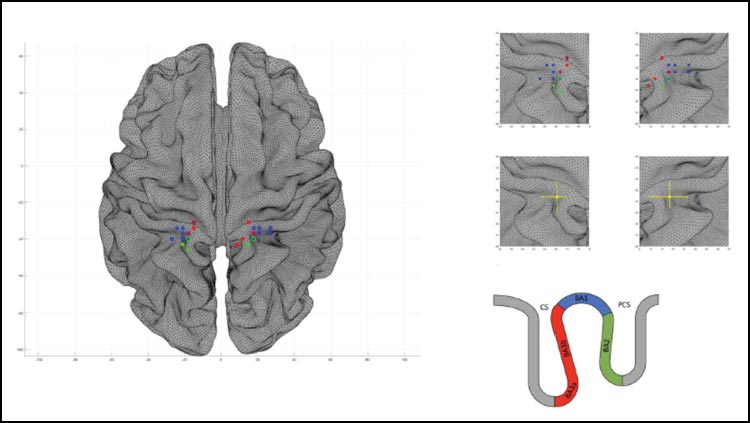
    Female Brain Responds to Genital Touch
    Interindividual variability of the genital somatosensory cortex in the MNI space. Credit: Knop et al., JNeurosci 2021

    Knop et al. used fMRI to map the exact representation of female genitalia by measuring the brain’s response to a membrane vibrating over the clitoral region. The study was designed to take great care to avoid any discomfort the participants could experience when targeting such a sensitive body region. The somatosensory cortex represented the genitals next to the hips, matching the body’s anatomy. However, the precise location varied from woman to woman. The thickness of the genital field varied with the frequency of sexual intercourse, suggesting the region’s structure alters in relation to its use. These results allow for future studies examining the role of the genital field in healthy sexual function, sexual dysfunction, and especially in the long-term consequences of sexual abuse. Based on this precise mapping, future work can now potentially target the genital representation for treatment of clinical conditions.

    Reference: “Sensory-Tactile Functional Mapping and Use-Associated Structural Variation of the Human Female Genital Representation Field” by Andrea J. J. Knop, Stephanie Spengler, Carsten Bogler, Carina Forster, Michael Brecht, John-Dylan Haynes and Christine Heim, 8 February 2022, Journal of Neuroscience.
    DOI: 10.1523/JNEUROSCI.1081-21.2021

    Never miss a breakthrough: Join the SciTechDaily newsletter.
    Follow us on Google and Google News.

    Brain Neuroscience Popular Society for Neuroscience
    Share. Facebook Twitter Pinterest LinkedIn Email Reddit

    Related Articles

    Hidden Brain Energy Leak Links Stress to Depression and Anxiety

    Scientists Just Found the Secret Difference Between Human and Primate Brains

    The Brain’s Alarm System To Suppress Intrusive Thoughts and Inhibit Unwanted Memories

    Deep Inside the Brain: Neuroscientists Discover the Missing Piece of the Brain’s Multitasking Network

    Scientists Use Modified Version Rabies to Trace Neural Pathways in the Brain

    Reactivation of the Hippocampus Causes Memory Recall

    “Area X” of Zebra Finch May Provide Insights to Human Speech Disorders

    Researchers Use FDDNP–PET Scanning to Predict Cognitive Decline

    Neuroscientists Decode Correlation Between Sound and Brain Activity

    2 Comments

    1. Clyde Spencer on December 20, 2021 3:28 pm

      “The new research in JNeurosci also found the region was thicker the more frequently the participants engaged in sexual intercourse.”

      It appears that the researchers did not account for, let alone correct for, masturbation or homosexual experiences as alternate stimulations.

      Reply
      • Josh R on January 21, 2026 12:14 am

        They also didn’t seem to take into consideration that typical heterosexual intercourse doesn’t even primarily stimulate the clitoris – the particular part of female genitalia they chose to study.

        I’m surprised that (based on assumed gender from authors names) so many women were involved and they didn’t point that out. Or perhaps they did, but as is often the case, input given by women in STEM fields isn’t always valued as much as men’s. ¯\_(ツ)_/¯

        Reply
    Leave A Reply Cancel Reply

    • Facebook
    • Twitter
    • Pinterest
    • YouTube

    Don't Miss a Discovery

    Subscribe for the Latest in Science & Tech!

    Trending News

    Researchers Have Found a Dietary Compound That Increases Longevity

    Scientists Baffled by Bizarre “Living Fossil” From 275 Million Years Ago

    Your IQ at 23 Could Predict Your Wealth at 27, Study Finds

    320 Light-Years Away, a Planet Confirms a Fundamental Cosmic Assumption

    The Crown Jewel of Dentistry? Breakthrough Tech Could Transform Tooth Repair

    Python Blood Could Hold the Secret to Weight Loss Without Side Effects

    Naturally Occurring Bacteria Completely Eradicate Tumors in Mice With a Single Dose

    New “Nanozyme Hypothesis” Could Rewrite the Story of Life’s Origins

    Follow SciTechDaily
    • Facebook
    • Twitter
    • YouTube
    • Pinterest
    • Newsletter
    • RSS
    SciTech News
    • Biology News
    • Chemistry News
    • Earth News
    • Health News
    • Physics News
    • Science News
    • Space News
    • Technology News
    Recent Posts
    • How Quantum Mechanics Went From Baffling Theory to Revolutionizing Modern Technology
    • Scientists May Have Found the Key to Jupiter and Saturn’s Moon Mystery
    • Scientists Uncover Hidden Clues to the Origin of the Genetic Code
    • Scientists Discover Unexpected Role of Alzheimer’s Protein in Cell Division
    • Scientists Uncover Brain Changes That Link Pain to Depression
    Copyright © 1998 - 2026 SciTechDaily. All Rights Reserved.
    • Science News
    • About
    • Contact
    • Editorial Board
    • Privacy Policy
    • Terms of Use

    Type above and press Enter to search. Press Esc to cancel.