
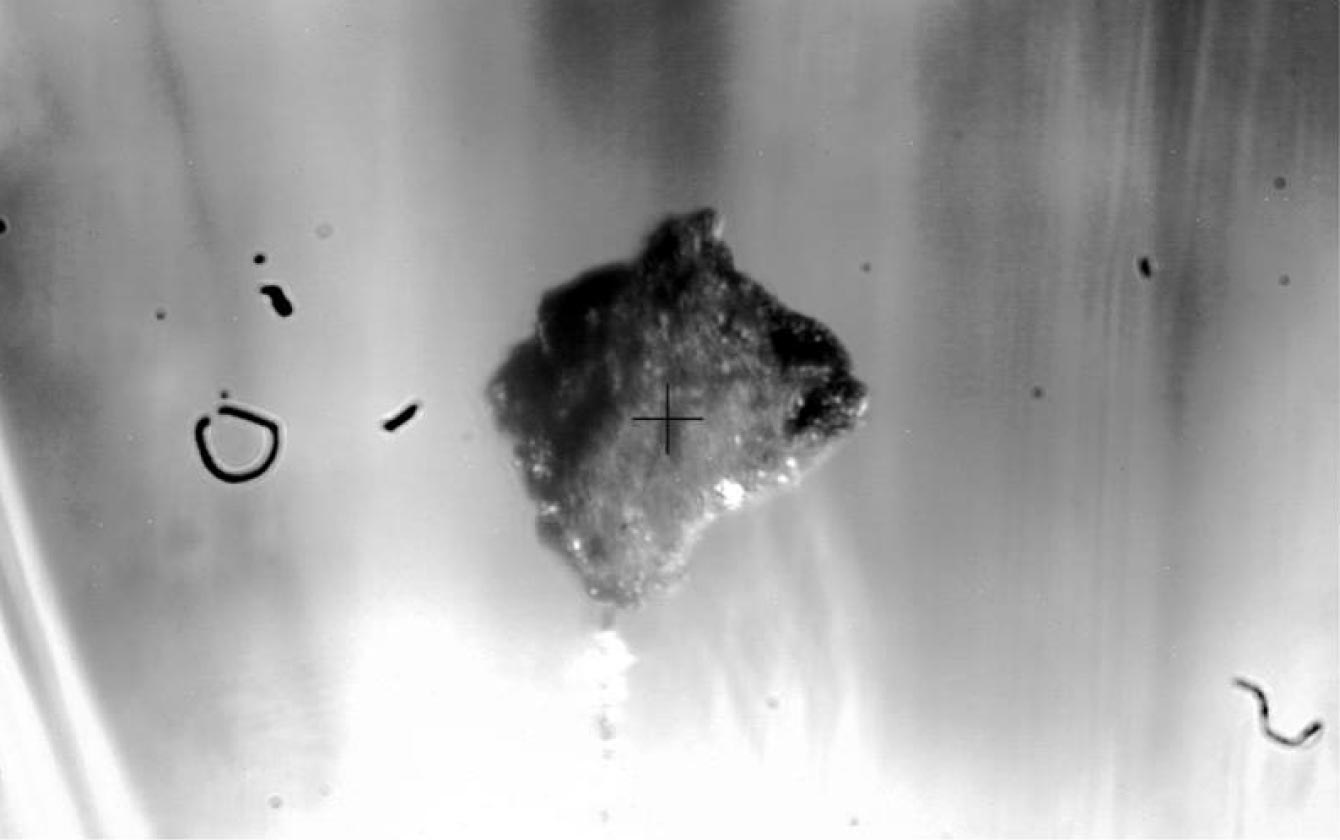
Researchers studied tiny asteroid fragments from Ryugu, revealing that it originated in the outer solar system and evolved over billions of years.
Using Mössbauer spectroscopy, they discovered changes in the asteroid’s composition due to temperature shifts, offering new insights into the formation and migration of celestial bodies within our galaxy.
Exploring Asteroid Origins With Advanced Technology
Researchers at the Advanced Photon Source (APS), a U.S. Department of Energy Office of Science light source user facilit, played a key role in an international effort to study microscopic fragments from a nearby asteroid. These tiny specks of dust were collected from asteroid 162173 Ryugu by a Japanese space mission and then sent to the APS for analysis. Using advanced X-ray technology, including a specialized technique called Mössbauer spectroscopy, researchers examined the fragments in unprecedented detail.
Their findings revealed that Ryugu originated more than 4 billion years ago in the outer reaches of the solar system as part of a larger, ice-rich asteroid. Over time, the asteroid broke apart, and Ryugu’s fragment slowly traveled to its current orbit, just 60,000 miles from Earth.
Insights From Asteroid Dust
These tiny fragments held a treasure trove of information about the asteroid’s history and composition. Mössbauer spectroscopy allowed scientists to determine that Ryugu was once composed largely of ice, but temperature shifts over millions of years transformed its makeup. The fragments also contained elements forged in the distant outer regions of the Milky Way, offering valuable insights into the early processes of planetary and rock formation in our solar system.
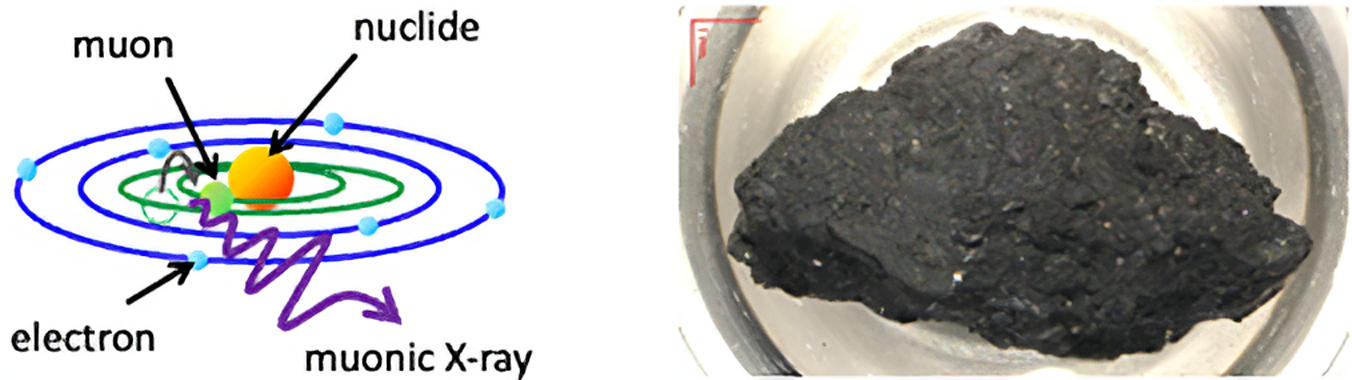
Precision Techniques in Asteroid Analysis
The key contribution of the APS to this global effort is the special technique Mössbauer spectroscopy, which allowed the research team to determine the oxidation state of iron in the samples. These fragments are very small, ranging from 400 microns (about the width of six human hairs) to one millimeter in diameter. However, the APS X-ray beam can be focused down to 4 microns for this technique, allowing for several readings from each fragment.
Unlocking the Secrets of Asteroid Ryugu
These readings provided evidence that Ryugu was once part of a larger asteroid that formed at the outer reaches of the solar system. The structure of each sample was porous and fine-grained, meaning it once contained ice that melted over millions of years as the solar system warmed up. Researchers found a large concentration of pyrrhotite, an iron sulfide that is nowhere to be found in meteorites that otherwise resemble the Ryugu fragments. This result put limits on the temperature and location of Ryugu’s parent asteroid at the time it was formed. Taken together with results from dozens of other scientific teams, the APS data helped to tell the story of Ryugu and its journey through our solar system over billions of years.
For more on this study, see New Analysis Unveils True Nature of Ancient Asteroid.
Reference: “Formation and evolution of carbonaceous asteroid Ryugu: Direct evidence from returned samples” by T. Nakamura, M. Matsumoto, K. Amano, Y. Enokido, M. E. Zolensky, T. Mikouchi, H. Genda, S. Tanaka, M. Y. Zolotov, K. Kurosawa, S. Wakita, R. Hyodo, H. Nagano, D. Nakashima, Y. Takahashi, Y. Fujioka, M. Kikuiri, E. Kagawa, M. Matsuoka, A. J. Brearley, A. Tsuchiyama, M. Uesugi, J. Matsuno, Y. Kimura, M. Sato, R. E. Milliken, E. Tatsumi, S. Sugita, T. Hiroi, K. Kitazato, D. Brownlee, D. J. Joswiak, M. Takahashi, K. Ninomiya, T. Takahashi, T. Osawa, K. Terada, F. E. Brenker, B. J. Tkalcec, L. Vincze, R. Brunetto, A. Aléon-Toppani, Q. H. S. Chan, M. Roskosz, J.-C. Viennet, P. Beck, E. E. Alp, T. Michikami, Y. Nagaashi, T. Tsuji, Y. Ino, J. Martinez, J. Han, A. Dolocan, R. J. Bodnar, M. Tanaka, H. Yoshida, K. Sugiyama, A. J. King, K. Fukushi, H. Suga, S. Yamashita, T. Kawai, K. Inoue, A. Nakato, T. Noguchi, F. Vilas, A. R. Hendrix, C. Jaramillo-Correa, D. L. Domingue, G. Dominguez, Z. Gainsforth, C. Engrand, J. Duprat, S. S. Russell, E. Bonato, C. Ma, T. Kawamoto, T. Wada, S. Watanabe, R. Endo, S. Enju, L. Riu, S. Rubino, P. Tack, S. Takeshita, Y. Takeichi, A. Takeuchi, A. Takigawa, D. Takir, T. Tanigaki, A. Taniguchi, K. Tsukamoto, T. Yagi, S. Yamada, K. Yamamoto, Y. Yamashita, M. Yasutake, K. Uesugi, I. Umegaki, I. Chiu, T. Ishizaki, S. Okumura, E. Palomba, C. Pilorget, S. M. Potin, A. Alasli, S. Anada, Y. Araki, N. Sakatani, C. Schultz, O. Sekizawa, S. D. Sitzman, K. Sugiura, M. Sun, E. Dartois, E. De Pauw, Z. Dionnet, Z. Djouadi, G. Falkenberg, R. Fujita, T. Fukuma, I. R. Gearba, K. Hagiya, M. Y. Hu, T. Kato, T. Kawamura, M. Kimura, M. K. Kubo, F. Langenhorst, C. Lantz, B. Lavina, M. Lindner, J. Zhao, B. Vekemans, D. Baklouti, B. Bazi, F. Borondics, S. Nagasawa, G. Nishiyama, K. Nitta, J. Mathurin, T. Matsumoto, I. Mitsukawa, H. Miura, A. Miyake, Y. Miyake, H. Yurimoto, R. Okazaki, H. Yabuta, H. Naraoka, K. Sakamoto, S. Tachibana, H. C. Connolly, D. S. Lauretta, M. Yoshitake, M. Yoshikawa, K. Yoshikawa, K. Yoshihara, Y. Yokota, K. Yogata, H. Yano, Y. Yamamoto, D. Yamamoto, M. Yamada, T. Yamada, T. Yada, K. Wada, T. Usui, R. Tsukizaki, F. Terui, H. Takeuchi, Y. Takei, A. Iwamae, H. Soejima, K. Shirai, Y. Shimaki, H. Senshu, H. Sawada, T. Saiki, M. Ozaki, G. Ono, T. Okada, N. Ogawa, K. Ogawa, R. Noguchi, H. Noda, M. Nishimura, N. Namiki, S. Nakazawa, T. Morota, A. Miyazaki, A. Miura, Y. Mimasu, K. Matsumoto, K. Kumagai, T. Kouyama, S. Kikuchi, K. Kawahara, S. Kameda, T. Iwata, Y. Ishihara, M. Ishiguro, H. Ikeda, S. Hosoda, R. Honda, C. Honda, Y. Hitomi, N. Hirata, N. Hirata, T. Hayashi, M. Hayakawa, K. Hatakeda, S. Furuya, R. Fukai, A. Fujii, Y. Cho, M. Arakawa, M. Abe, S. Watanabe and Y. Tsuda, 22 September 2022, Science.
DOI: 10.1126/science.abn8671
The APS portion of this work was supported by the Department of Energy (DOE) Office of Science and the France and Chicago Collaborating in the Sciences (FACCTS) program administered by the University of Chicago. The research used resources at the Advanced Photon Source, a DOE Office of Science user facility operated by Argonne National Laboratory.
Never miss a breakthrough: Join the SciTechDaily newsletter.
Follow us on Google and Google News.