

Hubble’s 35-year journey showcases humanity’s boldest space achievements, capturing everything from new stars forming to ancient galaxies.
Its discoveries revolutionized our understanding of black holes, dark energy, and distant worlds, while its stunning images made space exploration a vivid, emotional experience for people worldwide.
Hubble’s 35th Anniversary: A Stunning Celestial Celebration
To celebrate 35 years of the Hubble Space Telescope’s mission in Earth orbit, a new collection of breathtaking images has been released. These recent observations span everything from the frosty plains of Mars to dramatic scenes of stellar birth and death, as well as a spectacular nearby galaxy. After more than three decades exploring the restless universe, Hubble remains the most iconic and widely recognized telescope in scientific history.
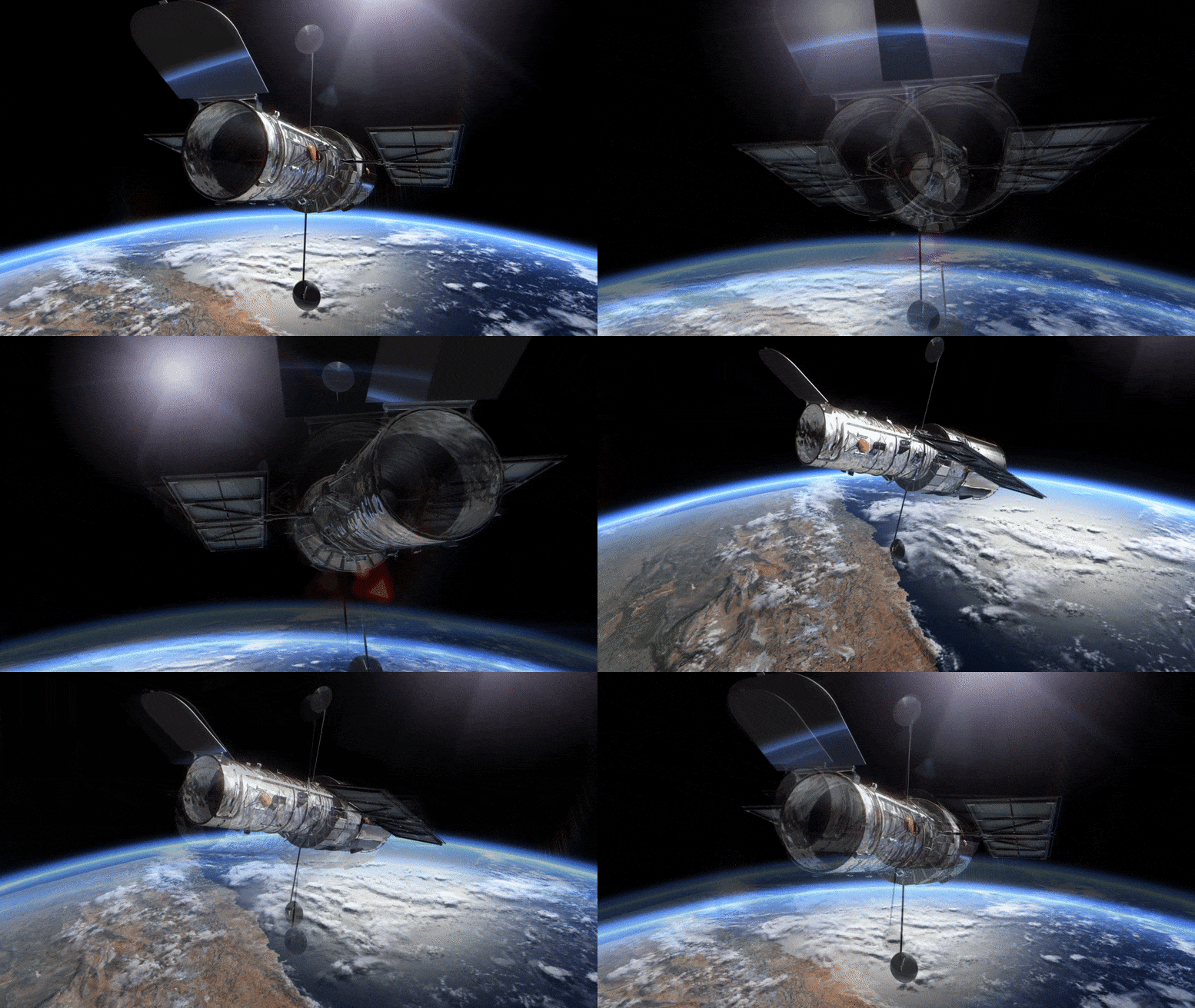
Astronomers long understood that positioning a telescope above Earth’s blurry, light-distorting atmosphere would open an entirely new window to the universe. Hubble’s view would be ten times sharper than the best ground-based telescopes of its time. Its exceptional sensitivity would detect objects a billion times fainter than the dimmest stars visible to the human eye. Free from the atmospheric interference, Hubble could observe a broad range of wavelengths, from ultraviolet to near-infrared light. This unprecedented clarity would bring the hidden wonders of the cosmos into sharp focus, while also standing as a bold achievement in human engineering, imagination, and scientific ambition.
A New Era of Cosmic Discovery
Before Hubble, no generation had ever seen such vivid, detailed views of the universe, stretching nearly back to its earliest moments. For most of human history, the vastness and complexity of the cosmos existed only in our imagination. Hubble changed that forever, taking humanity into the final sprint toward the edge of the visible universe. The journey was first set in motion a century earlier, in the 1920s, when astronomer Edwin Hubble discovered that galaxies lay beyond our own Milky Way.
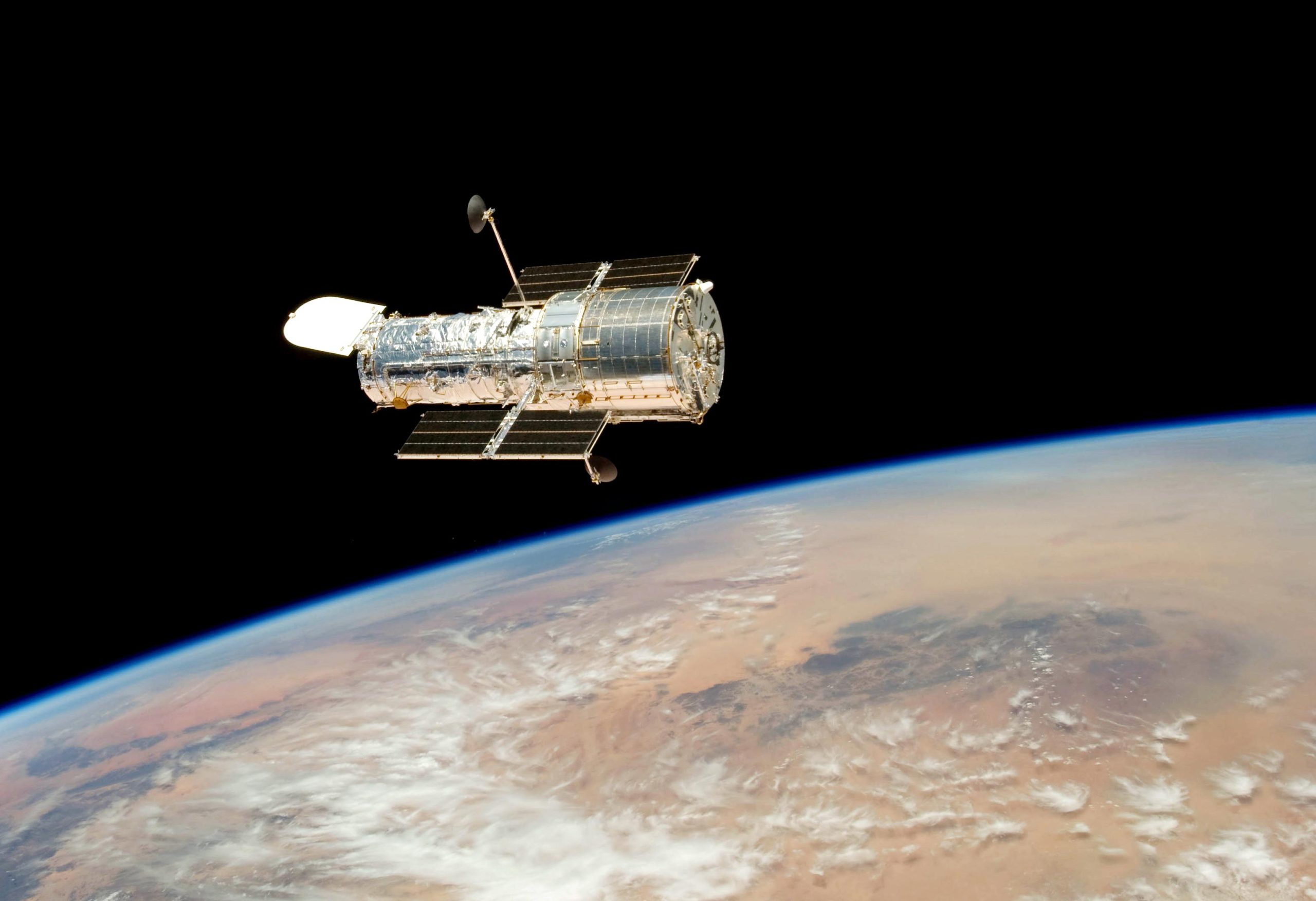
Today, the Hubble Space Telescope is operating at the peak of its scientific productivity, thanks to the dedication and expertise of engineers, scientists, and mission operators. Between 1993 and 2009, astronaut shuttle crews performed five daring servicing missions to repair, upgrade, and enhance Hubble. These missions, which included European Space Agency (ESA) astronauts on two occasions, equipped Hubble with new cameras, computers, and support systems, extending its life and expanding its capabilities far beyond its original design.
Massive Scientific Impact and Data Legacy
By extending Hubble’s operational life, the telescope has made nearly 1.7 million observations, looking at approximately 55,000 astronomical targets. Hubble discoveries have resulted in over 22,000 papers and over 1.3 million citations as of February 2025. All the data collected by Hubble is archived and currently adds up to over 400 terabytes. The demand for observing time remains very high with 6:1 oversubscriptions, making it one of the most in-demand observatories today.
Hubble’s long operational life has allowed astronomers to see astronomical changes spanning over three decades: seasonal variability on the planets in our solar system, black hole jets travelling at nearly the speed of light, stellar convulsions, asteroid collisions, expanding supernova bubbles, and much more.
Hubble’s Enduring Legacy in Space Science
Hubble’s legacy is the bridge between our past and future knowledge of a Universe that is unbelievably glorious, as well as rambunctious, with colliding galaxies, voracious black holes, and relentless stellar fireworks. Hubble, more than any other telescope, sees the Universe through the eyes of Einstein: microlensing, time-dilation, the cosmological constant, matter disappearing into a black hole, a source of gravitational waves.
Before 1990, powerful optical telescopes on Earth could see only halfway across the cosmos. Estimates for the age of the Universe disagreed by a big margin. Supermassive black holes were only suspected to be the powerhouses behind a rare zoo of energetic phenomena. Not a single planet had been seen around another star.
Unraveling the Mysteries of the Cosmos
Among its long list of breakthroughs: Hubble’s deep fields unveiled myriad galaxies dating back to the early Universe; precisely measured the Universe’s expansion; found that supermassive black holes are common among galaxies; made the first measurement of the atmospheres of extrasolar planets; contributed to discovering dark energy, which is accelerating the Universe.
After three decades, Hubble remains a household word as the most well-recognized and celebrated scientific instrument in all of human history. Hubble’s discoveries and images have been nothing less than transformative for the public’s perception of the cosmos. Unlike any other telescope before it, Hubble has made astronomy very relevant, engaging, and accessible for people of all ages. Hubble became “the people’s telescope,” touching the minds as well as the emotions of hundreds of millions of humans around the globe.
The Emotional Power of Hubble’s Images
A single Hubble snapshot can portray the Universe as awesome, mysterious, and beautiful—and at the same time chaotic, overwhelming, and foreboding. These pictures have become iconic, seminal, and timeless. They viscerally communicate the value of science: the awe and drive to seek understanding of our place in the cosmos. In commemoration NASA and ESA released images today of five astronomical targets that were selected for the celebration, ranging from planets to nebulae to galaxies.
The relentless pace of Hubble’s trailblazing discoveries kicked-started a new generation of space telescopes for the 21st century. The powerful James Webb Space Telescope may not have been built without Hubble revealing an “undiscovered country” of far-flung, seemingly countless galaxies. Hubble provided the first observational evidence that there was a lot for Webb to pursue in infrared wavelengths that reach even greater distances beyond Hubble’s gaze. Now, Hubble and Webb are often being used in complement to study everything from exoplanets to galaxy dynamics.
Spectacular 35th Anniversary Images Released
An assortment of compelling images has been released that were recently taken by Hubble:

In the right image, high-altitude evening clouds can be seen along the planet’s eastern limb. The 2,250-kilometer-wide Hellas basin, an ancient asteroid impact feature, appears far to the south. Most of the hemisphere is dominated by the classical “shark fin” feature, Syrtis Major. Credit: NASA, ESA, STScI
Mars: These are a combination of Hubble Space Telescope images of Mars taken from December 28th to 30th, 2024. At the midpoint of the observations, Mars was approximately 98 million kilometres from Earth. Thin water-ice clouds that are apparent in ultraviolet light give the Red Planet a frosty appearance. The icy northern polar cap was experiencing the start of Martian spring.

Planetary Nebula NGC 2899: This object has a diagonal, bipolar, cylindrical outflow of gas. This is propelled by radiation and stellar winds from a nearly 22,000 degree Celsius white dwarf at the center. In fact, there may be two companion stars that are interacting and sculpting the nebula, which is pinched in the middle by a fragmented ring or torus – looking like a half-eaten donut. It has a forest of gaseous “pillars” that point back to the source of radiation and stellar winds. The colors are from glowing hydrogen and oxygen. The nebula lies approximately 4,500 light-years away in the southern constellation Vela.

Rosette Nebula: This is a Hubble Space Telescope photo of a small portion of the Rosette Nebula, a huge star-forming region spanning 100 light-years across and located 5,200 light-years away. Hubble zooms into a small portion of the nebula that is only 4 light-years across (the approximate distance between our Sun and the neighboring Alpha Centauri star system.) Dark clouds of hydrogen gas laced with dust are silhouetted across the image. The clouds are being eroded and shaped by the seething radiation from the cluster of larger stars in the center of the nebula (NGC 2440). An embedded star seen at the tip of a dark cloud in the upper right portion of the image is launching jets of plasma that are crashing into the cold cloud around it. The resulting shock wave is causing a red glow. The colors come from the presence of hydrogen, oxygen, and nitrogen.

Barred Spiral Galaxy NGC 5335: This object is categorized as a flocculent spiral galaxy with patchy streamers of star formation across its disk. There is a striking lack of well-defined spiral arms that are commonly found among galaxies, including our Milky Way. A notable bar structure slices across the center of the galaxy. The bar channels gas inwards toward the galactic center, fueling star formation. Such bars are dynamic in galaxies and may come and go over two-billion-year intervals. They appear in about 30 percent of observed galaxies, including our Milky Way.
Hubble’s Recent Scientific Highlights
Even at the impressive age of 35, there has been no slowdown in the research and new discoveries made using Hubble — if anything, the opposite. Astronomers from Europe make intensive use of the telescope, with the share of observing time awarded to European-led programmes being consistently above the 15% guaranteed by ESA’s participation in the Hubble mission, thanks to their many proposals with strong scientific merit. This has led directly to discoveries including evidence for an intermediate-mass black hole in Omega Centauri, a precursor to the earliest supermassive black holes, a bizarre explosion of extraordinarily bright light originating far from any host galaxy, hydrogen burning in white dwarf stars, and the absence of Population III stars as far back in time as Hubble can see. A particular highlight, and a demonstration of Hubble’s incredible capabilities, was the discovery in 2022 of Earendel. The most distant single star ever seen, Earendel is viewed 12.9 billion years into the past when the Universe was under a billion years old.
Discoveries Across the Solar System and Beyond
Benefitting from Hubble’s long operational life, the OPAL programme celebrated a decade studying the Solar System’s outer planets. Discoveries such as evidence for water vapor on Jupiter’s moons Europa and Ganymede, “spokes” in Saturn’s rings, the size of Jupiter’s Great Red Spot, and the colors of Uranus and Neptune are just some that have resulted. Smaller Solar System bodies got attention from Hubble as well — not least the asteroid Dimorphos, target of the DART asteroid redirection test. Hubble took images of Dimorphos before and after the impact alongside Webb, later producing a movie of the debris and spotting ejected boulders. A citizen science project also discovered thousands of asteroid trails in over two decades of archived Hubble snapshots.
Beyond the Solar System, Hubble proved its continued importance in the rapidly growing field of research into exoplanets. It studied weather patterns in an exoplanet’s atmosphere, saw a new atmosphere being formed around a rocky exoplanet similar to Earth, and found a small exoplanet with water vapor in its atmosphere. Also completed in 2021 was a compilation of supernova host galaxies from 18 years of study, images that were used to measure the Hubble constant to its highest accuracy yet. This year, too, brought the culmination of the largest ever photomosaic of the Andromeda Galaxy, created from ten years of Hubble observations of our near neighbor.
Hubble Space Telescope
The Hubble Space Telescope has been exploring the universe for more than three decades, transforming our fundamental understanding of space with its groundbreaking discoveries. A joint project between NASA and the European Space Agency (ESA), Hubble represents a landmark in international scientific cooperation. NASA’s Goddard Space Flight Center in Greenbelt, Maryland, oversees the management of the telescope and its mission operations, with operational support also provided by Lockheed Martin Space in Denver. Scientific operations are conducted by the Space Telescope Science Institute in Baltimore, which is operated by the Association of Universities for Research in Astronomy (AURA). Even after decades in orbit, Hubble continues to deliver revolutionary insights into the cosmos, from distant galaxies to the atmospheres of exoplanets.
Never miss a breakthrough: Join the SciTechDaily newsletter.
Follow us on Google and Google News.
1 Comment
Spend our tax dollars on this! Not war machines!