

Pinpointing a Milepost Marker Star that Opened the Realm of Galaxies
At the dawn of the 20th century, astronomers faced a cosmic puzzle. The night sky was dotted with more than 100 nebulous objects cataloged in the late 1700s by French astronomer Charles Messier. Most were identified as star clusters, nebulae, supernova remnants, or glowing clouds of gas.
However, 40 of these objects stood apart. These mysterious whirlpool-like shapes, collectively called the “spiral nebulae,” were scattered across the sky, unlike the others. Adding to the mystery, astronomer Vesto Slipher used spectroscopy to reveal that the light from these spiral nebulae was redshifted, suggesting they were moving away from Earth. This left astronomers wondering: What were these objects, and why did they appear to recede?
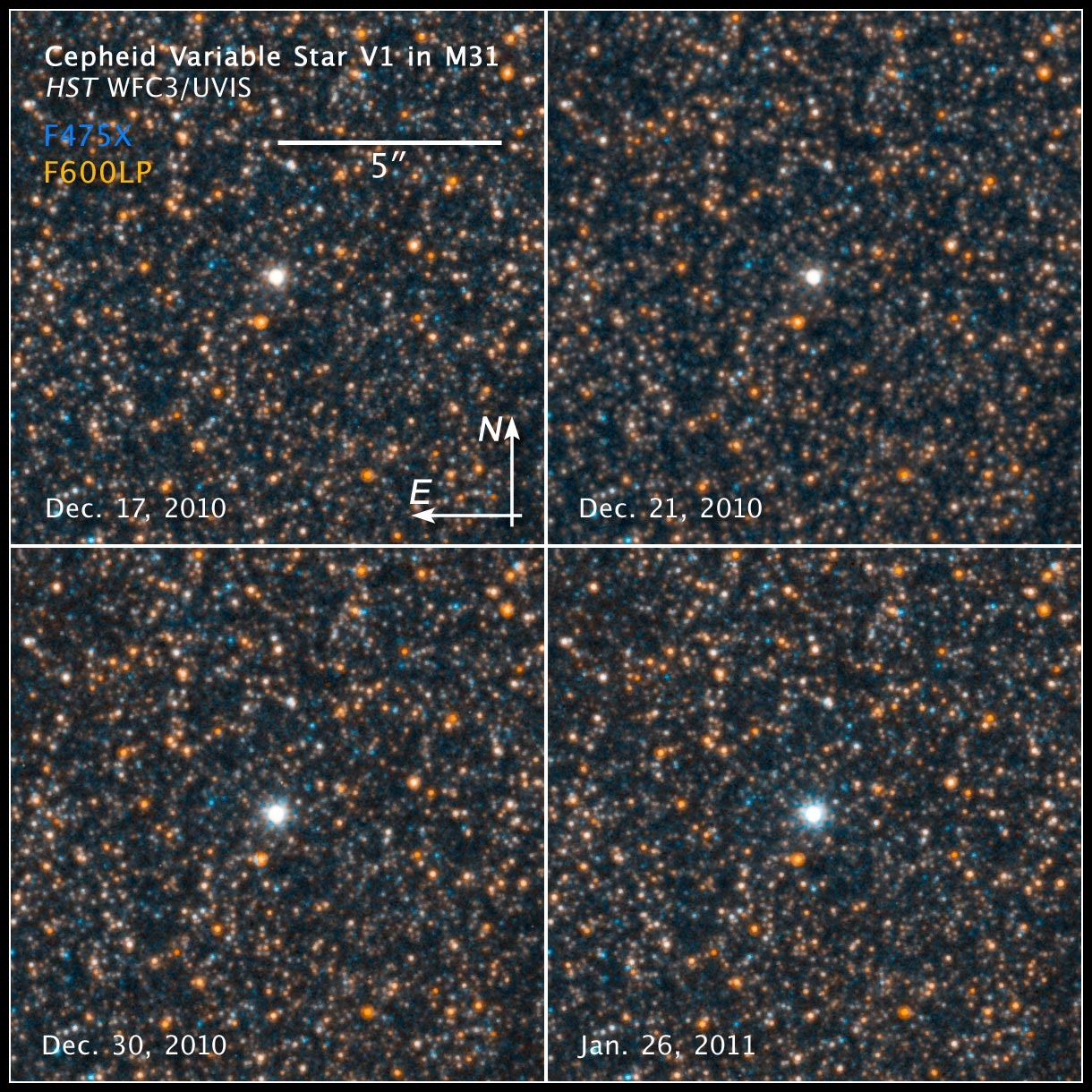
Edwin Hubble theorized that the spiral nebulae were not part of our Milky Way but instead extragalactic, positioned far beyond it. To prove this, he needed precise distance measurements. Hubble searched for Cepheid variable stars within these nebulae, a unique class of stars whose rhythmic pulsations correlate with their intrinsic brightness, making them invaluable tools for calculating astronomical distances. When Hubble measured the distance to a Cepheid in the Andromeda galaxy, known as V1, he determined it was over 2 million light-years away—far beyond the Milky Way’s boundaries. This discovery resolved the debate: the spiral nebulae were not mere clouds but entire galaxies.
Hubble’s finding fundamentally altered humanity’s understanding of the cosmos, revealing a universe far larger and more complex than previously imagined. He demonstrated that Andromeda was roughly 20 times the diameter of the Milky Way and that galaxies were rushing away from us in all directions. This suggested the universe was not eternal but had a finite age and an expanding structure.
Hubble’s breakthrough, made 100 years ago, marked a turning point in human knowledge, unveiling a universe teeming with distant galaxies. Over the next century, astronomers would explore this vast frontier using ever-more powerful tools. The Hubble Space Telescope, a crowning achievement, built on this legacy by precisely measuring the universe’s age—13.8 billion years—partly through observations of far-flung Cepheid stars.
NASA celebrates Edwin Hubble’s discovery of a new universe
For humans, the most important star in the universe is undoubtedly our Sun. But another star, hidden deep within the Andromeda galaxy, holds extraordinary significance. This flickering star, located 2.2 million light-years away, is so faint that it’s just 1/100,000th as bright as the dimmest star visible to the naked eye.
Yet, a century ago, its discovery by Edwin Hubble, then an astronomer at Carnegie Observatories, opened humanity’s eyes as to how large the universe really is. Its discovery revealed that the universe is far larger than we once imagined and showed that the Milky Way is just one of hundreds of billions of galaxies. This groundbreaking realization marked a pivotal moment in humanity’s journey to scientifically explore our origins through the light of the stars. Carnegie Science and NASA recently celebrated the centennial of this discovery at the 245th meeting of the American Astronomical Society in Washington, D.C.
The star, known simply as V1, seemed unremarkable at first but unlocked profound mysteries about time and space that still challenge astronomers. In 1923, Hubble identified this star using the Carnegie-funded 100-inch Hooker Telescope at Mount Wilson Observatory in California, then the largest telescope in the world. V1 is a rare type of pulsating star called a Cepheid variable, which serves as a cosmic distance marker. Decades earlier, astronomer Henrietta Swan Leavitt discovered that the pulsation period of Cepheid variables is directly linked to their intrinsic brightness, providing a “yardstick” for measuring vast distances in the universe.
Many astronomers long believed that the edge of the Milky Way marked the edge of the entire universe. But Hubble determined that V1, located inside the Andromeda “nebula,” was at a distance that far exceeded anything in our own Milky Way galaxy. This led Hubble to the jaw-dropping realization that the universe extends far beyond our own galaxy.

In fact, Hubble had suspected there was a larger universe out there, but here was the proof in the pudding. He was so amazed he scribbled an exclamation mark on the photographic plate of Andromeda that pinpointed the variable star.
As a result, the science of cosmology exploded almost overnight. Hubble’s contemporary, the distinguished Harvard astronomer Harlow Shapley, upon Hubble notifying him of the discovery, was devastated. “Here is the letter that destroyed my universe,” he lamented to fellow astronomer Cecilia Payne-Gaposchkin, who was in his office when he opened Hubble’s message.
Just three years earlier, Shapley had presented his observational interpretation of a much smaller universe in a debate one evening at the Smithsonian Museum of Natural History in Washington. He maintained that the Milky Way galaxy was so huge, it must encompass the entirety of the universe. Shapley insisted that the mysteriously fuzzy “spiral nebulae,” such as Andromeda, were simply stars forming on the periphery of our Milky Way, and inconsequential.
Little could Hubble have imagined that 70 years later, an extraordinary telescope named after him, lofted hundreds of miles above the Earth, would continue his legacy. The marvelous telescope made “Hubble” a household word, synonymous with wonderous astronomy.
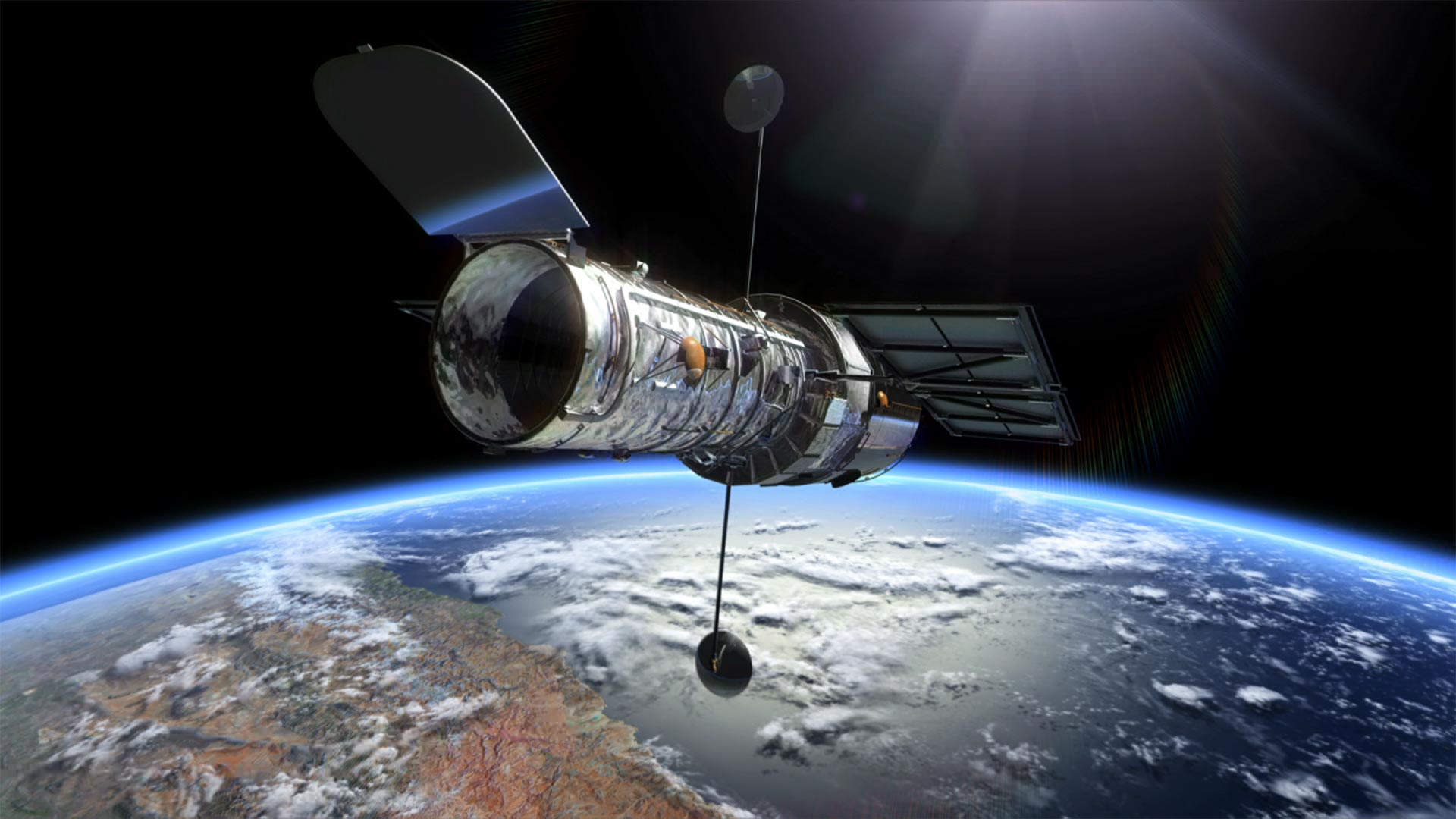
Today, NASA’s Hubble Space Telescope pushes the frontiers of knowledge over 10 times farther than Edwin Hubble could ever see. The space telescope has lifted the curtain on a compulsive universe full of active stars, colliding galaxies, and runaway black holes, among the celestial fireworks of the interplay between matter and energy.
Edwin Hubble was the first astronomer to take the initial steps that would ultimately lead to the Hubble Space Telescope, revealing a seemingly infinite ocean of galaxies. He thought that, despite their abundance, galaxies came in just a few specific shapes: pinwheel spirals, football-shaped ellipticals, and oddball irregular galaxies. He thought these might be clues to galaxy evolution – but the answer had to wait for the Hubble Space Telescope’s legendary Hubble Deep Field in 1994.
The most impactful finding that Edwin Hubble’s analysis showed was that the farther the galaxy is, the faster it appears to be receding from Earth. The universe looked like it was expanding like a balloon. This was based on Hubble tying galaxy distances to the reddening of light — the redshift – that proportionally increased the father away the galaxies are.
The redshift data were first collected by Lowell Observatory astronomer Vesto Slipher, who spectroscopically studied the “spiral nebulae” a decade before Hubble. Slipher did not know they were extragalactic, but Hubble made the connection. Slipher first interpreted his redshift data an example of the Doppler effect. This phenomenon is caused by light being stretched to longer, redder wavelengths if a source is moving away from us. To Slipher, it was curious that all the spiral nebulae appeared to be moving away from Earth.
Two years prior to Hubble publishing his findings, the Belgian physicist and Jesuit priest Georges Lemaître analyzed the Hubble and Slifer observations and first came to the conclusion of an expanding universe. This proportionality between galaxies’ distances and redshifts is today termed Hubble–Lemaître’s law.
Because the universe appeared to be uniformly expanding, Lemaître further realized that the expansion rate could be run back into time – like rewinding a movie – until the universe was unimaginably small, hot, and dense. It wasn’t until 1949 that the term “big bang” came into fashion.
This was a relief to Edwin Hubble’s contemporary, Albert Einstein, who deduced the universe could not remain stationary without imploding under gravity’s pull. The rate of cosmic expansion is now known as the Hubble Constant.
Ironically, Hubble himself never fully accepted the runaway universe as an interpretation of the redshift data. He suspected that some unknown physics phenomenon was giving the illusion that the galaxies were flying away from each other. He was partly right in that Einstein’s theory of special relativity explained redshift as an effect of time-dilation that is proportional to the stretching of expanding space. The galaxies only appear to be zooming through the universe. Space is expanding instead.
After decades of precise measurements, the Hubble telescope came along to nail down the expansion rate precisely, giving the universe an age of 13.8 billion years. This required establishing the first rung of what astronomers call the “cosmic distance ladder” needed to build a yardstick to far-flung galaxies. They are cousins to V1, Cepheid variable stars that the Hubble telescope can detect out to over 100 times farther from Earth than the star Edwin Hubble first found.
Astrophysics was turned on its head again in 1998 when the Hubble telescope and other observatories discovered that the universe was expanding at an ever-faster rate, through a phenomenon dubbed “dark energy.” Einstein first toyed with this idea of a repulsive form of gravity in space, calling it the cosmological constant.
Even more mysteriously, the current expansion rate appears to be different than what modern cosmological models of the developing universe would predict, further confounding theoreticians. Today astronomers are wrestling with the idea that whatever is accelerating the universe may be changing over time. NASA’s Roman Space Telescope, with the ability to do large cosmic surveys, should lead to new insights into the behavior of dark matter and dark energy. Roman will likely measure the Hubble constant via lensed supernovae.
This grand century-long adventure, plumbing depths of the unknown, began with Hubble photographing a large smudge of light, the Andromeda galaxy, at the Mount Wilson Observatory high above Los Angeles.
In short, Edwin Hubble is the man who wiped away the ancient universe and discovered a new universe that would shrink humanity’s self-perception into being an insignificant speck in the cosmos.
The Hubble Space Telescope, launched in 1990, has been a cornerstone of modern astronomy for over three decades, continuously delivering groundbreaking discoveries that have deepened our understanding of the universe. As a collaboration between NASA and the European Space Agency (ESA), Hubble operates under the management of NASA’s Goddard Space Flight Center in Greenbelt, Maryland, with mission support from Lockheed Martin Space in Denver. Scientific operations are conducted by the Space Telescope Science Institute (STScI) in Baltimore, managed by the Association of Universities for Research in Astronomy. Positioned above Earth’s atmosphere, Hubble captures unparalleled images of distant galaxies, nebulae, and other cosmic phenomena, helping scientists unlock mysteries related to dark energy, black holes, and the age of the universe. Its contributions continue to revolutionize our knowledge of the cosmos and inspire future space exploration endeavors.
Never miss a breakthrough: Join the SciTechDaily newsletter.
Follow us on Google and Google News.
14 Comments
God made cehpeid variables so that we can get a clue e to the intrnisic brightness of stars by comparison.
You have to keep in mind that being a believer is a self-serving position because you put yourself in a privileged position in the Universe where a god made you with a purpose and cares for your existence, and you even get an eternal afterlife. While nonbelievers do not get anything as they exist by chance and they stop existing when they die.
That is a neutral comment . Between believers and non believers
Once you come to understand everything that you do not yet understand, then you will find that there is no God who understands everything you have yet to understand. Note the wondrous quotation: “Discovery consists of seeing what everyone has seen, yet thinking what no one else has thought.”
Peace. This stuff is a great way to keep people from actually staying out all night for a few weeks and observing the visible stars without a FCC compliant telescope. Wouldn’t want that to happen especially with that galaxy spining round and round. ✌️
Ok, lets make a comment that will satisfy everybody : God made science…
Yikes! And I thought I was throwing red meat to the wolves! You got stones, bro….
Jets coming out from black hole is proving that old theory about black hole (light cannot come out from here so seem it black) is absolute false. Perhaps it may be a black star
You need to do some morning learning about black holes and energy. Hawking is a good source.
Many astronomers long believed that the edge of the Milky Way marked the edge of the entire universe. They were wrong. Before that specialists thought and ‘believed’ the sun was the centre of the universe. Wrong again. Believing in hypothetical ideas constructed from fragmentary observations over such extreme distances with no possibility of conformation by controlled experiments are bound to be speculative. That should urge caution from those representing the scientific approach, but apparently not.
So, why did they remove two of the comments?
YES!! Why did they leave MY COMMENT PSALM 19:1 ????, TOO Many people do NOT want to HEAR about GOD very sad!!