
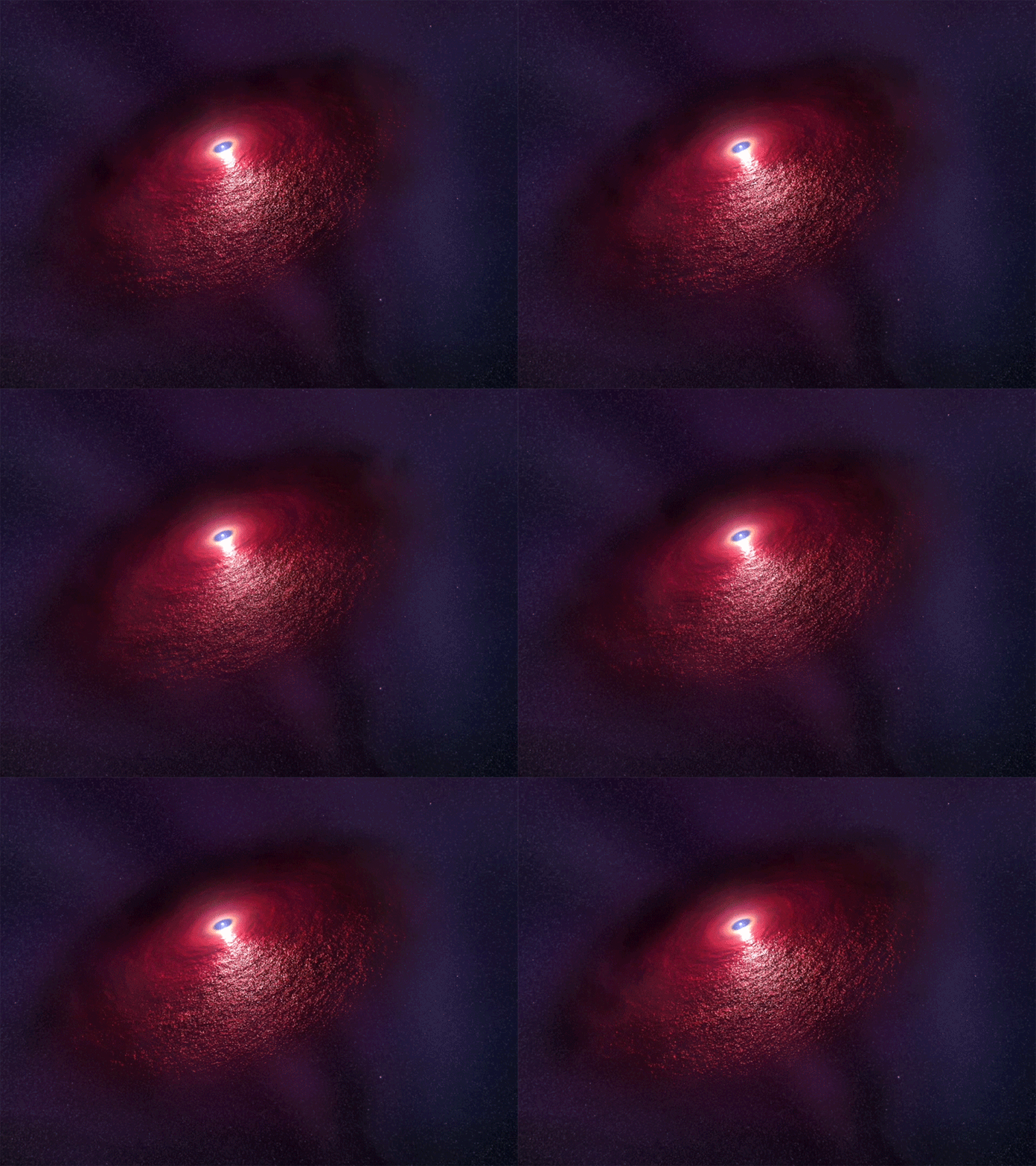
An unusual infrared light emission from a nearby neutron star detected by NASA’s Hubble Space Telescope could indicate new features never before seen. One possibility is that there is a dusty disk surrounding the neutron star; another is that there is an energetic wind coming off the object and slamming into gas in interstellar space the neutron star is plowing through.
Although neutron stars are generally studied in radio and high-energy emissions, such as X-rays, this study demonstrates that new and interesting information about neutron stars can also be gained by studying them in infrared light, say researchers.
The observation, by a team of researchers at Pennsylvania State University, University Park, Pennsylvania; Sabanci University, Istanbul, Turkey; and the University of Arizona, Tucson, Arizona, could help astronomers better understand the evolution of neutron stars — the incredibly dense remnants after a massive star explodes as a supernova. Neutron stars are also called pulsars because their very fast rotation (typically fractions of a second, in this case, 11 seconds) causes time-variable emission from light-emitting regions.
A paper describing the research and two possible explanations for the unusual finding appears on September 17, 2018, in the Astrophysical Journal.
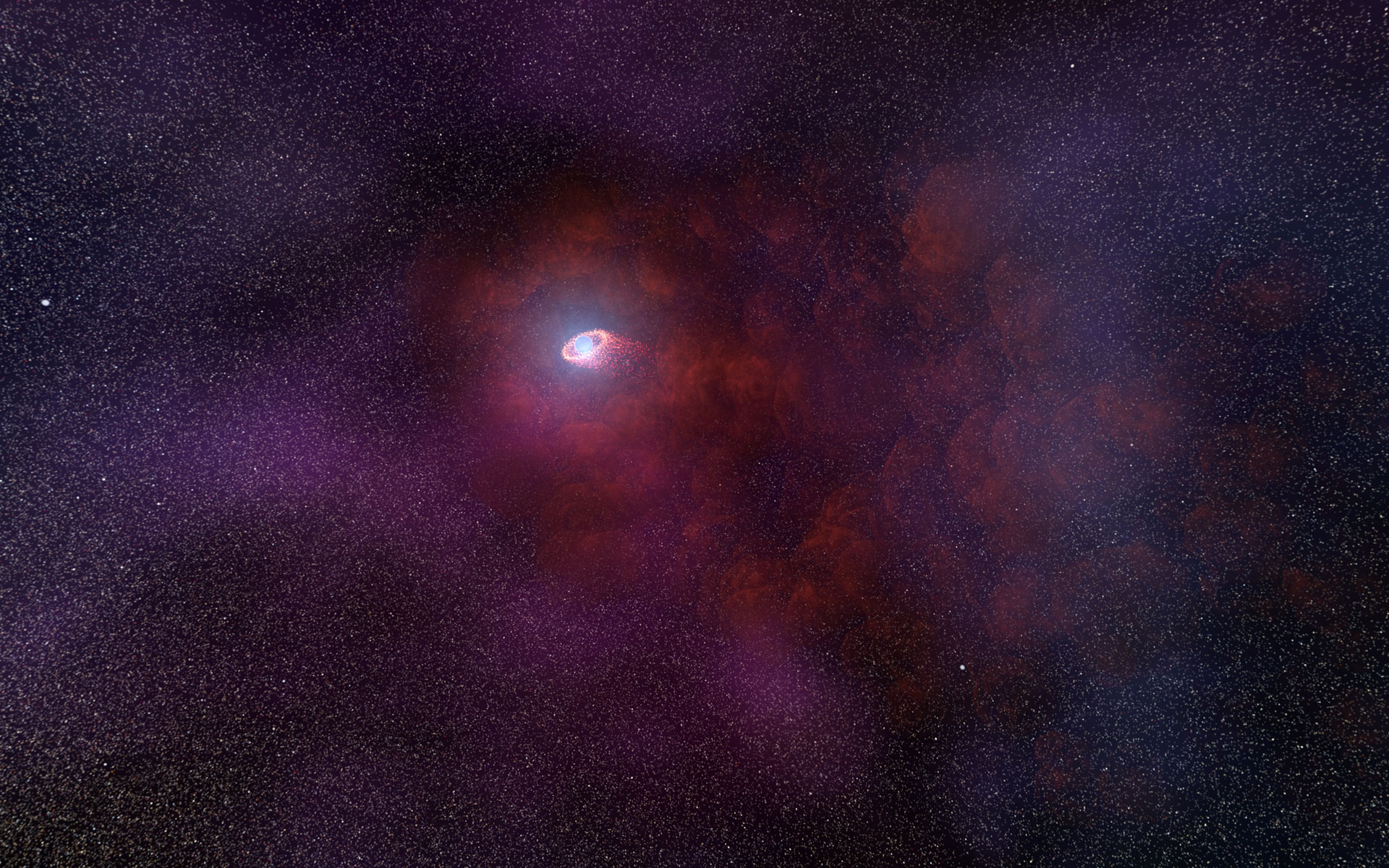
“This particular neutron star belongs to a group of seven nearby X-ray pulsars — nicknamed ‘the Magnificent Seven’ — that are hotter than they ought to be considering their ages and available energy reservoir provided by the loss of rotation energy,” said Bettina Posselt, associate research professor of astronomy and astrophysics at Pennsylvania State and the lead author of the paper. “We observed an extended area of infrared emissions around this neutron star — named RX J0806.4-4123 — the total size of which translates into about 200 astronomical units (approximately 18 billion miles) at the assumed distance of the pulsar.”
This is the first neutron star in which an extended signal has been seen only in infrared light. The researchers suggest two possibilities that could explain the extended infrared signal seen by Hubble. The first is that there is a disk of material — possibly mostly dust — surrounding the pulsar.
“One theory is that there could be what is known as a ‘fallback disk’ of material that coalesced around the neutron star after the supernova,” said Posselt. “Such a disk would be composed of matter from the progenitor massive star. Its subsequent interaction with the neutron star could have heated the pulsar and slowed its rotation. If confirmed as a supernova fallback disk, this result could change our general understanding of neutron star evolution.”
The second possible explanation for the extended infrared emission from this neutron star is a “pulsar wind nebula.”
“A pulsar wind nebula would require that the neutron star exhibits a pulsar wind,” said Posselt. “A pulsar wind can be produced when particles are accelerated in the electrical field that is produced by the fast rotation of a neutron star with a strong magnetic field. As the neutron star travels through the interstellar medium at greater than the speed of sound, a shock can form where the interstellar medium and the pulsar wind interact. The shocked particles would then emit synchrotron radiation, causing the extended infrared signal that we see. Typically, pulsar wind nebulae are seen in X-rays and an infrared-only pulsar wind nebula would be very unusual and exciting.”
Using NASA’s upcoming James Webb Space Telescope, astronomers will be able to further explore this newly opened discovery space in the infrared to better understand neutron star evolution.
In addition to Posselt, the research team included George Pavlov and Kevin Luhman at Pennsylvania State; Ünal Ertan and Sirin Çaliskan at Sabanci University; and Christina Williams at the University of Arizona. The research was supported by NASA, The Scientific and Technological Research Council of Turkey, the U.S. National Science Foundation, Pennsylvania State, the Penn State Eberly College of Science, and the Pennsylvania Space Grant Consortium.
The Hubble Space Telescope is a project of international cooperation between NASA and ESA (European Space Agency). NASA’s Goddard Space Flight Center in Greenbelt, Maryland, manages the telescope. The Space Telescope Science Institute (STScI) in Baltimore, Maryland, conducts Hubble science operations. STScI is operated for NASA by the Association of Universities for Research in Astronomy, in Washington, D.C.
Reference: “Discovery of Extended Infrared Emission around the Neutron Star RXJ0806.4–4123” by B. Posselt, G. G. Pavlov, Ü. Ertan, S. Çalışkan, K. L. Luhman and C. C. Williams, 17 September 2018, The Astrophysical Journal.
DOI: 10.3847/1538-4357/aad6df
Never miss a breakthrough: Join the SciTechDaily newsletter.
Follow us on Google and Google News.
1 Comment
This has been rendered through space engine or universe sandbox 2 and this is just pictures that this stuff is all made up and its still looks like its being rendered by an engine by blender engine or the new unreal engine 5 that release on may 16 on 5:37 by epic games.