
A Triple Star System Yields an Unusual Surviving Star
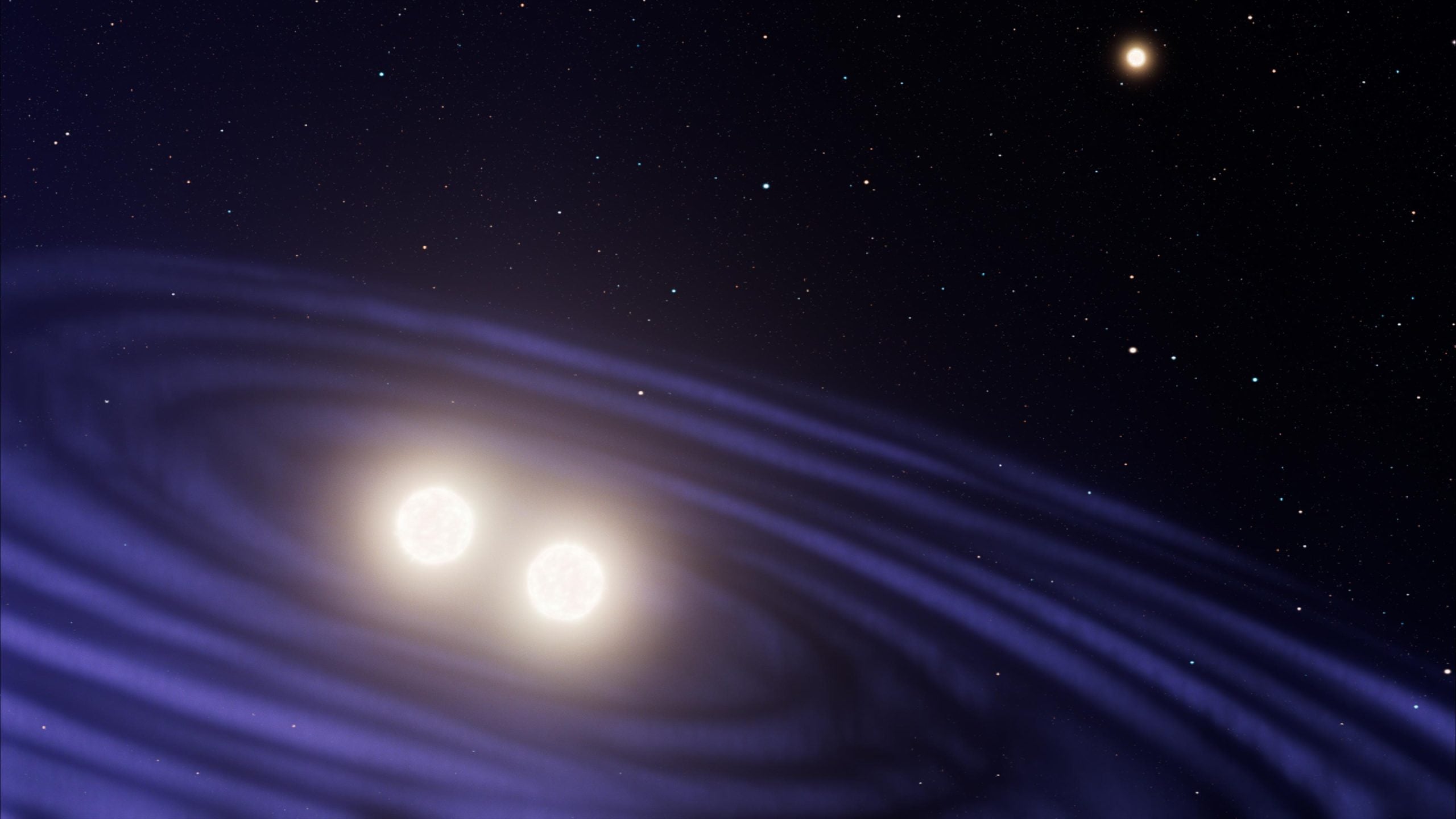
Unlike our Sun, which exists alone, at least half of the stars in our galaxy have a companion. This concept was famously depicted in the Star Wars movies, where Luke Skywalker watched two suns set over his home planet, Tatooine. But imagine a world with three suns in the sky—this was once the reality for a remarkable triple-star system recently studied by NASA’s Hubble Space Telescope.
Hubble’s data reveals that this system had a chaotic past. Around 500 million years ago, two of the stars merged, forming a much larger and more massive star. Over time, this new star burned through its fuel and eventually collapsed into an unusually massive white dwarf. The third star in the system, once a companion, became a bystander to this cosmic upheaval.
During the merger, the surviving star siphoned material from its massive neighbor, gaining mass and becoming brighter in the process. However, it now finds itself alone, orbiting the remnants of its former companion—a dead white dwarf. Hubble’s observations revealed that this lone star spins much faster than expected, a clue that it once absorbed gas from the stellar merger, fueling its rapid rotation.

Panel 1: A triple star system containing three Sun-like stars. Two are very tightly orbiting. The third star has a much wider orbit.
Panel 2: The close stellar pair spiral together and merge to form one more massive star.
Panel 3: The merged star evolves into a giant star. As the huge photosphere expands, some of the material falls onto the outer companion, causing the companion to grow larger and its rotation rate to increase.
Panels 4-5: The central merged star eventually burns out and forms a massive white dwarf, and the outer companion spirals in towards the white dwarf, leaving a binary star system with a tighter orbit.
Panel 6: The surviving outer companion is much like our Sun but nicknamed a “blue lurker.” Although it is slightly brighter bluer than expected because of the earlier mass-transfer from the central star and is now rotating very rapidly, these features are subtle. The star could easily be mistaken for a normal Sun-like star despite its exotic evolutionary history.
Credit: NASA, ESA, Leah Hustak (STScI)
Hubble Space Telescope Tracks Down a ‘Blue Lurker’ Among Stars
The term “blue lurker” might sound like a villain from a superhero movie, but it actually refers to a rare type of star. NASA’s Hubble Space Telescope recently studied this unique star in the open star cluster M67, located about 2,800 light-years from Earth.
Data from Hubble reveals that the blue lurker has had a dramatic past, interacting with two other stars in a complex triple-star system. It shares similarities with “blue stragglers” — stars that appear hotter, brighter, and bluer than expected, often formed through stellar mergers.
What makes the blue lurker stand out is its unexpectedly fast rotation, which led to its discovery. Despite this rapid spin, it otherwise resembles a typical Sun-like star. The name “blue” can be misleading, as the star’s color blends in with the surrounding solar-mass stars in the cluster. This ability to blend in is why it’s described as “lurking” among the others.
Unraveling the Spin Mystery
The spin rate is evidence that the lurker must have siphoned in material from a companion star, causing its rotation to speed up. The star’s high spin rate was discovered with NASA’s retired Kepler space telescope. While normal Sun-like stars typically take about 30 days to complete one rotation, the lurker takes only four days.
How the blue lurker got that way is a “super complicated evolutionary story,” said Emily Leiner of the Illinois Institute of Technology in Chicago. “This star is really exciting because it’s an example of a star that has interacted in a triple-star system.” The blue lurker originally rotated more slowly and orbited a binary system consisting of two Sun-like stars.
Evolution of a Stellar Enigma
Around 500 million years ago, the two stars in that binary merged, creating a single, much more massive star. This behemoth soon swelled into a giant star, dumping some of its own material onto the blue lurker and spinning it up in the process. Today, we observe that the blue lurker is orbiting a white dwarf star — the burned-out remains of the massive merger.
“We know these multiple star systems are fairly common and are going to lead to really interesting outcomes,” Leiner explained. “We just don’t yet have a model that can reliably connect through all of those stages of evolution. Triple-star systems are about 10 percent of the Sun-like star population. But being able to put together this evolutionary history is challenging.”
Observations and Implications
Hubble observed the white dwarf companion star that the lurker orbits. Using ultraviolet spectroscopy, Hubble found the white dwarf is very hot (as high as 23,000 degrees Fahrenheit, or roughly three times the Sun’s surface temperature) and a heavyweight at 0.72 solar masses. According to theory, hot white dwarfs in M67 should be only about 0.5 solar masses. This is evidence that the white dwarf is the byproduct of the merger of two stars that once were part of a triple-star system.
“This is one of the only triple systems where we can tell a story this detailed about how it evolved,” said Leiner. “Triples are emerging as potentially very important to creating interesting, explosive end products. It’s really unusual to be able to put constraints on such a system as we are exploring.”
Leiner’s results are being presented at the 245th meeting of the American Astronomical Society in Washington, D.C.
The Hubble Space Telescope has been exploring the universe for over three decades, delivering groundbreaking discoveries that have transformed our understanding of space. A collaborative effort between NASA and the European Space Agency (ESA), Hubble is managed by NASA’s Goddard Space Flight Center in Greenbelt, Maryland, with mission support provided by Lockheed Martin Space in Denver. Scientific operations are conducted by the Space Telescope Science Institute in Baltimore, which is operated by the Association of Universities for Research in Astronomy. Hubble’s continued observations provide invaluable insights into the cosmos, from distant galaxies to the formation of stars and planets, cementing its legacy as one of the most influential scientific instruments in history.
Never miss a breakthrough: Join the SciTechDaily newsletter.
Follow us on Google and Google News.
5 Comments
Hello, in the past our solar system also went through these multi-star stages, but we can rarely reach this joining of stars in the Milky Way galaxy. These steps of connecting several stars to a larger star take hundreds of years and sometimes thousands of years. But in the stars of the Milky Way, we see such scenes, these collisions rarely take place and take a long time. Another thing I should mention is that, when a planet joins a star, when planets collide with a star, the observer who sees the star collides with the planet. He sees a scene where he thinks that the star has exploded, but it is not so, stars do not explode, only these planets have explosive materials and in the center of the star, when they collide with the core of the star, all the gases that then explode From the impact of the planet in spread around the star. It reassembles at the center of the star, an event that has been repeated at least a dozen times in the Solar System during the 4.5 billion years that the Sun has collided with the stars of the Galactic Arm
Hello sir namaste god bless all family members und company together work welt bitte achtu ihre gusendheit und cyber security settings.viel Gluck global business Schone Gruss Rajveer Singh sun of karnail singh batth village kotala bet po chhourian district Ludhiana Punjab India thanks for alls.
“W.T.F.?!?”
Try again…in English.
Try again…only THIS time, do it in ENGLISH.