
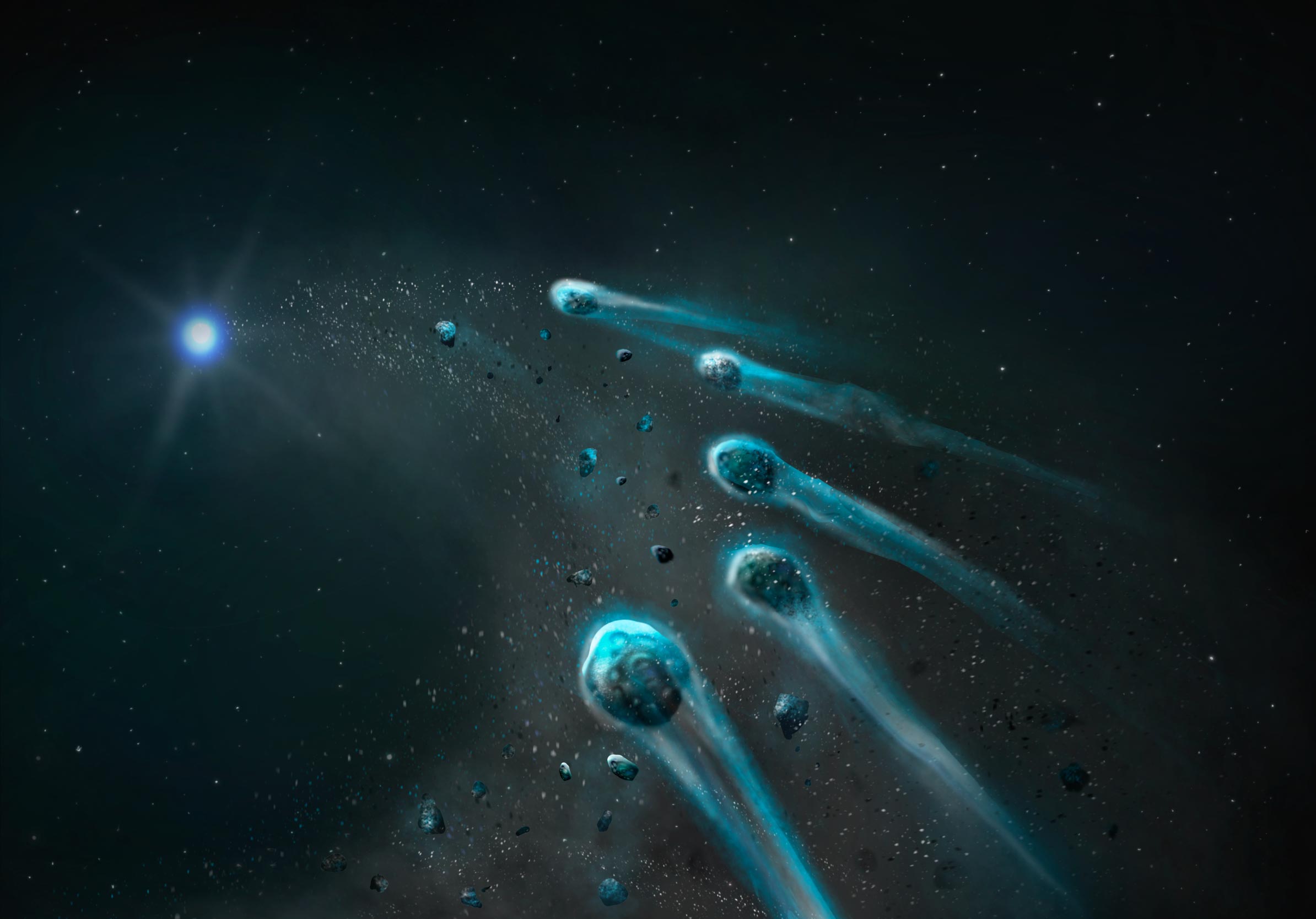
Astronomers using the Hubble Space Telescope have uncovered the remains of a frozen, Pluto-like world being devoured by a distant white dwarf star.
This cosmic “crime scene” not only reveals the dramatic fate of planetary fragments but also strengthens the case that the ingredients for life are scattered throughout the galaxy.
Discovery of a Frozen, Water-Rich Planetary Fragment
University of Warwick astronomers have uncovered the chemical fingerprint of a frozen, water-rich planetary fragment being consumed by a white dwarf star outside our Solar System.
In our Solar System, it is thought that comets and icy planetesimals (small solid objects in space) were responsible for delivering water to Earth. The existence of these icy objects is a requirement for the development of life on other worlds, but it is incredibly difficult to identify them outside our Solar System, as icy objects are small, faint, and require chemical analysis.
Clues from the Hubble Space Telescope
In a study published in the Monthly Notices of the Royal Astronomical Society, astronomers from Warwick, Europe, and the US have found strong evidence that icy, volatile-rich bodies – capable of delivering water and the ingredients for life – exist in planetary systems beyond our own.
To make this discovery, the group used ultraviolet spectroscopy from the Hubble Space Telescope to study the chemical makeup of distant stars. One star, WD 1647+375, stood out as having ‘volatiles’ (chemical substances with low melting points) on the surface. White dwarf atmosphere is typically made up of hydrogen and helium, but WD 1647+375 had elements such as carbon, nitrogen, sulfur, and oxygen.
This volatile-rich atmosphere was the first clue that WD 1647+375 was different.
A Cosmic Crime Scene: White Dwarfs as Evidence Holders
Lead author Snehalata Sahu, Research Fellow, Department of Physics, University of Warwick, said: “It is not unusual for white dwarfs to show signatures of calcium, iron, and other metals from the material they are accreting (absorbing). This material comes from planets and asteroids that come too close to the star and are shredded and accreted. Analyzing the chemical makeup of this material gives us a window into how planetesimals outside the Solar System are composed.
“In this way, white dwarfs act like cosmic crime scenes – when a planetesimal falls in, its elements leave chemical fingerprints in the star’s atmosphere, letting us reconstruct the identity of the ‘victim’. Typically, we see evidence of rocky material being accreted, such as calcium and other metals, but finding volatile-rich debris has been confirmed in only a handful of cases.”
Nitrogen and Oxygen Reveal an Icy World
One volatile, nitrogen, is a particularly important chemical fingerprint of icy worlds. The ultraviolet spectroscopy in this study showed that the material gained by WD 1647+375 had a high percentage of its mass as nitrogen (~5%). This is the highest nitrogen abundance ever detected in a white dwarf’s debris. The atmosphere of WD 1647+375 had also gained much more oxygen than would be expected if the object being absorbed was rock – 84% more, both suggesting an icy object.
The astronomers also had data to show that the debris had been feeding the star for at least the last 13 years, at a rate of 200,000 kg (the weight of an adult blue whale) per second. This meant that the icy object was at least 3km across (or comet-sized), but this is a minimum size, as accretion can take hundreds of thousands of years more than this 13-year snapshot, meaning the object could be closer to 50km in diameter and a quintillion kilograms.
Together, the data painted a picture of an icy/water-rich planetesimal (made up of 64% water) that was being consumed by this star, perhaps a comet like Halley’s or a dwarf planet fragment like C/2016 R2.
A Pluto-Like World Beyond Our Solar System
Second author Professor Boris T. Gänsicke, Department of Physics, University of Warwick, said: “The volatile-rich nature of WD 1647+375 makes it like Kuiper-belt objects (KBOs) in our solar system – the icy objects found beyond the orbit of Neptune. We think that the planetesimal being absorbed by the star is most likely a fragment of a dwarf planet like Pluto. This is based on its nitrogen-rich composition, the high predicted mass, and the high ice-to-rock ratio of 2.5, which is more than typical KBOs and likely originates from the crust or mantle of a Pluto-like planet.”
This is the first unambiguous finding of a hydrogen-atmosphere white dwarf purely absorbing an icy planetesimal. Whether this object formed in the planetary system around the original star or is instead an interstellar comet captured from deep space, remains an open question. Either way, the finding provides compelling evidence that icy, volatile-rich bodies exist in planetary systems beyond our own.
Unlocking the Building Blocks of Life
The discovery also highlights the unique role of ultraviolet spectroscopy in probing the composition of such rare volatile-rich objects beyond our Solar System. Only UV can detect the volatile elements (carbon, sulfur, oxygen, and especially nitrogen) and will be an important part of future attempts to search for the building blocks of life around other stars.
Reference: “Chemical enrichment by collapsars as the origin of the unusually high [Ba/Fe] in a massive star cluster of the dwarf galaxy NGC 1569” by Brayden Leicester, Kenji Bekki and Takuji Tsujimoto, 27 January 2025, Monthly Notices of the Royal Astronomical Society.
DOI: 10.1093/mnras/staf142
Never miss a breakthrough: Join the SciTechDaily newsletter.
Follow us on Google and Google News.