
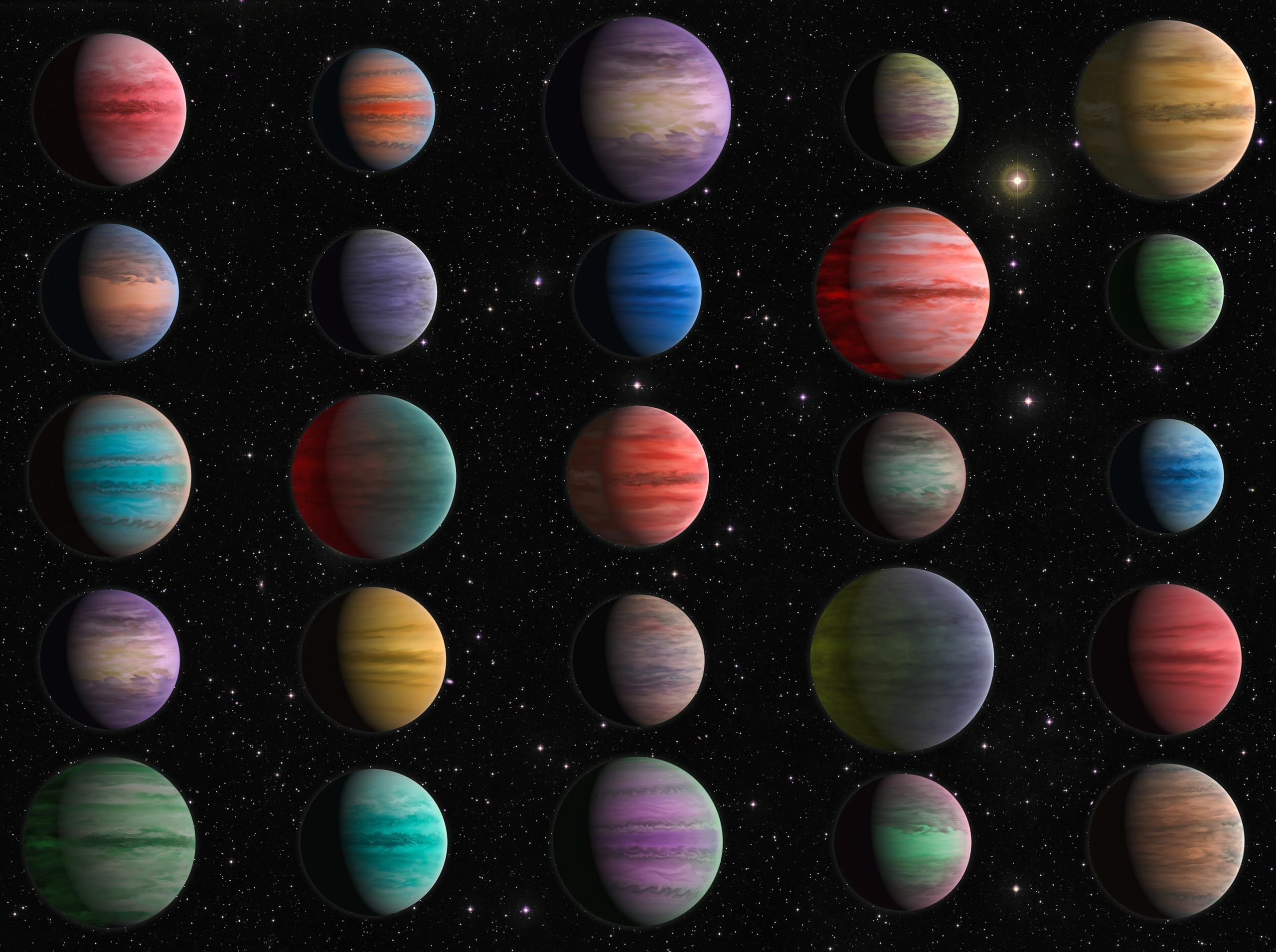
Research on 25 hot Jupiters shows a link between thermal inversions and metallic species, offering new insights into exoplanet formation and atmospheres.
A worldwide team of astronomers studied archival Hubble Space Telescope observations of 25 hot Jupiters, allowing them to answer five unresolved questions important to our understanding of exoplanet atmospheres. The researchers discovered, among other things, that the existence of metal oxides and hydrides in the hottest exoplanet atmospheres was clearly connected with the atmospheres being thermally inverted.
The field of exoplanet science has long since shifted its focus from just detection to characterization, although characterization remains extremely challenging. Thus far, the majority of research on characterization has been focused on modeling or studies of one or a few exoplanets. This new research study, led by researchers based at University College London (UCL), used the most archival data ever examined in a single exoplanet atmospheric survey to assess the atmospheres of 25 exoplanets. The majority of the data came from observations made with the NASA/ESA Hubble Space Telescope.
Hot Jupiters are a class of gas giant exoplanets that are inferred to be physically similar to Jupiter but that have very short orbital periods (P < 10 days). Because of their close proximity to their stars and high surface-atmosphere temperatures, they are colloquially known as “hot Jupiters.”
The lead author, Quentin Changeat, explains: “Hubble enabled the in-depth characterization of 25 exoplanets, and the amount of information we learned about their chemistry and formation — thanks to a decade of intense observing campaigns — is incredible.”
New Approaches to Characterizing Exoplanets
The science team sought to find answers to five open questions about exoplanet atmospheres — an ambitious goal that they succeeded in reaching. Their questions probed what H– and certain metals can tell us about the chemistry and circulation of exoplanet atmospheres, and about planet formation. They chose to investigate a wide range of hot Jupiters, with the intention of identifying trends within their sample population that might provide insight into exoplanet atmospheres more generally.
The study’s co-leader, Billy Edwards of UCL and the Commissariat à l’énergie atomique et aux énergies alternatives (CEA) said: “Our paper marks a turning point for the field: we are now moving from the characterization of individual exoplanet atmospheres to the characterization of atmospheric populations.”
In order to investigate their sample of 25 exoplanets, the team reanalyzed an enormous amount of archival data, consisting of 600 hours of Hubble observations, which they complemented with more than 400 hours of observations from the Spitzer Space Telescope. Their data contained eclipses for all 25 exoplanets, and transits for 17 of them. An eclipse occurs when an exoplanet passes behind its star as seen from Earth, and a transit occurs when a planet passes in front of its star. Eclipse and transit data can both provide crucial information about an exoplanet’s atmosphere.
The large-scale survey yielded results, with the team able to identify some clear trends and correlations between the exoplanets’ atmospheric constitutions and observed behavior. Some of their key findings related to the presence or absence of thermal inversions in the atmospheres of their exoplanet sample. They found that almost all the exoplanets with a thermally inverted atmosphere were extremely hot, with temperatures over 2,000 Kelvins (3,100 Fahrenheit or 1,700 Celsius). Importantly, this is sufficiently hot that the metallic species TiO (titanium oxide), VO (vanadium oxide), and FeH (iron hydride) are stable in an atmosphere. Of the exoplanets displaying thermal inversions, almost all of them were found to have H–, TiO, VO, or FeH in their atmospheres.
Metal Oxides and Hydrides in Thermal Inversions
It is always challenging to draw inferences from such results because correlation does not necessarily equal causation. However, the team was able to propose a compelling argument for why the presence of H–, TiO, VO, or FeH might lead to a thermal inversion — namely that all these metallic species are very efficient absorbers of stellar light. It might be that exoplanet atmospheres hot enough to sustain these species tend to be thermally inverted because they then absorb so much stellar light that their upper atmospheres heat up even more. Conversely, the team also found that colder hot Jupiters (with temperatures less than 2000 Kelvins, and thus without H–, TiO, VO, or FeH in their atmospheres) almost never had thermally inverted atmospheres.
A significant aspect of this research was that the team was able to use a large sample of exoplanets and an extremely large amount of data to determine trends, which can be used to predict behavior in other exoplanets. This is extremely useful, because it provides insight into how planets may form, and also because it allows other astronomers to more effectively plan future observations. Conversely, if a paper studies a single exoplanet in great detail, whilst that is valuable it is much harder to extrapolate trends from. An improved understanding of exoplanet populations could also bring us closer to solving open mysteries about our own Solar System.
As Changeat says: “Many issues such as the origins of the water on Earth, the formation of the Moon, and the different evolutionary histories of Earth and Mars, are still unsolved despite our ability to obtain in-situ measurements. Large exoplanet population studies, such as the one we present here, aim at understanding those general processes.”
Never miss a breakthrough: Join the SciTechDaily newsletter.
Follow us on Google and Google News.