
Close Menu
    Facebook X (Twitter) Instagram
    SciTechDaily
    • Biology
    • Chemistry
    • Earth
    • Health
    • Physics
    • Science
    • Space
    • Technology
    Facebook X (Twitter) Pinterest YouTube RSS
    SciTechDaily
    Home»Space»Hubble Telescope Image of the Week – A Spiral Disguised
    Space

    Hubble Telescope Image of the Week – A Spiral Disguised

    By Mathias Jäger, Hubble Space TelescopeMay 14, 20182 Comments2 Mins Read
    Facebook Twitter Pinterest Telegram LinkedIn WhatsApp Email Reddit
    Share
    Facebook Twitter LinkedIn Pinterest Telegram Email Reddit
    Hubble Views NGC 1032
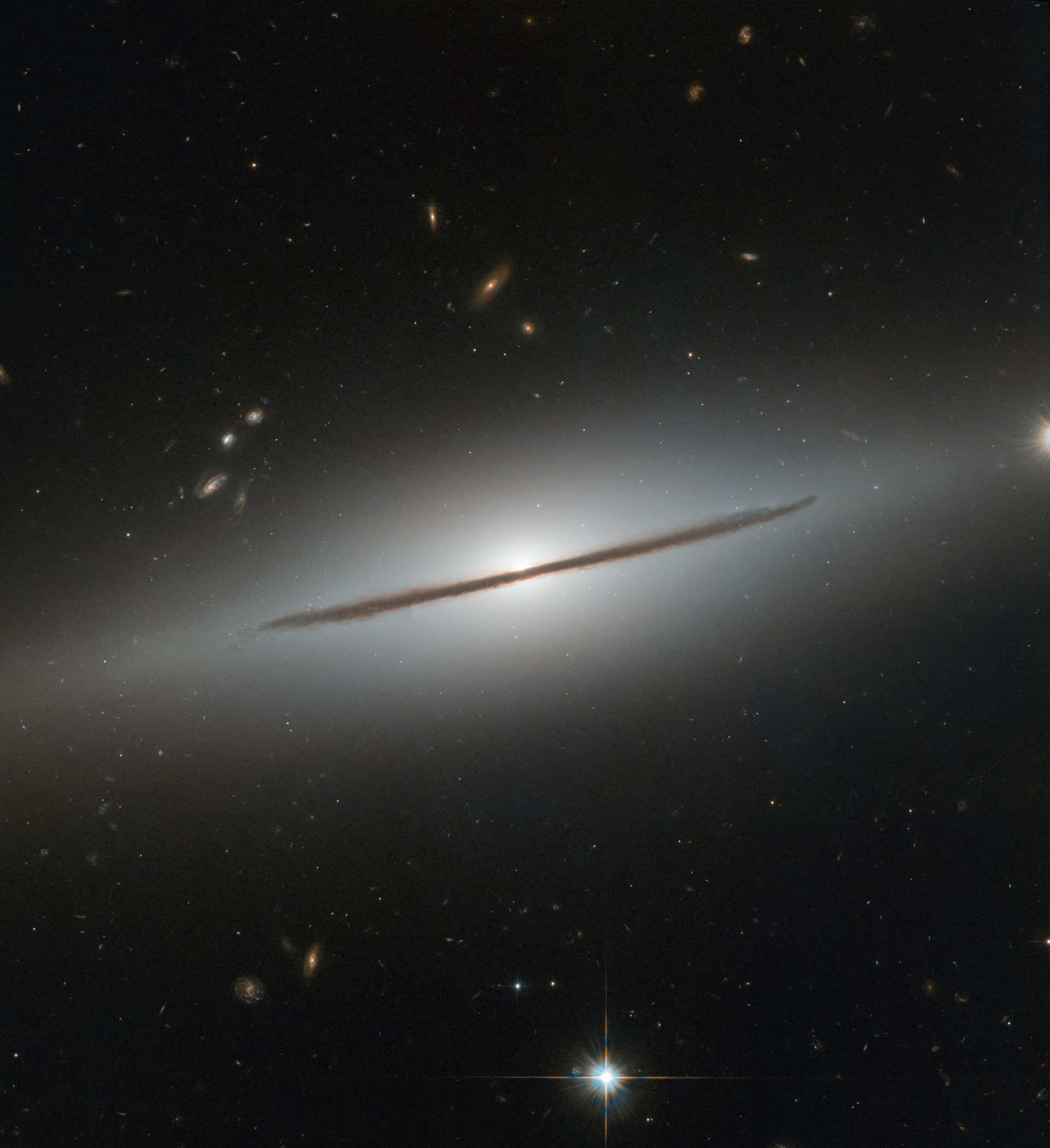
    This is an image of NGC 1032 located about a hundred million light years away in the constellation Cetus (The Sea Monster). Credit: ESA/Hubble & NASA

    Resembling a wizard’s staff set aglow, NGC 1032 cleaves the quiet darkness of space in two in this image from the NASA/ESA Hubble Space Telescope.

    NGC 1032 is located about a hundred million light years away in the constellation Cetus (The Sea Monster). Although beautiful, this image perhaps does not do justice to the galaxy’s true aesthetic appeal: NGC 1032 is actually a spectacular spiral galaxy, but from Earth, the galaxy’s vast disc of gas, dust and stars is seen nearly edge-on.

    A handful of other galaxies can be seen lurking in the background, scattered around the narrow stripe of NGC 1032. Many are oriented face-on or at tilted angles, showing off their glamorous spiral arms and bright cores. Such orientations provide a wealth of detail about the arms and their nuclei, but fully understanding a galaxy’s three-dimensional structure also requires an edge-on view. This gives astronomers an overall idea of how stars are distributed throughout the galaxy and allows them to measure the “height” of the disc and the bright star-studded core.


    Never miss a breakthrough: Join the SciTechDaily newsletter.
    Follow us on Google and Google News.

    Astronomy Hubble Space Telescope
    Share. Facebook Twitter Pinterest LinkedIn Email Reddit

    Related Articles

    A Morphing Spiral Galaxy Amongst Friends

    Hubble Views Magnificent Lopsided Galaxy NGC 2276

    Hubble Captures Fantastic Detail of Eponymous Spiral Galaxy NGC 691

    Spectacular Image Captured by Hubble Shows a Strangely Contorted Spiral Galaxy

    A Distant Spiral in Virgo: Extraordinary Detail Seen in a Galaxy 150 Million Light-Years Away From Earth

    Magnetic Monsters: Hubble Tracks Down Location of Mysterious Radio Signals From Intergalactic Space

    A Menagerie of Galaxies: Hubble Captures a Cluster With Galaxies of All Shapes and Sizes

    How Habitable Are Planets That Orbit Red Dwarfs – The Most Common Type of Stars in the Galaxy?

    Cosmic Silver Lining: Hubble Spots V565 Surrounded by Four Prominent Diffraction Spikes

    2 Comments

    1. VALERIY POLULYAKH on May 14, 2018 8:46 am

      The main idea of the formation of celestial bodies was actually given by Sir Isaac Newton. Once upon a time, the world was filled with a homogeneous cloud of neutral hydrogen. If we look very far back in time, we will see how condensations appear in this cloud which, under the influence of gravitation, do not turn into a single huge mass, but transform into beautiful structured galaxies in which beautiful constellations appear by condensation. Unfortunately, this remarkable picture does not correspond to observations. We do not see gas clouds in which galactic structures gradually appear. There is no any gas reservoirs. The most distant observations demonstrate ready-made galaxies with all their structures and stellar populations. So, the new cosmogony only added dark matter and dark energy, which unfortunately are not observed.

      Reply
    2. VALERIY POLULYAKH on May 15, 2018 8:03 am

      he main idea of the formation of celestial bodies was actually given by Sir Isaac Newton. Once upon a time, the world was filled with a homogeneous cloud of neutral hydrogen. If we look very far back in time, we will see how condensations appear in this cloud which, under the influence of gravitation, do not turn into a single huge mass, but transform into beautiful structured galaxies in which beautiful constellations appear by condensation. Unfortunately, this remarkable picture does not correspond to observations. We do not see gas clouds in which galactic structures gradually appear. There is no any gas reservoirs. The most distant observations demonstrate ready-made galaxies with all their structures and stellar populations. So, the new cosmogony only added dark matter and dark energy, which unfortunately are not observed. https://www.academia.edu/26879556/The_Galaxies_Where_Do_They_Come_From

      Reply
    Leave A Reply Cancel Reply

    • Facebook
    • Twitter
    • Pinterest
    • YouTube

    Don't Miss a Discovery

    Subscribe for the Latest in Science & Tech!

    Trending News

    A Billion Years Before the Grand Canyon, a Giant Cliff May Have Stretched Across America

    The Immune Systems of 110-Year-Olds Are Hiding a Remarkable Secret

    Common Osteoarthritis Treatment Fails a Major Test

    Dark Stars May Have Left a Gravitational-Wave Signal We Can Detect Today

    Blackbirds Somehow Know When a Snake Is Too Dangerous To Attack

    A Hidden Gut Reaction May Explain Why Vegetables Are So Good for You

    New “Invisible” Cell Therapy Could Provide Side-Effect-Free Diabetes Treatment

    Nanoscale “Defects” Unlock a Major Heat Transfer Breakthrough

    Follow SciTechDaily
    • Facebook
    • Twitter
    • YouTube
    • Pinterest
    • Newsletter
    • RSS
    SciTech News
    • Biology News
    • Chemistry News
    • Earth News
    • Health News
    • Physics News
    • Science News
    • Space News
    • Technology News
    Recent Posts
    • “Zombie” Cells Reveal a Surprising New Driver of Chronic Inflammation
    • The Rare Vision Side Effect of Ozempic and Wegovy You Should Know About
    • NASA’s New Space Telescope Could Map the Entire Sky With Hubble-Like Detail
    • Hidden Deep Beneath Mars, Scientists Find Evidence of a Vast Magmatic System
    • One Tiny Chemical Difference in RNA Could Help Explain the Origins of Life
    Copyright © 1998 - 2026 SciTechDaily. All Rights Reserved.
    • Science News
    • About
    • Contact
    • Editorial Board
    • Privacy Policy
    • Terms of Use

    Type above and press Enter to search. Press Esc to cancel.