
Close Menu
    Facebook X (Twitter) Instagram
    SciTechDaily
    • Biology
    • Chemistry
    • Earth
    • Health
    • Physics
    • Science
    • Space
    • Technology
    Facebook X (Twitter) Pinterest YouTube RSS
    SciTechDaily
    Home»Space»Hubble Uncovers a Galactic Wonder: Strange Galaxy Captured in Stunning Detail
    Space

    Hubble Uncovers a Galactic Wonder: Strange Galaxy Captured in Stunning Detail

    By ESA/HubbleDecember 26, 20225 Comments3 Mins Read
    Facebook Twitter Pinterest Telegram LinkedIn WhatsApp Email Reddit
    Share
    Facebook Twitter LinkedIn Pinterest Telegram Email Reddit
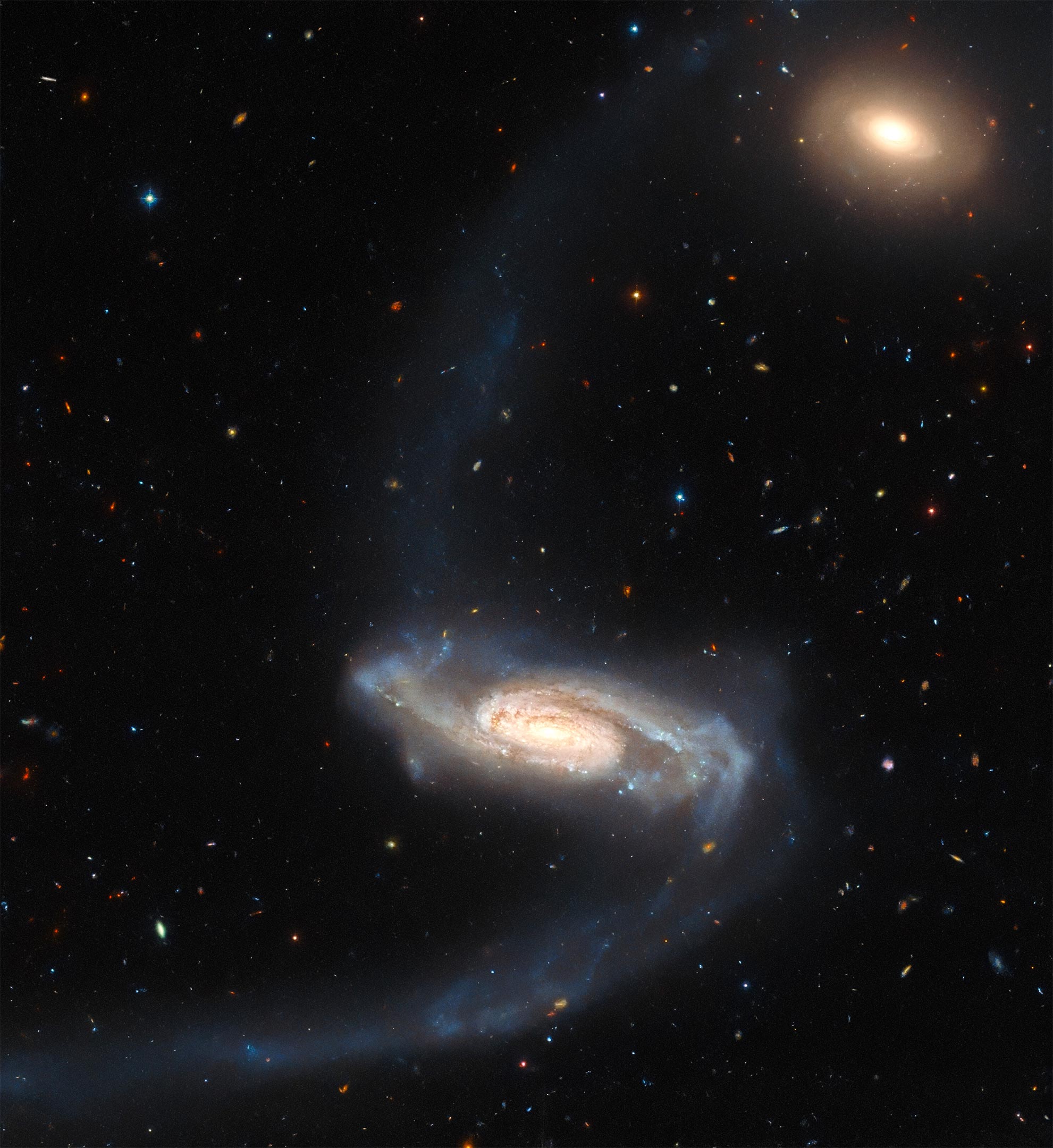
    Galaxy ESO 415-19
    Hubble Space Telescope image of spiral galaxy ESO 415-19, which lies around 450 million light-years away. Credit: ESA/Hubble & NASA, J. Dalcanton, Dark Energy Survey/DOE/FNAL/DECam/CTIO/NOIRLab/NSF/AURA

    The peculiar spiral galaxy ESO 415-19, which is located approximately 450 million light-years away from Earth, stretches lazily across this image from the NASA/ESA Hubble Space Telescope. While the center of this object resembles a regular spiral galaxy, long streams of stars stretch out from the galactic core like bizarrely elongated spiral arms. These are tidal streams caused by some chance interaction in the galaxy’s past, and give ESO 415-19 a distinctly peculiar appearance.

    ESO 415-19’s peculiarity made it a great target for Hubble. This observation comes from an ongoing campaign to explore the Arp Atlas of Peculiar Galaxies, a menagerie of some of the weirdest and most wonderful galaxies that the Universe has to offer. These galaxies range from bizarre lonesome galaxies to spectacularly interacting galaxy pairs, triplets, and even quintets. These space oddities are spread throughout the night sky, which means that Hubble can spare a moment to observe them as it moves between other observational targets.

    Hubble Ultra Deep Field
    This view of nearly 10,000 galaxies is called the Hubble Ultra Deep Field. The snapshot includes galaxies of various ages, sizes, shapes, and colors. The smallest, reddest galaxies may be among the most distant known, existing when the universe was just about 800 million years old. The nearest galaxies – the larger, brighter, well-defined spirals and ellipticals – thrived about 1 billion years ago, when the cosmos was 13 billion years old. The image required 800 exposures taken over the course of 400 Hubble orbits around Earth. The total amount of exposure time was 11.3 days, taken between September 24, 2003, and January 16, 2004. Credit: NASA, ESA, and S. Beckwith (STScI) and the HUDF Team

    This particular observation lies in a part of the night sky contained by the Fornax constellation. This constellation was also the site of a particularly important Hubble observation; the Hubble Ultra Deep Field (see image above). Creating the Ultra Deep Field required almost a million seconds of Hubble time, and captured nearly 10,000 galaxies of various ages, sizes, shapes, and colors. Just as climate scientists can recreate the planet’s atmospheric history from ice cores, astronomers can use deep field observations to explore slices of the Universe’s history from the present all the way to when the Universe was only 800 million years old!

    Never miss a breakthrough: Join the SciTechDaily newsletter.
    Follow us on Google and Google News.

    Astronomy European Space Agency Hubble Space Telescope Popular
    Share. Facebook Twitter Pinterest LinkedIn Email Reddit

    Related Articles

    Hubble’s Newest Discovery Isn’t a Star, It’s a Window Into the Dark Universe

    Hubble Views Spiral Galaxy NGC 5793

    Hubble Captures the Best Ever Image of the Antennae Galaxies

    Hubble Captures Face-On Image of Messier 61

    Hubble Views an Ongoing Cosmic Collision

    Hubble Views Newborn Stars in Galaxy IC 5052

    New XDF Image, The Deepest-Ever View of the Universe

    Hubble Zooms in on the Center of M4

    Hubble Image of Peculiar Galaxy Pair Arp 116

    5 Comments

    1. Jojo on December 26, 2022 2:18 pm

      So cool! Imagine living in that wispy arm and being able to see and study the whole of your home galaxy.

      Reply
    2. Net Dev on December 26, 2022 9:51 pm

      Mindblowing!!! Actually your mind may never be able to comprehend the vastness of what we are seeing (or not seeing)
      Rather SoulSearching ⁉️ Perhaps by astral travel may we learn more of what we are looking at.

      Reply
    3. Cst on December 27, 2022 11:44 am

      For photos of this kind, I also suggest displaying a unit of measurement (e.g. light year). I think it would be very instructive!

      Reply
    4. Kolja on December 27, 2022 1:37 pm

      Wow!
      It is just impossible that out of so many galaxies with multiple planetary systems in it, the life only emerged on Earth. Not to mentioned how young and unstable this planet is, with things like ice age, biblical flooding etc. We know water is found on almost every planet in the solar system already. What about other planets then, which are more stable and older? The life not only exists but flourish I’d say.
      Chances we are alone in the universe are low. Very low. Almost impossible.
      As a matter of fact, we already have a scripture that confirms this – Vedas. With details on number of worlds, planets, species. And time.

      Reply
    5. John J on December 31, 2022 10:34 pm

      The vastness of space is amassing and the many shapes of the galaxies are beautiful. I am sure life exists elsewhere. Intelligent life survival has been a great miracle and that may be the most important thing that is rare here. The universe is a brutal by nature and surviving it is the lucky thing. Earth has had 5 E.L.E that took out most living things on the planet. Evolution and surviving to see this is a human condition, no other creatures on the planet observe the stars like mankind. We are fortunate to alive at this time of discovery to see such wonders.

      Reply
    Leave A Reply Cancel Reply

    • Facebook
    • Twitter
    • Pinterest
    • YouTube

    Don't Miss a Discovery

    Subscribe for the Latest in Science & Tech!

    Trending News

    Scientists Warn That This Common Pet Fish Can Wreck Entire Ecosystems

    Scientists Make Breakthrough in Turning Plastic Trash Into Clean Fuel Using Sunlight

    This Popular Supplement May Interfere With Cancer Treatment, Scientists Warn

    Scientists Finally Solved One of Water’s Biggest Mysteries

    Could This New Weight-Loss Pill Disrupt the Entire Market? Here’s What You Should Know About Orforglipron

    Earth’s Crust Is Tearing Open in Africa, and It Could Form a New Ocean

    Breakthrough Bowel Cancer Trial Leaves Patients Cancer-Free for Nearly 3 Years

    Natural Compound Shows Powerful Potential Against Rheumatoid Arthritis

    Follow SciTechDaily
    • Facebook
    • Twitter
    • YouTube
    • Pinterest
    • Newsletter
    • RSS
    SciTech News
    • Biology News
    • Chemistry News
    • Earth News
    • Health News
    • Physics News
    • Science News
    • Space News
    • Technology News
    Recent Posts
    • Kratom Use Explodes in the US, With Life-Changing Consequences
    • Scientists Uncover Fatal Weakness in “Zombie Cells” Linked to Cancer
    • World-First Study Reveals Human Hearts Can Regenerate After a Heart Attack
    • Why Your Dreams Feel So Real Sometimes and So Strange Other Times
    • Scientists Debunk 100-Year-Old Belief About Brain Cells, Rewriting Textbooks
    Copyright © 1998 - 2026 SciTechDaily. All Rights Reserved.
    • Science News
    • About
    • Contact
    • Editorial Board
    • Privacy Policy
    • Terms of Use

    Type above and press Enter to search. Press Esc to cancel.