
Close Menu
    Facebook X (Twitter) Instagram
    SciTechDaily
    • Biology
    • Chemistry
    • Earth
    • Health
    • Physics
    • Science
    • Space
    • Technology
    Facebook X (Twitter) Pinterest YouTube RSS
    SciTechDaily
    Home»Space»Hubble Witnesses Bright Shock Wave of Colliding Gases in Running Man Nebula
    Space

    Hubble Witnesses Bright Shock Wave of Colliding Gases in Running Man Nebula

    By NASA's Goddard Space Flight CenterNovember 26, 2021No Comments2 Mins Read
    Facebook Twitter Pinterest Telegram LinkedIn WhatsApp Email Reddit
    Share
    Facebook Twitter LinkedIn Pinterest Telegram Email Reddit
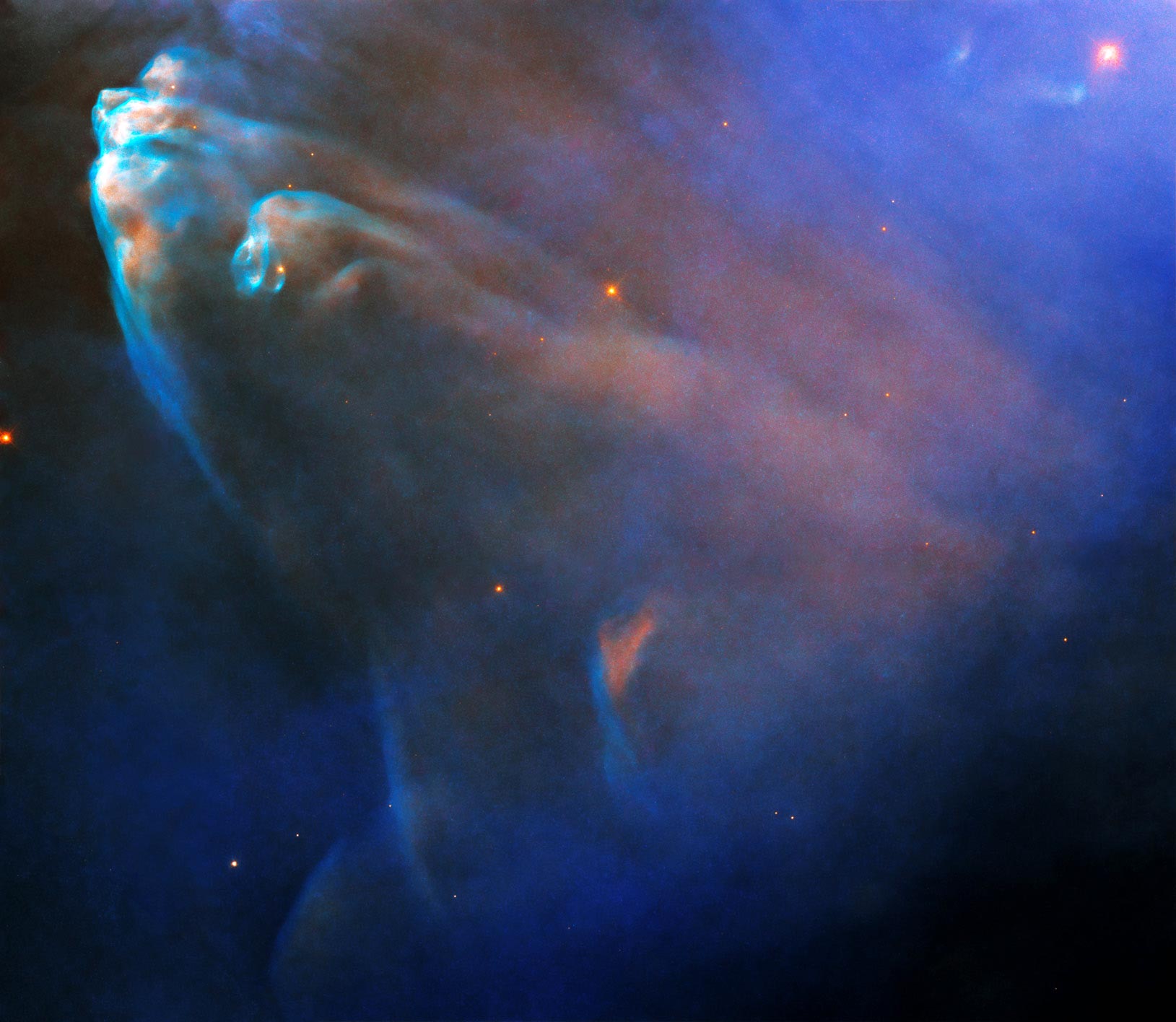
    Shock Wave of Colliding Gases in Running Man Nebula
    Credit: NASA, ESA, and J. Bally (University of Colorado at Boulder); Processing: Gladys Kober (NASA/Catholic University of America)

    Hubble’s view of HH 45 reveals shock waves from a young star’s jets in the Running Man Nebula, a reflection nebula that mirrors starlight.

    Mounded, luminous clouds of gas and dust glow in this Hubble image of a Herbig-Haro object known as HH 45. Herbig-Haro objects are a rarely seen type of nebula that occurs when hot gas ejected by a newborn star collides with the gas and dust around it at hundreds of miles per second, creating bright shock waves. In this image, blue indicates ionized oxygen (O II) and purple shows ionized magnesium (Mg II). Researchers were particularly interested in these elements because they can be used to identify shocks and ionization fronts.
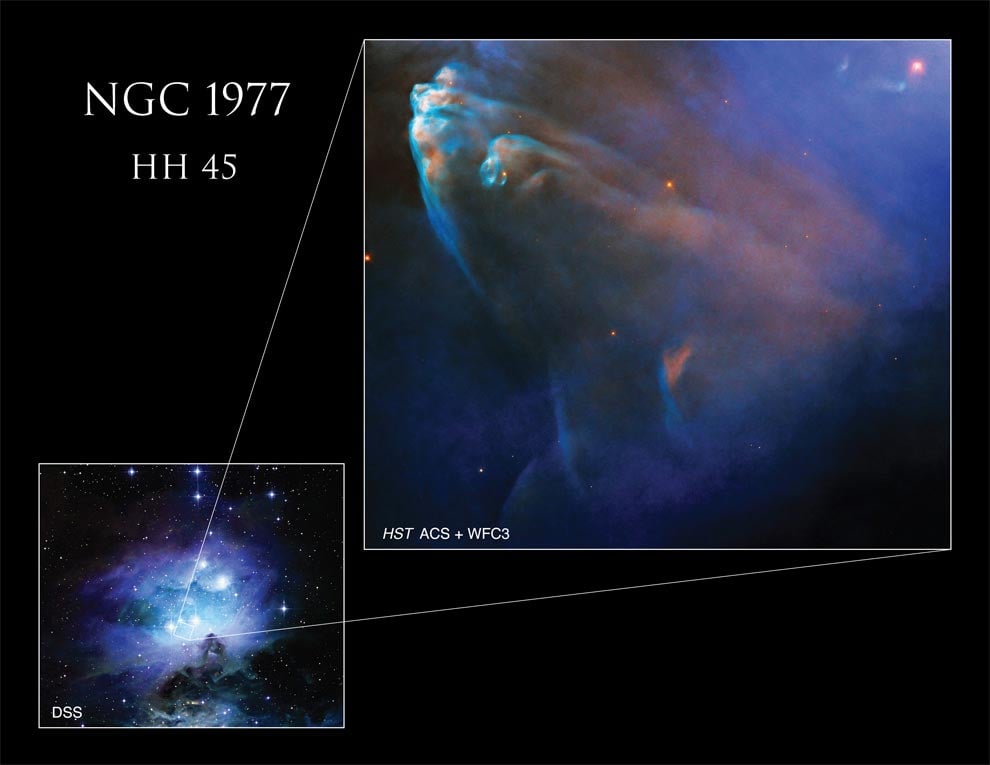
    Running Man Nebula NGC 1977 HH 45
    Hubble imaged a small section of the Running Man Nebula, which lies close to the famed Orion Nebula and is a favorite target for amateur astronomers to observe and photograph. Credit: NASA, ESA, J. Bally (University of Colorado at Boulder), and DSS; Processing: Gladys Kober (NASA/Catholic University of America)

    This object is located in the nebula NGC 1977, which itself is part of a complex of three nebulae called The Running Man. NGC 1977 – like its companions NGC 1975 and NGC 1973 – is a reflection nebula, which means that it doesn’t emit light on its own, but reflects light from nearby stars, like a streetlight illuminating fog.

    Hubble observed this region to look for stellar jets and planet-forming disks around young stars, and examine how their environment affects the evolution of such disks.

    Never miss a breakthrough: Join the SciTechDaily newsletter.
    Follow us on Google and Google News.

    Astronomy Hubble Space Telescope NASA NASA Goddard Space Flight Center
    Share. Facebook Twitter Pinterest LinkedIn Email Reddit

    Related Articles

    Astronomers Finally Solve Betelgeuse’s Biggest Mystery

    The Andromeda Mystery: Hubble Discovers Strange Galactic Behavior

    3.7 Billion Miles Away: Hubble Uncovers a Hidden Trio That Could Rewrite Kuiper Belt History

    Historic Discovery: Twin Titans Clash As NASA Unveils Closest Supermassive Black Hole Duo

    The Great Escape: NASA’s Hubble and MAVEN Help Solve Mystery of Mars’ Vanishing Water

    Into the Rosy Depths: Hubble’s Journey Through Andromeda

    Hubble Observes a Lonely Beacon in the Cosmic Dark

    What Lies Within? Hubble’s Deep Dive Into the Structured Chaos of Leo A

    Hubble Spots Billowing Bubbles of Stellar Floss Across 1,000 Light-Year Expanse

    Leave A Reply Cancel Reply

    • Facebook
    • Twitter
    • Pinterest
    • YouTube

    Don't Miss a Discovery

    Subscribe for the Latest in Science & Tech!

    Trending News

    Millions Take These IBS Drugs, But a New Study Finds Serious Risks

    Scientists Unlock Hidden Secrets of 2,300-Year-Old Mummies Using Cutting-Edge CT Scanner

    Bread Might Be Making You Gain Weight Even Without Eating More Calories

    Scientists Discover Massive Magma Reservoir Beneath Tuscany

    Europe’s Most Active Volcano Just Got Stranger – Here’s Why Scientists Are Rethinking It

    Alzheimer’s Symptoms May Start Outside the Brain, Study Finds

    Millions Take This Popular Supplement – Scientists Discover a Concerning Link to Heart Failure

    The Universe Is Expanding Too Fast and Scientists Can’t Explain Why

    Follow SciTechDaily
    • Facebook
    • Twitter
    • YouTube
    • Pinterest
    • Newsletter
    • RSS
    SciTech News
    • Biology News
    • Chemistry News
    • Earth News
    • Health News
    • Physics News
    • Science News
    • Space News
    • Technology News
    Recent Posts
    • Simple Blood Test May Predict Alzheimer’s Years Before Brain Scans Show Signs
    • Scientists Say Adding This Unusual Seafood to Your Diet Could Reverse Signs of Aging
    • U.S. Waste Holds $5.7 Billion Worth of Crop Nutrients
    • Scientists Say a Hidden Structure May Exist Inside Earth’s Core
    • Doctors Surprised by the Power of a Simple Drug Against Colon Cancer
    Copyright © 1998 - 2026 SciTechDaily. All Rights Reserved.
    • Science News
    • About
    • Contact
    • Editorial Board
    • Privacy Policy
    • Terms of Use

    Type above and press Enter to search. Press Esc to cancel.