
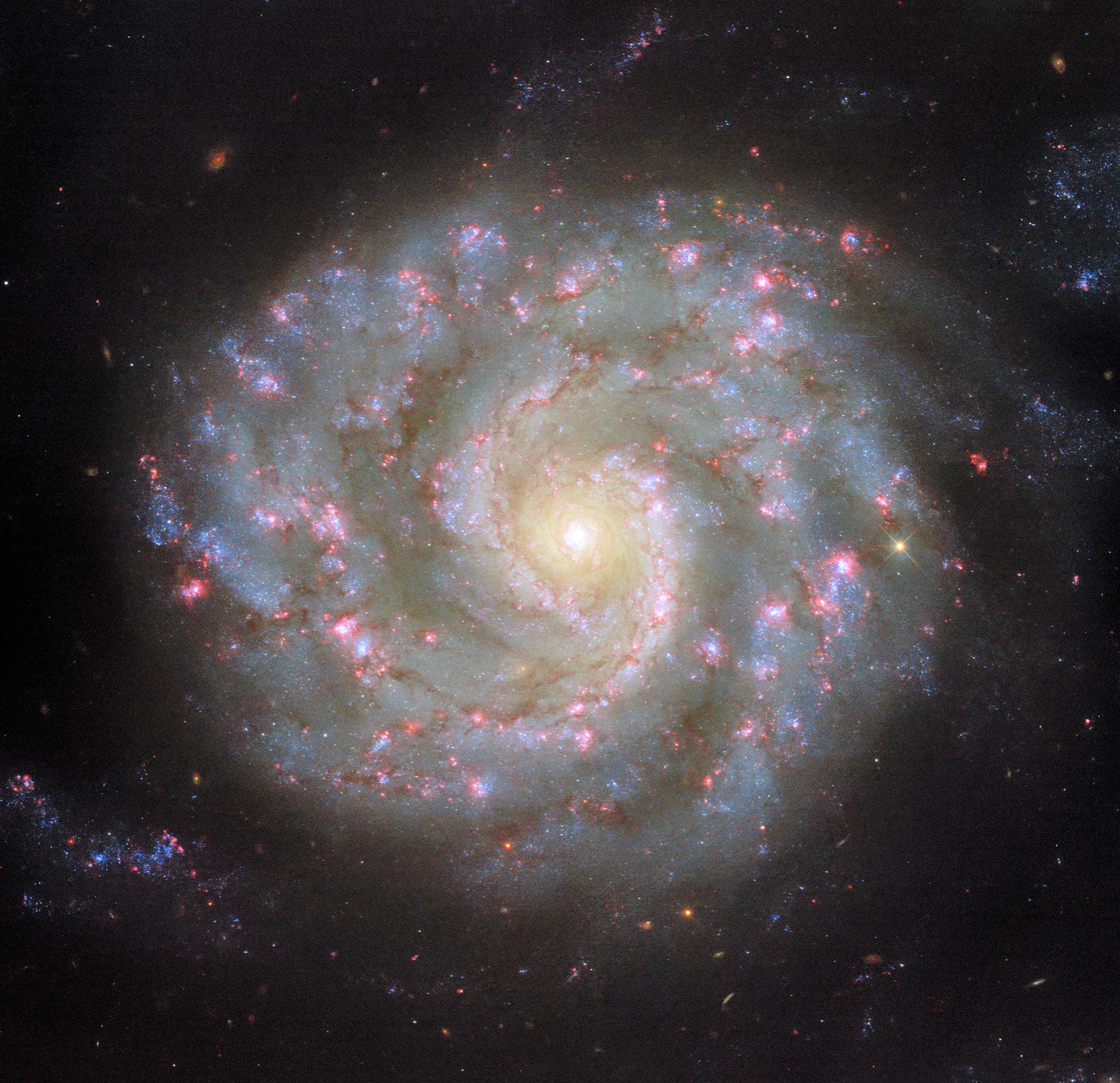
A breathtaking new image from the Hubble Space Telescope captures NGC 3596, a spiral galaxy 90 million light-years away, in stunning face-on detail.
Its swirling arms, glowing with pink star-forming regions and young blue stars, offer both beauty and mystery.
Stunning View of NGC 3596
A new image from the Hubble Space Telescope offers a detailed view of the spiral galaxy NGC 3596, located about 90 million light-years from Earth in the constellation Leo. The image, captured in six different wavelengths of light, highlights the structure and star-forming regions of this galaxy, which was first discovered in 1784 by astronomer William Herschel, the namesake of ESA’s Herschel Space Observatory.
NGC 3596 is positioned almost perfectly face-on from our point of view, giving us a clear look at its symmetrical spiral arms. These arms are areas where stars, gas, and dust are densely packed—and where new stars are actively forming. The image shows bright pink regions marking zones of star formation and young blue stars tracing the arms of the galaxy.
The Mystery Behind Spiral Arms
Despite decades of study, how spiral arms form and evolve remains an open question in astronomy. Spiral galaxies show a wide range of shapes and features. Some have well-defined arms, others more scattered or feathery patterns. Some galaxies contain prominent central bars or compact, circular nuclei, and their environments vary too—some are isolated, while others have nearby galactic companions.
Early ideas of how spiral arms formed were stumped by what’s called the ‘winding problem’. If a galaxy’s spiral arms are coherent structures, the arms would be wound tighter and tighter as the galaxy spins, until the arms are no longer visible. Now, researchers believe that spiral arms represent a pattern of high-density and low-density areas rather than a physical structure. As stars, gas, and dust orbit within a galaxy’s disc, they pass in and out of the spiral arms. Much like cars moving through a traffic jam, these materials slow down and bunch up as they enter a spiral arm, before emerging and continuing their journey through the galaxy.
Never miss a breakthrough: Join the SciTechDaily newsletter.
Follow us on Google and Google News.
1 Comment
thank you for this