
Close Menu
    Facebook X (Twitter) Instagram
    SciTechDaily
    • Biology
    • Chemistry
    • Earth
    • Health
    • Physics
    • Science
    • Space
    • Technology
    Facebook X (Twitter) Pinterest YouTube RSS
    SciTechDaily
    Home»Space»Two Black Holes Found Competing for Galactic Supremacy
    Space

    Two Black Holes Found Competing for Galactic Supremacy

    By ESA/HubbleDecember 9, 20242 Comments2 Mins Read
    Facebook Twitter Pinterest Telegram LinkedIn WhatsApp Email Reddit
    Share
    Facebook Twitter LinkedIn Pinterest Telegram Email Reddit
    Grand Spiral Galaxy NGC 5643
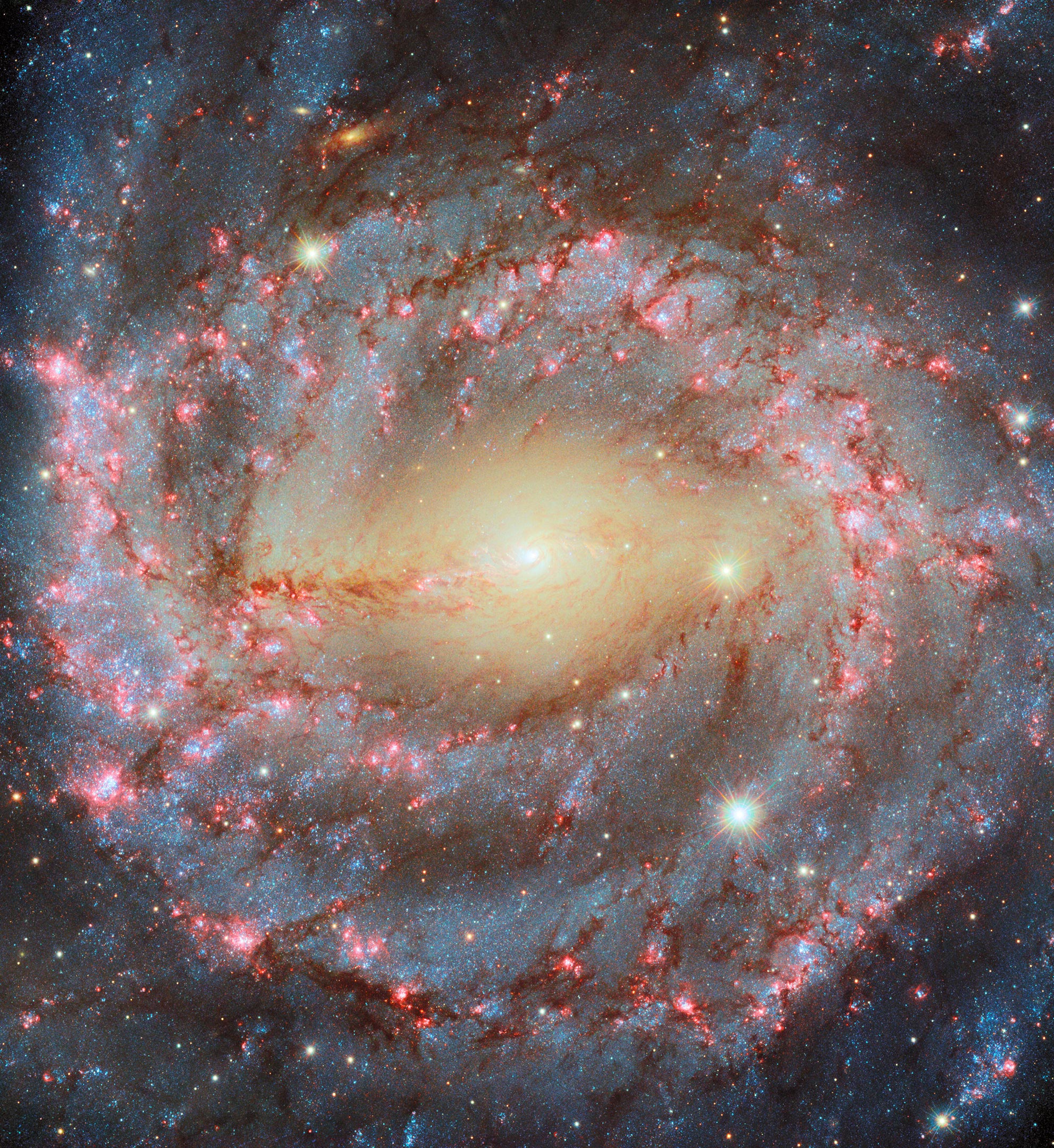
    NGC 5643, a grand design spiral galaxy, is showcased in the Hubble Space Telescope’s latest image. It contains a supermassive black hole at its core and a possibly smaller yet brighter X-ray-emitting black hole at its edge. Credit: ESA/Hubble & NASA, A. Riess, D. Thilker, D. De Martin (ESA/Hubble), M. Zamani (ESA/Hubble)

    This breathtaking new Hubble Space Telescope image highlights the stunning spiral galaxy NGC 5643, located about 40 million light-years away in the constellation Lupus. This galaxy is classified as a grand design spiral, meaning its two prominent, winding spiral arms are well-defined and easy to see. These arms are decorated with bright blue stars, intricate reddish-brown dust clouds, and pink star-forming regions.

    While its beauty is striking in visible light, some of NGC 5643’s most fascinating features remain hidden from the human eye. Observations using ultraviolet and X-ray imaging and spectra reveal that the galaxy hosts an active galactic nucleus — an extremely bright core powered by a supermassive black hole. As this black hole pulls in surrounding gas, the material forms a swirling disc that heats to hundreds of thousands of degrees. This intense heat causes the gas to emit light across the electromagnetic spectrum, with X-rays shining the brightest.

    NGC 5643’s active galactic nucleus isn’t the brightest source of X-rays in the galaxy, though. Using ESA’s XMM-Newton, researchers discovered an even brighter X-ray-emitting object, NGC 5643 X-1, on the galaxy’s outskirts. What could be a more powerful source of X-rays than a supermassive black hole? Surprisingly, the answer appears to be a much smaller black hole! While the exact identity of NGC 5643 X-1 is not yet known, evidence points to a black hole that is about 30 times more massive than the Sun. Locked in an orbital dance with a companion star, the black hole ensnares gas from its stellar companion, creating a superheated disc that outshines the galactic center.

    NGC 5643 was also the subject of a previous Hubble image. The new image incorporates additional wavelengths of light, including the red color that is characteristic of gas heated by massive young stars.

    Never miss a breakthrough: Join the SciTechDaily newsletter.
    Follow us on Google and Google News.

    Astronomy European Space Agency Hubble Space Telescope
    Share. Facebook Twitter Pinterest LinkedIn Email Reddit

    Related Articles

    A Diamond Necklace of Cosmic Proportions

    Hubble Snaps a Stunning Close-Up of a Magnificent Spiral Galaxy

    Extraordinary Hubble Image: Light Bends From the Beyond

    Hubble Space Telescope Sees Volcanic Activity Reforming the Atmosphere on a Rocky Exoplanet

    Hubble Spies a Luminous Heart With Dark Tendrils

    Spectacular Return to the Veil Nebula

    Hubble Spots a Peculiar Sight: Unusual Spiral Galaxy With a Heavy Arm

    A Flash of Life: Hubble Spies an Unusual Planetary Nebula

    Through the Cosmic Clouds: Hubble Spots a Beautiful Stellar Nursery

    2 Comments

    1. Bao-hua ZHANG on December 9, 2024 9:08 pm

      The breathtaking new Hubble Space Telescope image highlights the stunning spiral galaxy.
      VERY GOOD.

      Topological vortices and their fractal structures are the foundation of the motion and evolution of all things in the universe. Spins create everything, and spins shape the world.

      If anyone is interested in science, you can browse https://zhuanlan.zhihu.com/p/4659236468.

      Reply
    2. Bao-hua ZHANG on December 9, 2024 9:10 pm

      Spins create everything, and spins shape the world.
      If anyone is interested in science, you can browse https://zhuanlan.zhihu.com/p/4659236468.

      Reply
    Leave A Reply Cancel Reply

    • Facebook
    • Twitter
    • Pinterest
    • YouTube

    Don't Miss a Discovery

    Subscribe for the Latest in Science & Tech!

    Trending News

    Mezcal “Worm” in a Bottle Mystery: DNA Testing Reveals a Surprise

    New Research Reveals That Your Morning Coffee Activates an Ancient Longevity Switch

    This Is What Makes You Irresistible to Mosquitoes

    Shockingly Powerful Giant Octopuses Ruled the Seas 100 Million Years Ago

    Scientists Stunned by New Organic Molecules Found on Mars

    Rewriting Dinosaur Evolution: Scientists Unearth Remarkable 150-Million-Year-Old Stegosaur Skull

    Omega-3 Supplements Linked to Cognitive Decline in Surprising New Study

    First-of-Its-Kind Discovery: Homer’s Iliad Found Embedded in a 1,600-Year-Old Egyptian Mummy

    Follow SciTechDaily
    • Facebook
    • Twitter
    • YouTube
    • Pinterest
    • Newsletter
    • RSS
    SciTech News
    • Biology News
    • Chemistry News
    • Earth News
    • Health News
    • Physics News
    • Science News
    • Space News
    • Technology News
    Recent Posts
    • These Simple Daily Habits Can Quickly Improve Blood Pressure and Heart Risk Factors
    • A Common Nutrient May Play a Surprising Role in Anxiety
    • Doing This After 9 p.m. Could Double Your Risk of Gut Issues
    • New Research Challenges Long-Held Beliefs About How the Brain Makes Decisions
    • Breakthrough Technology Reveals New Treatment Targets for Cancer
    Copyright © 1998 - 2026 SciTechDaily. All Rights Reserved.
    • Science News
    • About
    • Contact
    • Editorial Board
    • Privacy Policy
    • Terms of Use

    Type above and press Enter to search. Press Esc to cancel.