
Close Menu
    Facebook X (Twitter) Instagram
    SciTechDaily
    • Biology
    • Chemistry
    • Earth
    • Health
    • Physics
    • Science
    • Space
    • Technology
    Facebook X (Twitter) Pinterest YouTube RSS
    SciTechDaily
    Home»Space»Hubble’s Pulsar Quest: A Deep Dive Into the Glistening Globular Cluster NGC 6544
    Space

    Hubble’s Pulsar Quest: A Deep Dive Into the Glistening Globular Cluster NGC 6544

    By ESA/HubbleJune 27, 2023No Comments3 Mins Read
    Facebook Twitter Pinterest Telegram LinkedIn WhatsApp Email Reddit
    Share
    Facebook Twitter LinkedIn Pinterest Telegram Email Reddit
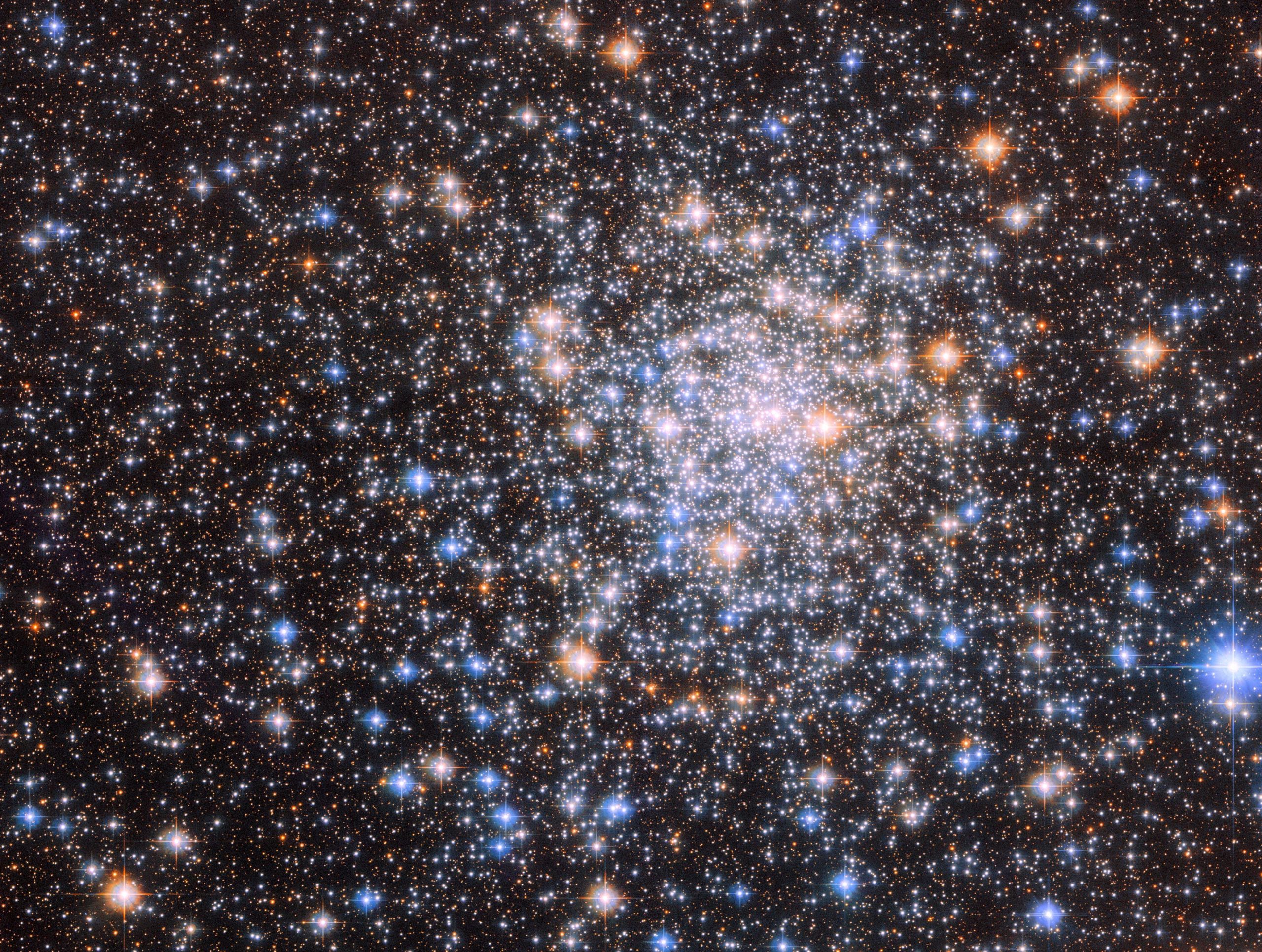
    Globular Cluster NGC 6544
    The globular cluster NGC 6544, located over 8000 light-years away from Earth and containing tens of thousands of stars, was captured by the Hubble Space Telescope. The cluster resides in the Sagittarius constellation near the vast Lagoon Nebula, a region teeming with newborn stars and hidden intricate structures revealed by previous infrared observations. Credit: ESA/Hubble & NASA, W. Lewin, F. R. Ferraro

    Hubble Space Telescope’s observations of the star-packed NGC 6544 globular cluster, situated over 8000 light-years away, aimed to identify a visible radio pulsar and faint X-ray sources to gain insight into the evolution of such clusters. The cluster, residing near the large Lagoon Nebula, holds secrets revealed by infrared studies of the nebula.

    The teeming stars of the globular cluster NGC 6544 glisten in this image from the NASA/ESA Hubble Space Telescope. This cluster of tightly bound stars lies more than 8000 light-years away from Earth and is — like all globular clusters — a densely populated region of tens of thousands of stars.

    This image of NGC 6544 combines data from two of Hubble’s instruments — the Advanced Camera for Surveys (ACS) and Wide Field Camera 3 (WFC3) — as well as two separate astronomical observations. The first observation was designed to find a visible counterpart to the radio pulsar discovered in NGC 6544. A pulsar is the rapidly spinning remnant of a dead star, emitting twin beams of electromagnetic radiation like a vast astronomical lighthouse. This pulsar rotates particularly quickly, and astronomers turned to Hubble to help determine how this object evolved in NGC 6544. 

    The second observation which contributed data to this image was also designed to find the visible counterparts of objects detected at other electromagnetic wavelengths. Instead of matching up sources to a pulsar, however, astronomers used Hubble to search for the counterparts of faint X-ray sources. Their observations could help explain how clusters like NGC 6544 change over time.

    NGC 6544 lies in the constellation Sagittarius, close to the vast Lagoon Nebula, a hazy labyrinth of gas and dust sculpted by the fierce winds of newly born stars. The Lagoon Nebula is truly colossal — even by astronomical standards — and measures 55 light-years across and 20 light-years from top to bottom. Previous Hubble images of the nebula incorporated infrared observations to reveal young stars and intricate structures that would be obscured at visible wavelengths by clouds of gas and dust.

    Never miss a breakthrough: Join the SciTechDaily newsletter.
    Follow us on Google and Google News.

    Astronomy European Space Agency Hubble Space Telescope
    Share. Facebook Twitter Pinterest LinkedIn Email Reddit

    Related Articles

    A Diamond Necklace of Cosmic Proportions

    Hubble Snaps a Stunning Close-Up of a Magnificent Spiral Galaxy

    Extraordinary Hubble Image: Light Bends From the Beyond

    Hubble Space Telescope Sees Volcanic Activity Reforming the Atmosphere on a Rocky Exoplanet

    Hubble Spies a Luminous Heart With Dark Tendrils

    Spectacular Return to the Veil Nebula

    Hubble Spots a Peculiar Sight: Unusual Spiral Galaxy With a Heavy Arm

    A Flash of Life: Hubble Spies an Unusual Planetary Nebula

    Through the Cosmic Clouds: Hubble Spots a Beautiful Stellar Nursery

    Leave A Reply Cancel Reply

    • Facebook
    • Twitter
    • Pinterest
    • YouTube

    Don't Miss a Discovery

    Subscribe for the Latest in Science & Tech!

    Trending News

    Your Blood Pressure Reading Could Be Wrong Because of One Simple Mistake

    Astronomers Stunned by Ancient Galaxy With No Spin

    Physicists May Be on the Verge of Discovering “New Physics” at CERN

    Scientists Solve 320-Million-Year Mystery of Reptile Skin Armor

    Scientists Say This Daily Walking Habit May Be the Secret to Keeping Weight Off After Dieting

    New Therapy Rewires the Brain To Restore Joy in Depression Patients

    Giant Squid Detected off Western Australia in Stunning Deep-Sea Discovery

    Popular Sugar-Free Sweetener Linked to Liver Disease, Study Warns

    Follow SciTechDaily
    • Facebook
    • Twitter
    • YouTube
    • Pinterest
    • Newsletter
    • RSS
    SciTech News
    • Biology News
    • Chemistry News
    • Earth News
    • Health News
    • Physics News
    • Science News
    • Space News
    • Technology News
    Recent Posts
    • A Crucial Atlantic Current Is Weakening and Weather Could Change Worldwide
    • Scientists Stunned As Volcano Removes Methane From the Air
    • Scientists Discover Signs Africa May Be Splitting Apart Beneath Zambia
    • New Stroke Study Challenges Decades-Old Medical Beliefs
    • These Simple Plant Foods Are Linked to Lower Blood Pressure
    Copyright © 1998 - 2026 SciTechDaily. All Rights Reserved.
    • Science News
    • About
    • Contact
    • Editorial Board
    • Privacy Policy
    • Terms of Use

    Type above and press Enter to search. Press Esc to cancel.