
Close Menu
    Facebook X (Twitter) Instagram
    SciTechDaily
    • Biology
    • Chemistry
    • Earth
    • Health
    • Physics
    • Science
    • Space
    • Technology
    Facebook X (Twitter) Pinterest YouTube RSS
    SciTechDaily
    Home»Science»Human Skin Lipids Repel Bed Bugs – Discovery Could Lead to New Pest Management Strategies
    Science

    Human Skin Lipids Repel Bed Bugs – Discovery Could Lead to New Pest Management Strategies

    By University of KentuckyDecember 13, 2021No Comments3 Mins Read
    Facebook Twitter Pinterest Telegram LinkedIn WhatsApp Email Reddit
    Share
    Facebook Twitter LinkedIn Pinterest Telegram Email Reddit
    Bed Bugs Feed
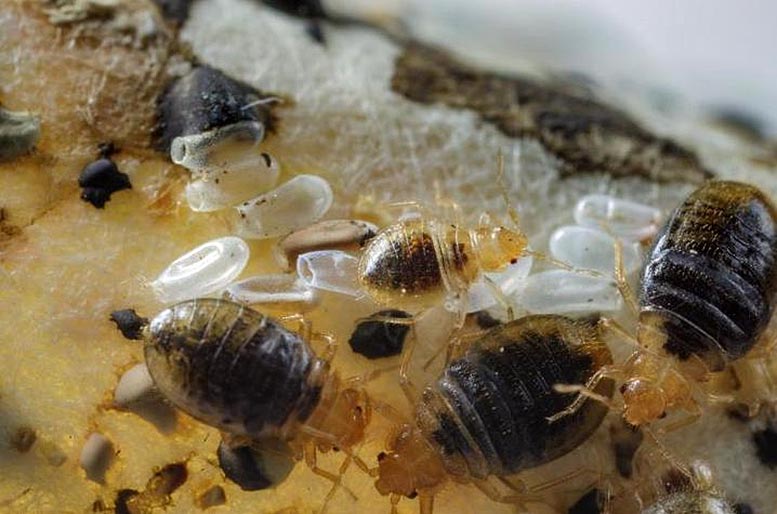
    Bed bugs only feed on their hosts for a short time before moving away to hide until it is time for their next meal. UK entomologists have found this behavior is due to triglycerides on human skin that repel the bugs. Credit: Photo by Matt Barton

    Human skin lipids may be the key to repelling bed bugs.

    University of Kentucky entomology researchers have found that skin triglycerides, or lipids, keep bed bugs from staying very long on human hosts. Their finding could lead to new management strategies for this important human pest.

    “We already knew that human body odors, carbon dioxide, and warmth attract bed bugs to feed on people. Our latest research shows the reason they do not stay on humans like other pests, such as lice, is due to lipids or triglycerides in our skin that cause them to leave their hosts and hide in nearby locations, such as beds and mattresses,” said Zach DeVries, assistant professor of urban entomology with the UK College of Agriculture, Food and Environment.

    DeVries and Sudip Gaire, UK postdoctoral scholar, tested this latest finding by rubbing a strip of filter paper on participants’ skin to collect samples. Research participants represented numerous ages and ethnicities. They also tested the theory on multiple populations of bed bugs raised in the lab and collected in the field.

    Consistent aversion to skin triglycerides

    “Our findings were consistent across all triglyceride types, all participant groups, and all bed bug populations,” DeVries said. “Bed bugs nearly always preferred the control filter strip to the one containing skin triglycerides.”

    “The bed bugs do not like to sit on skin triglycerides and refuse to stay on surfaces that contain triglycerides,” Gaire said. “We got tremendous results by using only a small amount of triglycerides.”

    While further research is needed to explore why bed bugs do not like the triglycerides and if there are other potential bed bug repellents in human skin, DeVries and Gaire think this could be an important beginning to more effective bed bug control.

    “There may be several potential management opportunities from our finding,” DeVries said. “It’s possible that our findings could be used to deter bed bugs from hitchhiking on people’s belongings, thus reducing their spread.”

    The findings were first reported in the journal Scientific Reports.

    Reference: “Human skin triglycerides prevent bed bug (Cimex lectularius L.) arrestment” by Sudip Gaire, Zachary C. DeVries, Russell Mick, Richard G. Santangelo, Grazia Bottillo, Emanuela Camera and Coby Schal, 8 December 2021, Scientific Reports.
    DOI: 10.1038/s41598-021-01981-1

    Additional researchers in the study include Russell Mick, Richard Santangelo and Coby Schal from North Carolina State University, and Grazia Bottillo and Emanuela Camera from the San Gallicano Dermatological Institute in Rome, Italy.

    The researchers were funded by grants UK received from the U.S. Department of Housing and Urban Development and National Institutes of Health and grants North Carolina State University received from the National Science Foundation, U.S. Department of the Army, U.S. Department of Housing and Urban Development and the Blanton J. Whitmore Endowment.

    Research reported in this publication was supported by the U.S. Department of Housing and Urban Development as part of an award KYHHU0061-20 totaling $400,000, 100% of which was funded by HUD. 

    Research reported in this publication was supported by the Office of the Director of the National Institutes of Health under Award Number DP5OD028155. The content is solely the responsibility of the authors and does not necessarily represent the official views of the National Institutes of Health.

    Never miss a breakthrough: Join the SciTechDaily newsletter.
    Follow us on Google and Google News.

    Entomology University of Kentucky
    Share. Facebook Twitter Pinterest LinkedIn Email Reddit

    Related Articles

    Moths to a Flame: Millennia-Old Mystery About Insects and Light at Night Solved at Last

    Bad News: Light Pollution Could Extend Mosquito Season

    Invasion Alert: Disease Fears Raised Over New Mosquito Species Reported in Florida

    Seek & Destroy: Black Widow Spiders Are Being Actively Hunted by Brown Widows

    Gigantic Ant Fossil – With a 6″ Wingspan – Raises Questions About Ancient Arctic Migrations

    Physics of Superpropulsion: Super-Fast Sharpshooter Insect Urination Using a “Butt Flicker”

    Giant Jurassic-Era Insect Discovered at Arkansas Walmart Sets Historic Record

    Genetic Factor? Honey Bee Life Spans 50% Shorter Now Compared to 50 Years Ago

    What Do Grasshoppers Eat? Startling Similarities Discovered Between the Mouths of Grasshoppers and Mammal Teeth

    Leave A Reply Cancel Reply

    • Facebook
    • Twitter
    • Pinterest
    • YouTube

    Don't Miss a Discovery

    Subscribe for the Latest in Science & Tech!

    Trending News

    Scientists Say This Natural Hormone Reverses Obesity by Targeting the Brain

    35-Million-Year-Old Mystery: Strange Arachnid Discovered Preserved in Amber

    Is AI Really Just a Tool? It Could Be Altering How You See Reality

    JWST Reveals a “Forbidden” Planet With a Baffling Composition

    The Protein “Sabotaging” Aging Muscle Recovery Could Be Key to Surviving Aging

    This Diet–Gut Interaction Could Transform Fat Into a Calorie-Burning Machine

    Scientists Discover Hidden Virus Linked to Colorectal Cancer

    Scientists Discover 132-Million-Year-Old Dinosaur Tracks on South Africa’s Coast

    Follow SciTechDaily
    • Facebook
    • Twitter
    • YouTube
    • Pinterest
    • Newsletter
    • RSS
    SciTech News
    • Biology News
    • Chemistry News
    • Earth News
    • Health News
    • Physics News
    • Science News
    • Space News
    • Technology News
    Recent Posts
    • 500 Million Years Ago, Life Changed Forever: Scientists Reveal the DNA Changes That Helped Animals Move Onto Land
    • Surprise RNA Discovery Challenges Long-Held Beliefs About How Genes Work
    • Your IQ at 23 Could Predict Your Wealth at 27, Study Finds
    • 320 Light-Years Away, a Planet Confirms a Fundamental Cosmic Assumption
    • Astronomers Solve Decades-Long Mystery About Saturn’s Spin – “Something Strange Was Happening”
    Copyright © 1998 - 2026 SciTechDaily. All Rights Reserved.
    • Science News
    • About
    • Contact
    • Editorial Board
    • Privacy Policy
    • Terms of Use

    Type above and press Enter to search. Press Esc to cancel.