Close Menu
    Facebook X (Twitter) Instagram
    SciTechDaily
    • Biology
    • Chemistry
    • Earth
    • Health
    • Physics
    • Science
    • Space
    • Technology
    Facebook X (Twitter) Pinterest YouTube RSS
    SciTechDaily
    Home»Space»Hungry Stars Cannibalize Each Other in ‘Be X-Ray’ Systems
    Space

    Hungry Stars Cannibalize Each Other in ‘Be X-Ray’ Systems

    By OzGravMarch 29, 2020No Comments3 Mins Read
    Facebook Twitter Pinterest Telegram LinkedIn WhatsApp Email Reddit
    Share
    Facebook Twitter LinkedIn Pinterest Telegram Email Reddit
    Planet Forming Lifeline Discovered in a Binary Star System
    Artist impression of a double-star system. Credit: ESO/L. Calçada

    Humans have been studying the light from stars since the beginning of our history; however, we’ve only just discovered in the last few decades that stars don’t like to be alone.

    Binary systems—containing two stars orbiting around each other—are one of the most common type of gravitationally-bound collections of stars, yet their evolution is complex. Astronomers are trying to piece together the puzzle of different stellar observations to reveal the bigger picture. Using their understanding of binary evolution, scientists can simulate populations of stellar binaries with the stellar population synthesis code COMPAS—mostly developed by researchers from the ARC Centre of Gravitational Wave Discovery (OzGrav).
     
    OzGrav researchers, in collaboration with the Max Planck Institute of Hannover, Monash University and University of Birmingham, recently conducted a study to understand the origin of the properties of ‘Be X-ray’ binaries observed in the Small Magellanic Cloud.

    Be X-ray binaries are star systems typically composed of a neutron star orbiting around a rapidly rotating massive star. This rotation causes the massive star to produce a disk of outflowing material—some of this is accumulated by the neutron star. The neutron star then shoots off X-ray radiation that scientists can observe and measure.

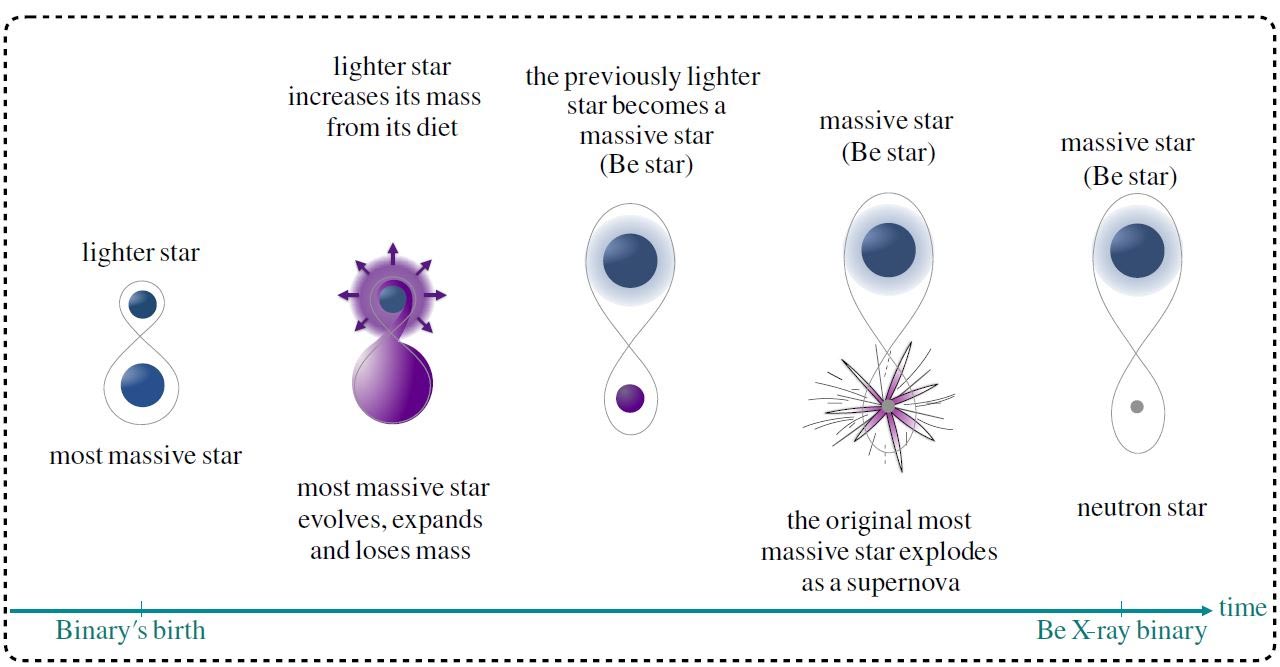
    The study, led by OzGrav Affiliate Serena Vinciguerra, used the COMPAS code to simulate an environment like the Small Magellanic Cloud. By comparing the orbital properties of the simulated Be X-ray binaries with the observed ones, researchers revealed the probable evolution of these star systems:​

    Orbital Properties X ray Binaries
    Credit: ARC Centre of Excellence for Gravitational Wave Discovery

    Initially, two stars are born in a tight binary system. The most massive star evolves quicker and expands. Because of the proximity between the two stars, the inflated massive star feeds its material to the smaller star. Over time, the massive star may feed and lose most of its mass; however, the smaller star may get too ‘full’ and not accept all the ‘food’ (material).

    Each star’s individual ‘diet’ depends not only on their constitution and age, but also on the massive star feeding them. In Be X-ray binaries, the stars’ diets are more generous than what astronomers previously assumed. Consequently, the well-fed stars become massive and spin rapidly. ​

    Later in their evolution, the original most massive star may explode as a supernova, leaving behind a small but very dense neutron star. If the stars survive the explosion, they form a Be X-ray system, with a neutron star orbiting a massive and rapidly rotating star.

    Reference: “Be X-ray binaries in the SMC as (I) indicators of mass transfer efficiency” by Serena Vinciguerra, Coenraad J. Neijssel, Alejandro Vigna-Gómez, Ilya Mandel, Philipp Podsiadlowski, Thomas J. Maccarone, Matt Nicholl, Samuel Kingdon, Alice Perry and Francesco Salemi, 29 February 2020, High Energy Astrophysical Phenomena.
    arXiv: 2003.00195

    Never miss a breakthrough: Join the SciTechDaily newsletter.
    Follow us on Google and Google News.

    Astrophysics Max Planck Institute Monash University Popular University of Birmingham
    Share. Facebook Twitter Pinterest LinkedIn Email Reddit

    Related Articles

    Cosmic Collision: Life-Essential Elements Forged in Massive Space Explosion

    Cosmic Gold Factory: Single Kilonova Produced 1,000x the Mass of the Earth in Very Heavy Elements

    Astronomers Discover BEBOP-1c: Tatooine-Like Exoplanet Orbits Twin Stars in a Multiplanetary System

    Physicists Create New Model of Ringing Black Holes

    Astronomers Discover Earth-Size Planet – Promising Target in the Search for Alien Life

    New Model Explains Two Puzzling Planetary Mysteries

    Mysterious Astronomical Signal Is Black Hole Jet Pointing Straight Toward Earth

    Astronomers Discover Two “Super-Earth” Planets About 100 Light-Years Away

    The End of the Cosmic Dawn: Settling a Two-Decade Debate

    Leave A Reply Cancel Reply

    • Facebook
    • Twitter
    • Pinterest
    • YouTube

    Don't Miss a Discovery

    Subscribe for the Latest in Science & Tech!

    Trending News

    Breakthrough Bowel Cancer Trial Leaves Patients Cancer-Free for Nearly 3 Years

    Natural Compound Shows Powerful Potential Against Rheumatoid Arthritis

    100,000-Year-Old Neanderthal Fossils in Poland Reveal Unexpected Genetic Connections

    Simple “Gut Reset” May Prevent Weight Gain After Ozempic or Wegovy

    2.8 Days to Disaster: Scientists Warn Low Earth Orbit Could Suddenly Collapse

    Common Food Compound Shows Surprising Power Against Superbugs

    5 Simple Ways To Remember More and Forget Less

    The Atomic Gap That Could Cost the Semiconductor Industry Billions

    Follow SciTechDaily
    • Facebook
    • Twitter
    • YouTube
    • Pinterest
    • Newsletter
    • RSS
    SciTech News
    • Biology News
    • Chemistry News
    • Earth News
    • Health News
    • Physics News
    • Science News
    • Space News
    • Technology News
    Recent Posts
    • After 37 Years, the World’s Longest-Running Soil Warming Experiment Uncovers a Startling Climate Secret
    • NASA Satellite Captures First-Ever High-Res View of Massive Pacific Tsunami
    • ADHD Isn’t Just a Deficit: Study Reveals Powerful Hidden Strengths
    • Scientists Uncover “Astonishing” Hidden Property of Light
    • Scientists Discover Stem Cells That Could Regrow Teeth and Bone
    Copyright © 1998 - 2026 SciTechDaily. All Rights Reserved.
    • Science News
    • About
    • Contact
    • Editorial Board
    • Privacy Policy
    • Terms of Use

    Type above and press Enter to search. Press Esc to cancel.