
Close Menu
    Facebook X (Twitter) Instagram
    SciTechDaily
    • Biology
    • Chemistry
    • Earth
    • Health
    • Physics
    • Science
    • Space
    • Technology
    Facebook X (Twitter) Pinterest YouTube RSS
    SciTechDaily
    Home»Science»Illuminating Seafloor Seismology With Existing ‘Dark’ Fiber-Optic Cables and Distributed Acoustic Sensing
    Science

    Illuminating Seafloor Seismology With Existing ‘Dark’ Fiber-Optic Cables and Distributed Acoustic Sensing

    By American Association for the Advancement of ScienceDecember 2, 2019No Comments3 Mins Read
    Facebook Twitter Pinterest Telegram LinkedIn WhatsApp Email Reddit
    Share
    Facebook Twitter LinkedIn Pinterest Telegram Email Reddit
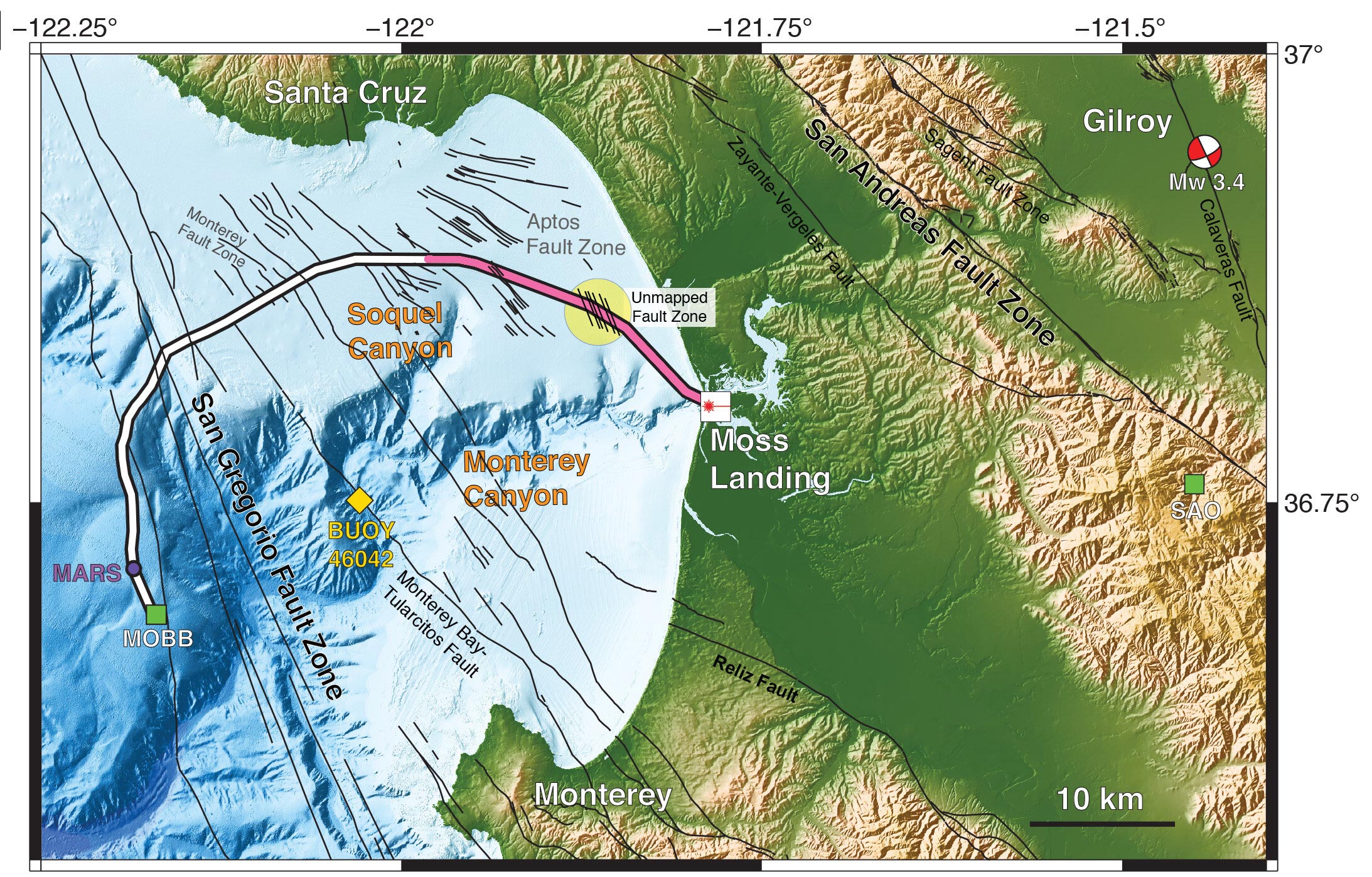
    Monterey Bay Seafloor Experiment
    Researchers employed 20 kilometers or 12 miles (pink) of a 51-kilometer (32 miles) undersea fiber-optic cable, normally used to communicate with an off-shore science node (MARS, Monterey Accelerated Research System), as a seismic array to study the fault zones under Monterey Bay. During the four-day test, the scientists detected a magnitude 3.5 earthquake 45 kilometers (28 miles) away in Gilroy, and mapped previously uncharted fault zones (yellow circle). Credit: Nate Lindsey, UC Berkeley

    A new fault system on the seafloor was discovered off California’s coast by temporarily transforming a pre-existing underwater fiber optic cable into an array of nearly 10,000 seismic sensors, according to a new study. The results showcase the potential of leveraging the extensive web of subsea optical fiber telecommunication cables already spanning the ocean’s floor to monitor and record oceanographic and seismic processes in unprecedented detail.

    Deep below the surface, tectonic forces conspire to fracture and fold the Earth’s crust. These rocks break and move at faults. Like geological scars, the surface of Earth is striated with faults; the largest and most lively — where rocks are actively snapping and shifting — are responsible for triggering destructive earthquakes and tsunamis. Mineral deposits like oil and gas are often found along these structures, too.

    However, charting Earth’s fault zones is challenging and many remain unknown, particularly those that lie on the bottom of the ocean. As a result, offshore seismic hazard potential is not fully understood, and information about offshore resources is incomplete.

    Distributed Acoustic Sensing (DAS), a type of fiber-optic sensing that uses pulses of laser light to continuously detect slight movements along optical fibers, has been used to measure seismic waves and map faults on land. Researchers have suggested it could be used to measure seafloor seismic activity as well. During a maintenance window, Nathanial Lindsey and colleagues temporarily repurposed an undersea fiber-optic cable — part of the Monterey Accelerated Research System — to collect DAS measurements across the continental shelf of California’s coast.

    According to Lindsey et al., DAS turned the decade-old cable into the equivalent of thousands of sensitive seismic sensors. Over the short duration, the authors were able to map a previously unknown fault system and observe several dynamic tidal and storm-driven processes in the water column above. Philippe Jousset discusses the study in a related Perspective.

    Read Undersea Fiber-Optic Cables Make Superb Seismic Network for more information on this study.

    Reference: “Illuminating seafloor faults and ocean dynamics with dark fiber distributed acoustic sensing” by Nathaniel J. Lindsey, T. Craig Dawe and Jonathan B. Ajo-Franklin, 29 November 2019, Science.
    DOI: 10.1126/science.aay5881

    Never miss a breakthrough: Join the SciTechDaily newsletter.
    Follow us on Google and Google News.

    American Association for the Advancement of Science DOE Lawrence Berkeley National Laboratory UC Berkeley
    Share. Facebook Twitter Pinterest LinkedIn Email Reddit

    Related Articles

    US Power Sector Is Already Halfway to Zero Carbon Emissions

    India Can Boost Clean Energy While Doubling Its Power Supply by 2030

    Underground Dark Matter Search Experiment Reaches Major Milestone

    Efficient AC Use: Building Scientist’s Tips on Keeping Cool During Heat Waves

    Defects Deliver the Best of Both Worlds: Highly Efficient Ultrahigh Energy Density Capacitor

    Dive Deep Into Hidden World of Quantum States to Find Silicon’s Successor in Race Against Moore’s Law

    When Solids and Liquids Meet: In Nanoscale Detail

    Scientists Use X-Rays and Infrared Light to Explore Egyptian Mummy Bones [Video]

    Light-Beam Performance at the Advanced Light Source Synchrotron Enhanced by Machine Learning

    Leave A Reply Cancel Reply

    • Facebook
    • Twitter
    • Pinterest
    • YouTube

    Don't Miss a Discovery

    Subscribe for the Latest in Science & Tech!

    Trending News

    Researchers Warn Widely Prescribed Blood Pressure Drugs Could Be Harming Diabetic Kidneys

    James Webb Spots Something Strange Between Day and Night on an Alien Planet

    How Ancient People Moved a 6-Ton Stone 700 Kilometers to Stonehenge

    The Unexpected Gut Health Risk of Cutting Out Sugar

    Popular Weight-Loss Drugs Like Ozempic Linked to Lower Breast Cancer Risk

    AI Learned the Rules of the Universe and That Became a Problem

    Scientists Found a Hidden Brain Signal That Predicts Social Behavior

    Even GPT-5 Failed This Human Attention Test

    Follow SciTechDaily
    • Facebook
    • Twitter
    • YouTube
    • Pinterest
    • Newsletter
    • RSS
    SciTech News
    • Biology News
    • Chemistry News
    • Earth News
    • Health News
    • Physics News
    • Science News
    • Space News
    • Technology News
    Recent Posts
    • Scientists Let People Play Video Games Using Only Their Thoughts
    • Women’s Brains May Be More Vulnerable to Dementia Risk Factors Than Scientists Realized
    • Scientists Say We’ve Been Wrong About the Aging Brain
    • More Weight Loss, Fewer Fractures? New Study Points to Semaglutide
    • These Tiny Birds Became Giants on Remote Scottish Islands
    Copyright © 1998 - 2026 SciTechDaily. All Rights Reserved.
    • Science News
    • About
    • Contact
    • Editorial Board
    • Privacy Policy
    • Terms of Use

    Type above and press Enter to search. Press Esc to cancel.