
Close Menu
    Facebook X (Twitter) Instagram
    SciTechDaily
    • Biology
    • Chemistry
    • Earth
    • Health
    • Physics
    • Science
    • Space
    • Technology
    Facebook X (Twitter) Pinterest YouTube RSS
    SciTechDaily
    Home»Space»Image Shows Galaxy Cluster “Tails”
    Space

    Image Shows Galaxy Cluster “Tails”

    By NASADecember 10, 2012No Comments2 Mins Read
    Facebook Twitter Pinterest Telegram LinkedIn WhatsApp Email Reddit
    Share
    Facebook Twitter LinkedIn Pinterest Telegram Email Reddit
    Two tails of X-ray emission have been seen trailing behind a galaxy
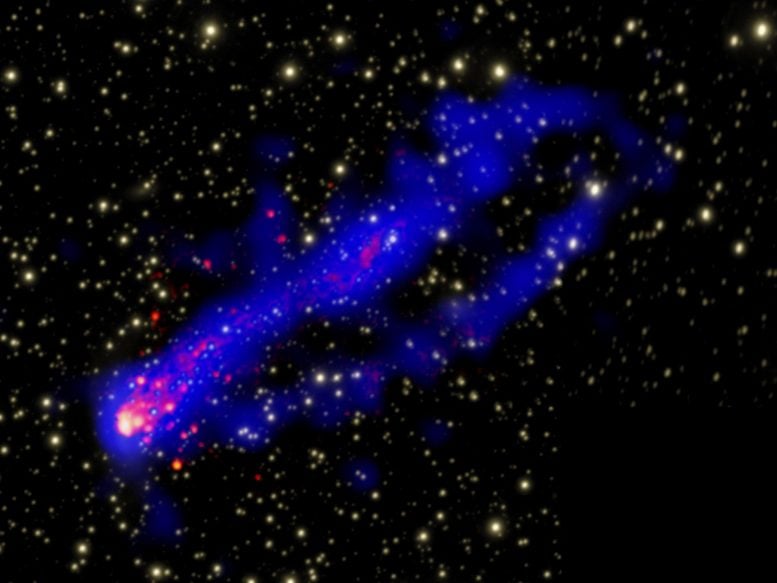
    A composite image displays two “tails” formed as cool gas from ESO 137-001 is stripped by hot gas while moving towards the center of the galaxy cluster Abell 3627. Credit: X-ray: NASA/CXC/UVa/M. Sun et al; H-alpha/Optical: SOAR/MSU/NOAO/UNC/CNPq-Brazil/M.Sun et al.

    A composite image shows two “tails” that were created when cool gas from ESO 137-001 was stripped by hot gas as it travels toward the center of the galaxy cluster Abell 3627.

    Two spectacular tails of X-ray emission have been seen trailing behind a galaxy using the Chandra X-ray Observatory. A composite image of the galaxy cluster Abell 3627 shows X-rays from Chandra in blue, optical emission in yellow and emission from hydrogen light — known to astronomers as ‘H-alpha’ — in red. The optical and H-alpha data were obtained with the Southern Astrophysical Research (SOAR) Telescope in Chile.

    At the front of the tail is the galaxy ESO 137-001. The brighter of the two tails has been seen before and extends for about 260,000 light years. The detection of the second, fainter tail, however, was a surprise to the scientists.

    The X-ray tails were created when cool gas from ESO 137-001 (with a temperature of about ten degrees above absolute zero) was stripped by hot gas (about 100 million degrees) as it travels toward the center of the galaxy cluster Abell 3627. What astronomers observe with Chandra is essentially the evaporation of the cold gas, which glows at a temperature of about 10 million degrees. Evidence of gas with temperatures between 100 and 1,000 degrees Kelvin (-173 and 727 degrees Celsius) in the tail was also found with the Spitzer Space Telescope.

    Galaxy clusters are collections of hundreds or even thousands of galaxies held together by gravity that are enveloped in hot gas. The two-pronged tail in this system may have formed because gas has been stripped from the two major spiral arms in ESO 137-001. The stripping of gas is thought to have a significant effect on galaxy evolution, removing cold gas from the galaxy, shutting down the formation of new stars in the galaxy, and changing the appearance of inner spiral arms and bulges because of the effects of star formation.

    Never miss a breakthrough: Join the SciTechDaily newsletter.
    Follow us on Google and Google News.

    Astronomy Galaxy NASA
    Share. Facebook Twitter Pinterest LinkedIn Email Reddit

    Related Articles

    Remarkable Similarities – New Analysis Reveals Links Between Galaxies Near and Far

    Astronomers Suggest More Galaxies Were Formed in the Early Universe Than Previously Thought

    The Most Extraordinary Example Yet – Tiny, Hidden Galaxy Provides a Portal Into the Distant Past

    A Spiral Within a Spiral, Galaxy ESO 498-G5

    Sombrero Galaxy Exhibits Dual Characteristics

    Hubble Captures New Image of Messier 9

    Searching for “Bubbles” in the Milky Way

    Ultra-Fast Outflows are Common Features of Black-Hole-Powered Galaxies

    Hubble Observes Rare Blue Stars in Andromeda’s Core

    Leave A Reply Cancel Reply

    • Facebook
    • Twitter
    • Pinterest
    • YouTube

    Don't Miss a Discovery

    Subscribe for the Latest in Science & Tech!

    Trending News

    Scientists May Have Found the Key to Jupiter and Saturn’s Moon Mystery

    Scientists Uncover Brain Changes That Link Pain to Depression

    Saunas May Do More Than Raise Body Temperature – They Activate Your Immune System

    Exercise in a Pill? Metformin Shows Surprising Effects in Cancer Patients

    Hidden Oceans of Magma Could Be Protecting Alien Life

    New Study Challenges Alzheimer’s Theories: It’s Not Just About Plaques

    Artificial Sweeteners May Harm Future Generations, Study Suggests

    Splashdown! NASA Artemis II Returns From Record-Breaking Moon Mission

    Follow SciTechDaily
    • Facebook
    • Twitter
    • YouTube
    • Pinterest
    • Newsletter
    • RSS
    SciTech News
    • Biology News
    • Chemistry News
    • Earth News
    • Health News
    • Physics News
    • Science News
    • Space News
    • Technology News
    Recent Posts
    • Researchers Capture Quantum Interference in One of Nature’s Rarest Atoms
    • Ancient DNA Reveals Irish Goats Have a 3,000-Year-Old Lineage Still Alive Today
    • Historians Reveal Secrets of the Strange Hat Wars That Shook Early Modern England
    • “A Plague Is Upon Us”: The Mass Death That Changed an Ancient City Forever
    • This Strange Material Can Turn Superconductivity on and off Like a Switch
    Copyright © 1998 - 2026 SciTechDaily. All Rights Reserved.
    • Science News
    • About
    • Contact
    • Editorial Board
    • Privacy Policy
    • Terms of Use

    Type above and press Enter to search. Press Esc to cancel.