

A new molecular DNA analysis technique has enabled the detection of viable microbes at depths of up to 4.20 meters. This discovery also holds significance for the search for extraterrestrial life.
Historically, the arid soils of Chile’s Atacama Desert were believed to be devoid of life. However, in one of its driest areas, a group of researchers led by Lucas Horstmann and Dirk Wagner from the GFZ German Research Centre for Geosciences, in collaboration with peers from TU Berlin and the University of Antofagasta in Chile, have now discovered a previously unknown subterranean habitat.
This was based on newly developed methods of molecular DNA analysis, which allow the focused extraction and analysis of intracellular DNA. This comes from intact cells of living or dormant organisms, making it possible to detect viable and potentially active microbial communities which inhabit hyperarid soils down to a depth of 4.20 meters. The study, published in the journal PNAS Nexus, thus expands our understanding of biodiversity of a region where extreme conditions of drought, salinity, and nutrient deficiency are close to the limits of life. The results also have implications for the search for life on other planets.
Background: The extreme desert habitat
Deserts are one of the largest and most fragile ecosystems on Earth. Although the conditions there are among the harshest and most life-threatening, they harbor microbial life. In the absence of regular rainfall, microorganisms are the most important ecological component mediating nutrient flows by utilizing soil components such as minerals and salts as well as atmospheric gases as a source of energy and water.
“The study of microbial diversity and distribution is crucial to fully understand the central role of microbial processes in maintaining the ecological balance and functionality of desert ecosystems, especially in regard of their future development in the context of climate change,” says Dirk Wagner, head of the GFZ Geomicrobiology Section and one of the leaders of the study.
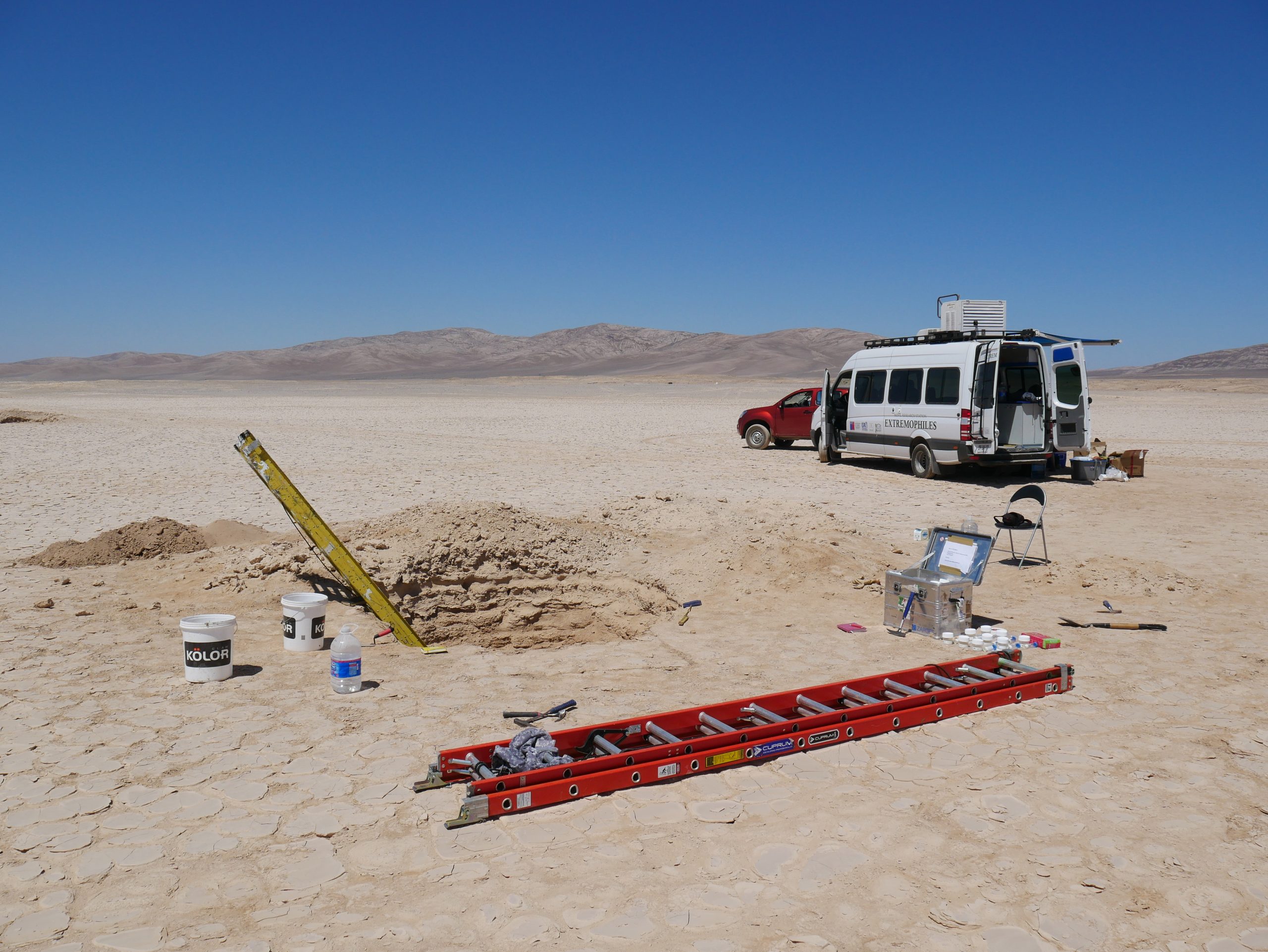
The 105,000 square kilometer Atacama Desert in northern Chile is considered the driest hot desert in the world. It is therefore an extremely relevant and suitable location for research into this habitat. Shallow areas down to a depth of around one meter have already been investigated. Here we know that it is a niche habitat that protects against UV radiation and where water is still available so that microbial life can thrive.
New approach: analyzing deep soils in the Atacama Desert with special DNA analysis
The deeper layers of desert soils, on the other hand, have only been analyzed in a few studies to date. They were, therefore, the focus of a team led by Lucas Horstmann, PhD student, and Daniel Lipus, post-doctoral researcher, both in the GFZ Geomicrobiology Section, and Dirk Wagner, head of the same section and Professor of Geomicrobiology and Geobiology at the University of Potsdam. Other colleagues came from the TU Berlin and the University of Antofagasta in Chile. The researchers wanted to test whether the deeper sediments of the hyperarid Atacama Desert could also be a habitat for specialized microbes.
The research team studied a soil profile in the Yungay area, about 60 kilometers south-east of Antofagasta, to analyze the microbial diversity and its interaction with soil properties along a depth profile that included both the sediments of the playa and the alluvial fan deposits below, reaching down to a depth of 4.2 meters. To do this, they dug a soil profile and took soil samples every 10 centimeters down to a depth of three meters, then every 30 centimeters, which were taken to the GFZ laboratories for analysis.
In order to detect traces of life in the samples, the scientists used a new technique of molecular DNA analysis, which was developed by Dirk Wagner and others at the GFZ: Using a special extraction method, it is possible to filter out only intracellular DNA from a sample, i.e. DNA that originates from intact and potentially active cells. Various chemicals, centrifuges, and filters are used for this.
“This approach represents a significant improvement for studies on microbial diversity in extreme environments, as it effectively excludes bias generated by the DNA from dead cells and still provides valid data even when the detection limit for other methods has been reached due to the low amount of biomass,” emphasizes Wagner.
Discovery of a potentially viable microbial community down to a depth of 4.2 meters
Through intracellular DNA extraction and subsequent gene sequencing of the samples, the researchers were able to identify potentially viable microbes down to a depth of 4.2 meters. In the upper 80 centimeters, they mainly found microbes of the Firmicutes phylum, but their numbers decreased with increasing depth and thus also increasing amounts of soluble salts. The researchers suspect that the high salt concentration and increasing water scarcity could also be responsible for the fact that the microbial colonization in the lower part of the playa sediments ceases. In this respect, their findings are consistent with earlier studies.
However, Horstmann and Wagner’s team once again discovered a microbial community in the alluvial fan deposits below two meters. It is more diverse than the surface community and is probably completely isolated from the surface. It consisted mainly of bacteria belonging to the phylum Actinobacteriota, a group with specialized members that are often found in dry or pristine soils.
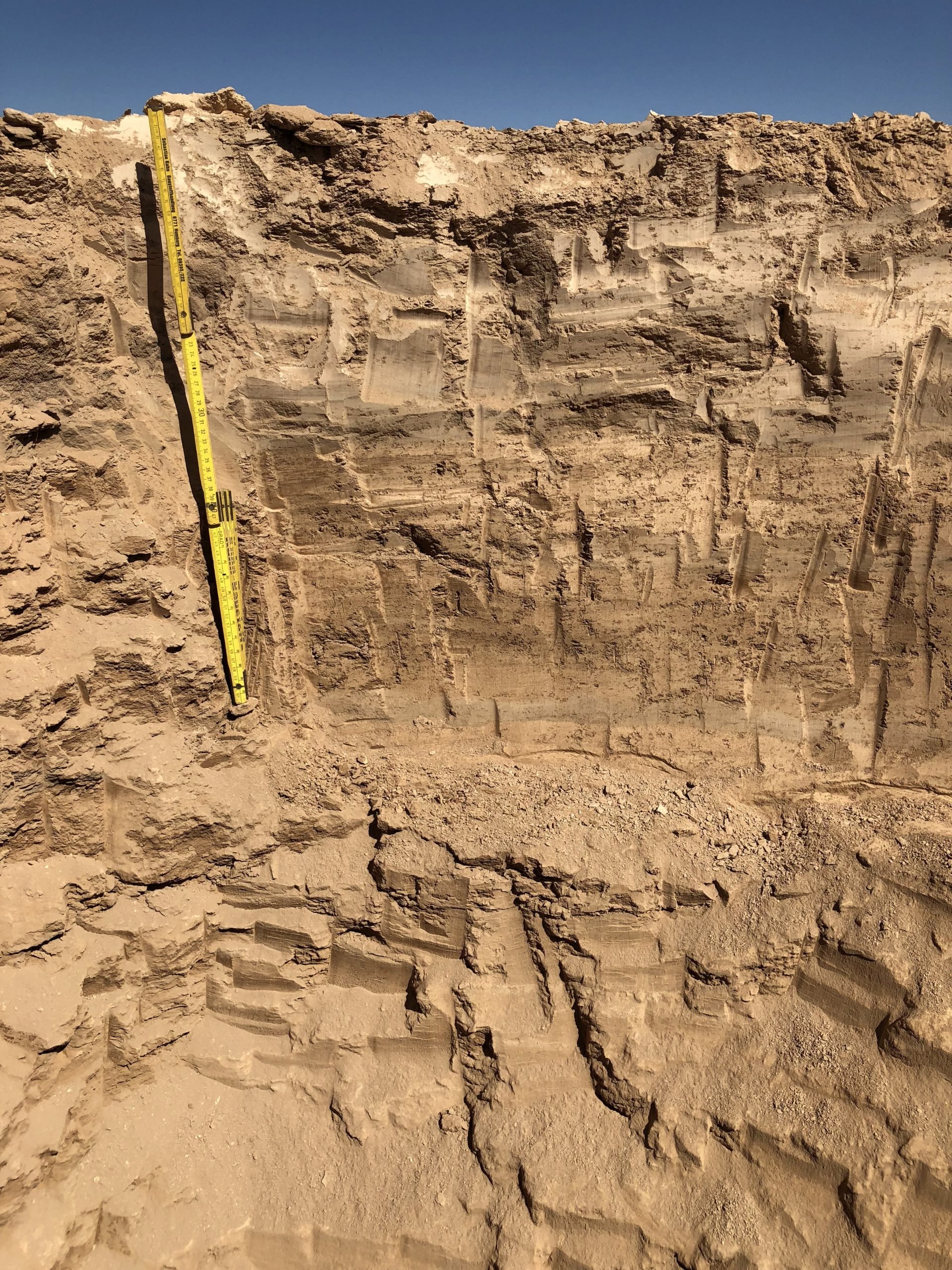
The existence of these microbes could be related to the presence of vesicular gypsum, which may provide an alternative water source by dissolving into anhydrite. The organisms observed in this study belonged to species that can use trace gases such as hydrogen as an energy source to utilize CO2 as a carbon source for their growth.
“This type of metabolism, called chemolithoautotrophy, has been suggested in other studies to be important for hyperarid soils where organic matter is extremely limited as a carbon source. It, therefore, could also be essential for the isolated subterranean niches investigated in this study,” says first author Lucas Horstmann.
Summary and outlook: Astonishing desert biodiversity and implications for extraterrestrial life
Horstmann concludes: “The discovery of this subsurface community, which thrives in alluvial fan sediments below two meters depth and shows an astonishing diversity and ecological stability, challenges our current understanding of desert ecosystems.”
The authors suggest that this community might have colonized the soil already 19,000 years ago, before its burial by playa deposits, and hypothesize that it could continue downwards for an unknown distance, representing a previously unknown deep biosphere under hyper-arid desert soils.
“Given the wide distribution of drylands on our planet, the presence of potentially carbon-binding communities in previously unexplored subsurface soils has profound implications not only for biodiversity in deserts, but also for element cycling on a global scale,” says co-author Dirk Wagner. “This indicates that the importance of these habitats has been underestimated so far. And it emphasizes the importance of subsurface habitats for a comprehensive understanding of desert ecosystems in the future.”
The researchers emphasize that the results of this study not only have implications for our planet Earth, but are also relevant to ongoing discussions about the search for life on other planets: “The presence of gypsum deposits on Mars, similar to those found in alluvial fan sediments, is of great interest to astrobiology. The association of these subsurface communities with gypseous substrates in the Atacama may provide further evidence that gypsum deposits on Mars not only indicate the possibility of liquid water in the past, but could also serve as a habitable niche for microbial life in the present.”
Reference: “Persistent microbial communities in hyperarid subsurface habitats of the Atacama Desert: Insights from intracellular DNA analysis” by Lucas Horstmann, Daniel Lipus, Alexander Bartholomäus, Felix Arens, Alessandro Airo, Lars Ganzert, Pedro Zamorano, Dirk Schulze-Makuch and Dirk Wagner, 23 April 2024, PNAS Nexus.
DOI: 10.1093/pnasnexus/pgae123
Never miss a breakthrough: Join the SciTechDaily newsletter.
Follow us on Google and Google News.