
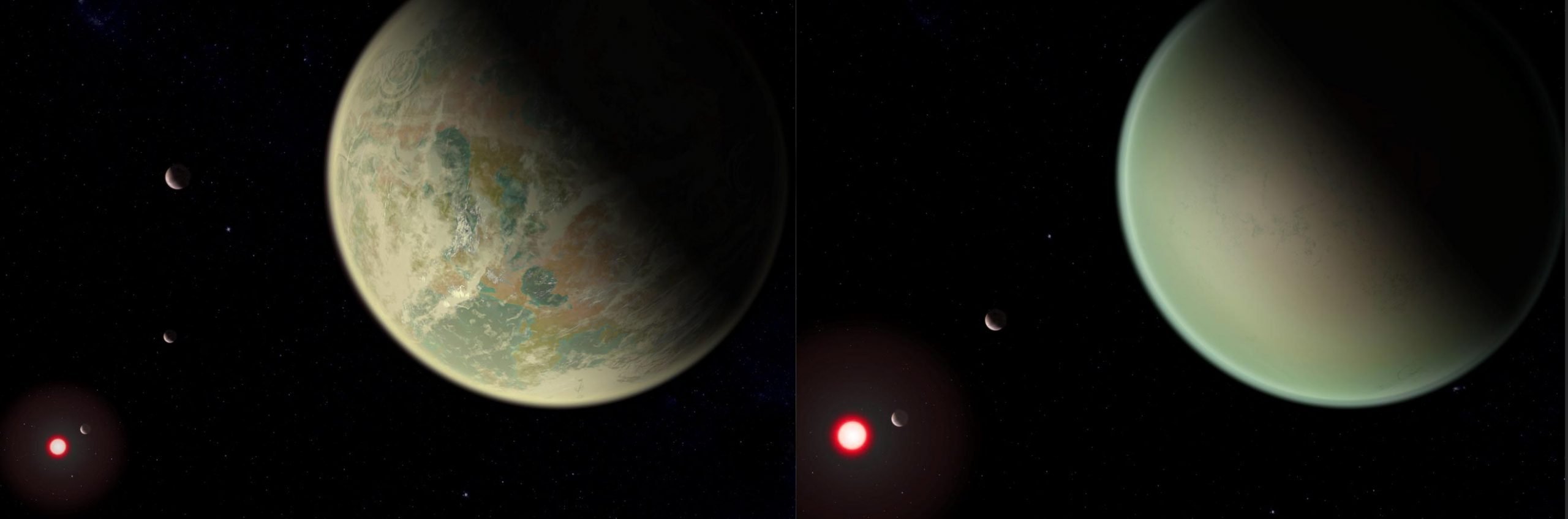
New Technique Could Speed Search for Life in Outer Space
Scientists have developed a new method for detecting oxygen in exoplanet atmospheres that may accelerate the search for life.
One possible indication of life, or biosignature, is the presence of oxygen in an exoplanet’s atmosphere. Oxygen is generated by life on Earth when organisms such as plants, algae, and cyanobacteria use photosynthesis to convert sunlight into chemical energy.
UC Riverside helped develop the new technique, which will use NASA’s James Webb Space Telescope to detect a strong signal that oxygen molecules produce when they collide. This signal could help scientists distinguish between living and nonliving planets.
Since exoplanets, which orbit stars other than our sun, are so far away, scientists cannot look for signs of life by visiting these distant worlds. Instead, they must use a cutting-edge telescope like Webb to see what’s inside the atmospheres of exoplanets.
“Before our work, oxygen at similar levels as on Earth was thought to be undetectable with Webb,” said Thomas Fauchez of NASA’s Goddard Space Flight Center and lead author of the study. “This oxygen signal is known since the early 1980s from Earth’s atmospheric studies but has never been studied for exoplanet research.”
UC Riverside astrobiologist Edward Schwieterman originally proposed a similar way of detecting high concentrations of oxygen from nonliving processes and was a member of the team that developed this technique. Their work was published today (January 6, 2020) in the journal Nature Astronomy.
“Oxygen is one of the most exciting molecules to detect because of its link with life, but we don’t know if life is the only cause of oxygen in an atmosphere,” Schwieterman said. “This technique will allow us to find oxygen in planets both living and dead.”
When oxygen molecules collide with each other, they block parts of the infrared light spectrum from being seen by a telescope. By examining patterns in that light, they can determine the composition of the planet’s atmosphere. Schwieterman helped the NASA team calculate how much light would be blocked by these oxygen collisions.
Intriguingly, some researchers propose oxygen can also make an exoplanet appear to host life when it does not, because it can accumulate in a planet’s atmosphere without any life activity at all.
If an exoplanet is too close to its host star or receives too much star light, the atmosphere becomes very warm and saturated with water vapor from evaporating oceans. This water could then be broken down by strong ultraviolet radiation into atomic hydrogen and oxygen. Hydrogen, which is a light atom, escapes to space very easily, leaving the oxygen behind.
Over time, this process may cause entire oceans to be lost while building up a thick oxygen atmosphere — more even, than could be made by life. So, abundant oxygen in an exoplanet’s atmosphere may not necessarily mean abundant life but may instead indicate a history of water loss. Schwieterman cautions that astronomers are not yet sure how widespread this process may be on exoplanets.
“It is important to know whether and how much dead planets generate atmospheric oxygen, so that we can better recognize when a planet is alive or not,” he said.
Schwieterman is a visiting postdoctoral fellow at UCR who will soon start as assistant professor of astrobiology in the Department of Earth and Planetary Sciences.
The research received funding from Goddard’s Sellers Exoplanet Environments Collaboration, which is funded in part by the NASA Planetary Science Division’s Internal Scientist Funding Model. This project has also received funding from the European Union’s Horizon 2020 research and innovation program under the Marie Sklodowska-Curie Grant, the NASA Astrobiology Institute Alternative Earths team, and the NExSS Virtual Planetary Laboratory.
Webb will be the world’s premier space science observatory when it launches in 2021. It will allow scientists to solve mysteries in our solar system, look beyond to distant worlds around other stars, and probe the mysterious structures and origins of our universe and our place in it.
Reference: “Sensitive probing of exoplanetary oxygen via mid-infrared collisional absorption” by Thomas J. Fauchez, Geronimo L. Villanueva, Edward W. Schwieterman, Martin Turbet, Giada Arney, Daria Pidhorodetska, Ravi K. Kopparapu, Avi Mandell and Shawn D. Domagal-Goldman, 6 January 2020, Nature Astronomy.
DOI: 10.1038/s41550-019-0977-7
Bill Steigerwald and Nancy Jones of NASA Goddard Space Flight Center made significant contributions to this article.
Never miss a breakthrough: Join the SciTechDaily newsletter.
Follow us on Google and Google News.