
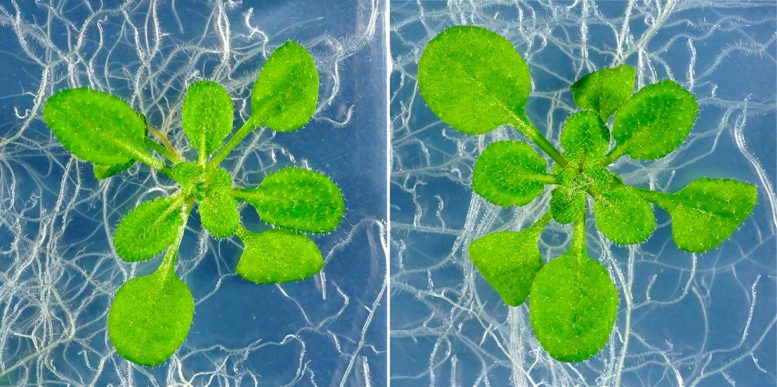
A recent study has revealed a novel pathway involving the PSY hormone that helps plants manage the trade-off between growth and stress response.
Crops often grow under unfavorable conditions. Factors such as disease, extreme temperatures, and salty soils force plants to use energy to respond to the resulting stress instead of using it to fuel growth. This is known as the “growth-stress response trade-off.”
Now, a group of scientists has discovered a previously unknown pathway that regulates whether a plant uses its resources for growth or stress tolerance. This discovery could enable the stress response to be controlled under agricultural conditions, increasing crop yields. The researchers, from Nagoya University in Japan, published the findings on October 13 in the journal Science.
Hormonal Regulation
A research team investigated the role of hormones and their receptors in the plant stress response. They focused on three receptors for which the corresponding hormone had not yet been identified. Using a small flowering plant known as thale cress (Arabidopsis thaliana), they discovered the PSY family, which functions as a hormone, binding to these receptors and mediating the switch between the stress response and growth. The study was led by Professor Yoshikatsu Matsubayashi and Assistant Professor Mari Ohnishi of the Graduate School of Science at Nagoya University in Japan.
After investigating the pathway involved, the researchers made a surprising discovery. Usually, receptors and hormones function like locks and keys, with the hormone (in this case, a peptide PSY hormone) acting as a key that is necessary to start a biological process. However, in this study, plant cells that did not produce PSY nevertheless exhibited an active stress response. Therefore, this indicates that instead of activating the stress response, the presence of the PSY ‘key’ in the receptor ‘lock’ keeps it switched off.
To test the nature of stress responses, the scientists grew plants under extremely stressful conditions. This included using heat and salt, and even infecting the plants with bacteria. Plants that were either deficient in PSY receptors or were continuously fed the hormone PSY failed to respond adequately to stress, resulting in reduced survival. The scientists concluded that stressed plants stop releasing PSY, the absence of which induces stress response genes.
PSY as a Key Mechanism for Plant Stress and Survival
To explain this phenomenon, the investigators postulated a mechanism in which damaged cells reduce the concentration of PSY hormones in the cell layers next to the damaged sites. This lack of PSY triggers the stress response. Importantly, this may explain why even damaged plants can send messages. Rather than using their limited resources to create a new signal, an impaired plant cell may instead stop the release of the PSY hormone, activating the stress response. Such a mechanism would balance stress tolerance with associated energy costs. As a consequence, plants can still grow by managing their limited resources even under the most stressful environmental conditions.
“Most of the mechanisms found in Arabidopsis are found in other plants. Therefore, our results apply to all crops,” explained Matsubayashi. “This mechanism makes it possible to artificially control the balance between stress tolerance and yield, which is a trade-off relationship. In recent years, an increasing number of crop plants have been grown in plant factories. When crops are grown indoors, it is a low-stress environment and the stress response system that is needed to withstand the fluctuating natural outdoor environment is not always necessary. Generating cultivars with reduced PSY receptor activity in plant factories may lead to higher yields in these controlled environments.”
Reference: “Peptide ligand-mediated trade-off between plant growth and stress response” by Mari Ogawa-Ohnishi, Tomohide Yamashita, Mitsuru Kakita, Takuya Nakayama, Yuri Ohkubo, Yoko Hayashi, Yasuko Yamashita, Taizo Nomura, Saki Noda, Hidefumi Shinohara and Yoshikatsu Matsubayashi, 13 October 2022, Science.
DOI: 10.1126/science.abq5735
This research was supported by Grant-in-Aid for Scientific Research (S) (project number 18H05274), which started in FY2008, and by Grant-in-Aid for Scientific Transformation (A) (project number 20H05907), which started in FY 2020.
Never miss a breakthrough: Join the SciTechDaily newsletter.
Follow us on Google and Google News.