
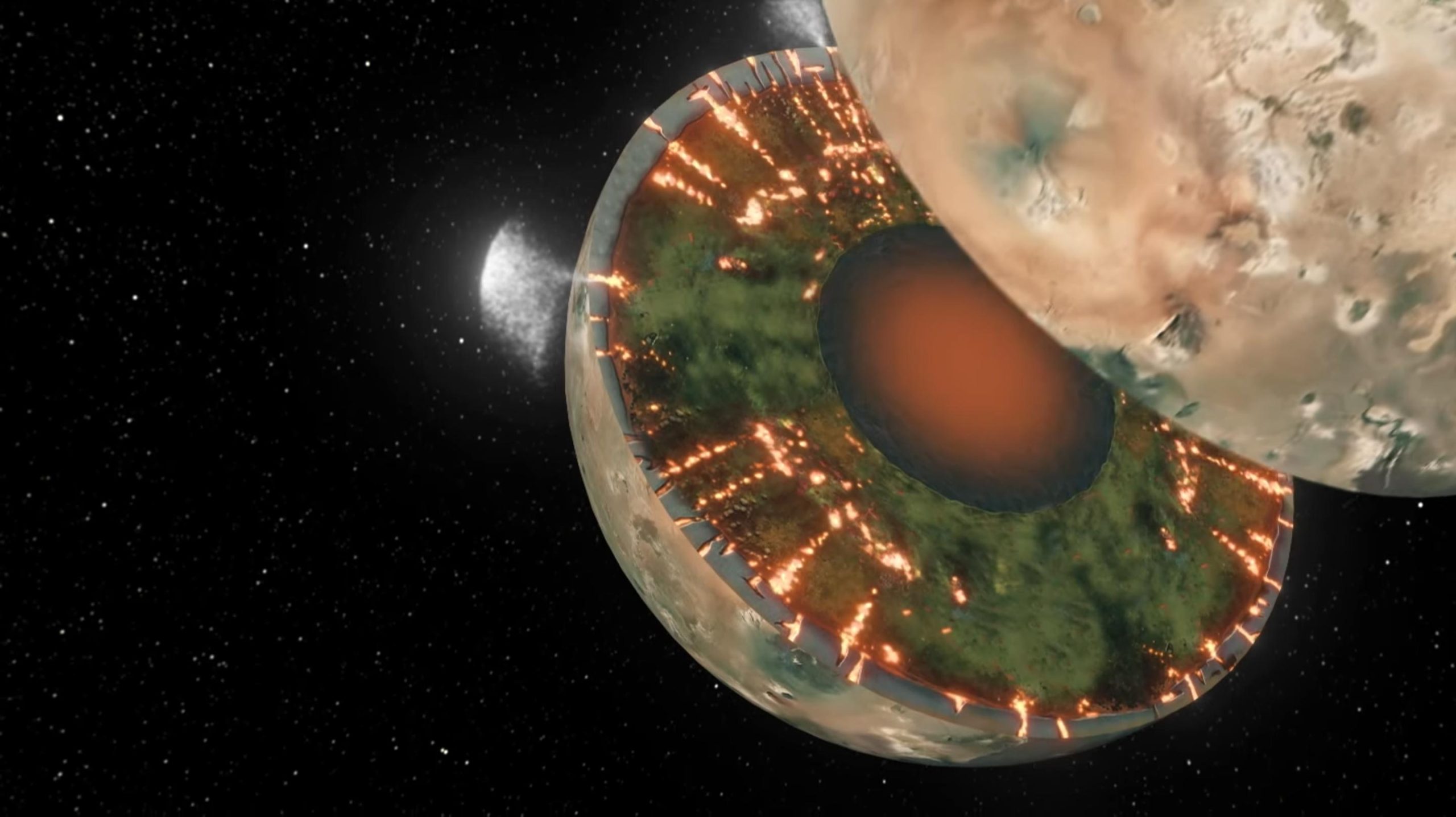
NASA’s Juno mission has revealed that each of Io’s volcanoes is likely fueled by its own magma chamber, not a global magma ocean.
This conclusion was drawn from precise gravity measurements during Juno’s close flybys, resolving a long-standing mystery about Io’s volcanic activity.
Discovery of Io’s Magma Chambers
Scientists from NASA’s Juno mission to Jupiter have discovered that the volcanoes on the planet’s moon Io are likely fueled by individual magma chambers rather than a single global magma ocean. This breakthrough resolves a 44-year-old mystery about the source of Io’s dramatic volcanic activity.
The discovery was published on December 12 in the journal Nature and highlighted during a media briefing at the American Geophysical Union’s annual meeting in Washington, the largest gathering of Earth and space scientists in the U.S.

Unveiling the Mystery of Io’s Volcanoes
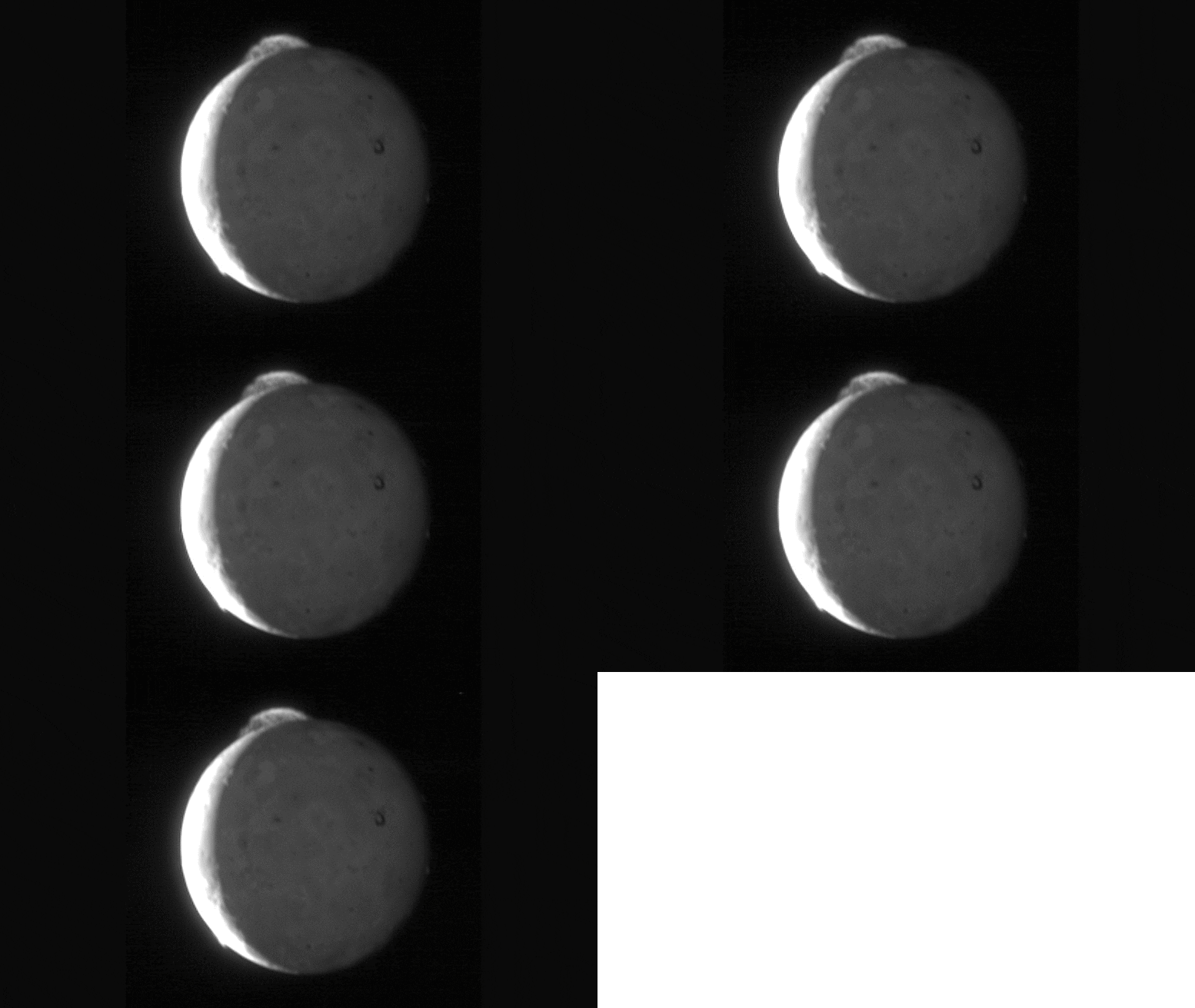
About the size of Earth’s Moon, Io is known as the most volcanically active body in our solar system. The moon is home to an estimated 400 volcanoes, which blast lava and plumes in seemingly continuous eruptions that contribute to the coating on its surface.
Although the moon was discovered by Galileo Galilei on January 8, 1610, volcanic activity there wasn’t discovered until 1979, when imaging scientist Linda Morabito of NASA’s Jet Propulsion Laboratory in Southern California first identified a volcanic plume in an image from the agency’s Voyager 1 spacecraft.
“Since Morabito’s discovery, planetary scientists have wondered how the volcanoes were fed from the lava underneath the surface,” said Scott Bolton, Juno principal investigator from the Southwest Research Institute in San Antonio. “Was there a shallow ocean of white-hot magma fueling the volcanoes, or was their source more localized? We knew data from Juno’s two very close flybys could give us some insights on how this tortured moon actually worked.”
This animated tour of Jupiter’s fiery moon Io, based on data collected by NASA’s Juno mission, shows volcanic plumes, a view of lava on the surface, and the moon’s internal structure. Credit: NASA/JPL-Caltech/SwRI/Koji Kuramura/Gerald Eichstädt
Juno’s Close Encounters with Io
The Juno spacecraft made extremely close flybys of Io in December 2023 and February 2024, getting within about 930 miles (1,500 kilometers) of its pizza-faced surface. During the close approaches, Juno communicated with NASA’s Deep Space Network, acquiring high-precision, dual-frequency Doppler data, which was used to measure Io’s gravity by tracking how it affected the spacecraft’s acceleration. What the mission learned about the moon’s gravity from those flybys led to the new paper by revealing more details about the effects of a phenomenon called tidal flexing.
Understanding Tidal Flexing
Io is extremely close to mammoth Jupiter, and its elliptical orbit whips it around the gas giant once every 42.5 hours. As the distance varies, so does Jupiter’s gravitational pull, which leads to the moon being relentlessly squeezed. The result: an extreme case of tidal flexing — friction from tidal forces that generates internal heat.
“This constant flexing creates immense energy, which literally melts portions of Io’s interior,” said Bolton. “If Io has a global magma ocean, we knew the signature of its tidal deformation would be much larger than a more rigid, mostly solid interior. Thus, depending on the results from Juno’s probing of Io’s gravity field, we would be able to tell if a global magma ocean was hiding beneath its surface.”
The Juno team compared Doppler data from their two flybys with observations from the agency’s previous missions to the Jovian system and from ground telescopes. They found tidal deformation consistent with Io not having a shallow global magma ocean.
Implications for Planetary Science
“Juno’s discovery that tidal forces do not always create global magma oceans does more than prompt us to rethink what we know about Io’s interior,” said lead author Ryan Park, a Juno co-investigator and supervisor of the Solar System Dynamics Group at JPL. “It has implications for our understanding of other moons, such as Enceladus and Europa, and even exoplanets and super-Earths. Our new findings provide an opportunity to rethink what we know about planetary formation and evolution.”
There’s more science on the horizon. The spacecraft made its 66th science flyby over Jupiter’s mysterious cloud tops on Nov. 24. Its next close approach to the gas giant will occur 12:22 a.m. EST, Dec. 27. At the time of perijove, when Juno’s orbit is closest to the planet’s center, the spacecraft will be about 2,175 miles (3,500 kilometers) above Jupiter’s cloud tops and will have logged 645.7 million miles (1.039 billion kilometers) since entering the gas giant’s orbit in 2016.
Reference: “Io’s tidal response precludes a shallow magma ocean” by R. S. Park, R. A. Jacobson, L. Gomez Casajus, F. Nimmo, A. I. Ermakov, J. T. Keane, W. B. McKinnon, D. J. Stevenson, R. Akiba, B. Idini, D. R. Buccino, A. Magnanini, M. Parisi, P. Tortora, M. Zannoni, A. Mura, D. Durante, L. Iess, J. E. P. Connerney, S. M. Levin and S. J. Bolton, 12 December 2024, Nature.
DOI: 10.1038/s41586-024-08442-5
The Juno mission, managed by NASA’s Jet Propulsion Laboratory (JPL), is dedicated to exploring Jupiter’s atmosphere, magnetic field, and moons. Led by principal investigator Scott Bolton of the Southwest Research Institute, Juno is part of NASA’s New Frontiers Program, overseen by NASA’s Marshall Space Flight Center for the Science Mission Directorate. Built and operated by Lockheed Martin Space in Denver, the spacecraft carries advanced instruments from various U.S. research institutions. The Italian Space Agency (ASI) contributed the Jovian InfraRed Auroral Mapper, enhancing Juno’s ability to study Jupiter’s powerful auroras and deep atmospheric processes.
Never miss a breakthrough: Join the SciTechDaily newsletter.
Follow us on Google and Google News.
1 Comment
Hello sir namaste god bless all family members danke fur god.bitte believen gusend.bitte cyber security settings.viel Gluck global business Schone Gruss Rajveer Singh sun of karnail singh batth village kotala bet po chhourian district Ludhiana Punjab India thanks for alls