
New forensic tools are uncovering the origins of Nazi uranium cubes, helping both historians and modern nuclear security efforts.
During World War II, Nazi Germany and the U.S. were racing to develop nuclear technology. Before Germany could succeed, Allied forces disrupted the program and confiscated some of the cubes of uranium at the heart of it. The ultimate fate of most of that uranium is unknown, but a few cubes thought to be associated with the program are in the U.S. and Europe. Today, scientists report initial results from new methods being developed to confirm their provenance. The techniques might also help with investigations into illicit trafficking of nuclear material.
The researchers will present their results at the fall meeting of the American Chemical Society (ACS). ACS Fall 2021 is a hybrid meeting being held virtually and in-person August 22-26, and on-demand content will be available August 30-September 30. The meeting features more than 7,000 presentations on a wide range of science topics.
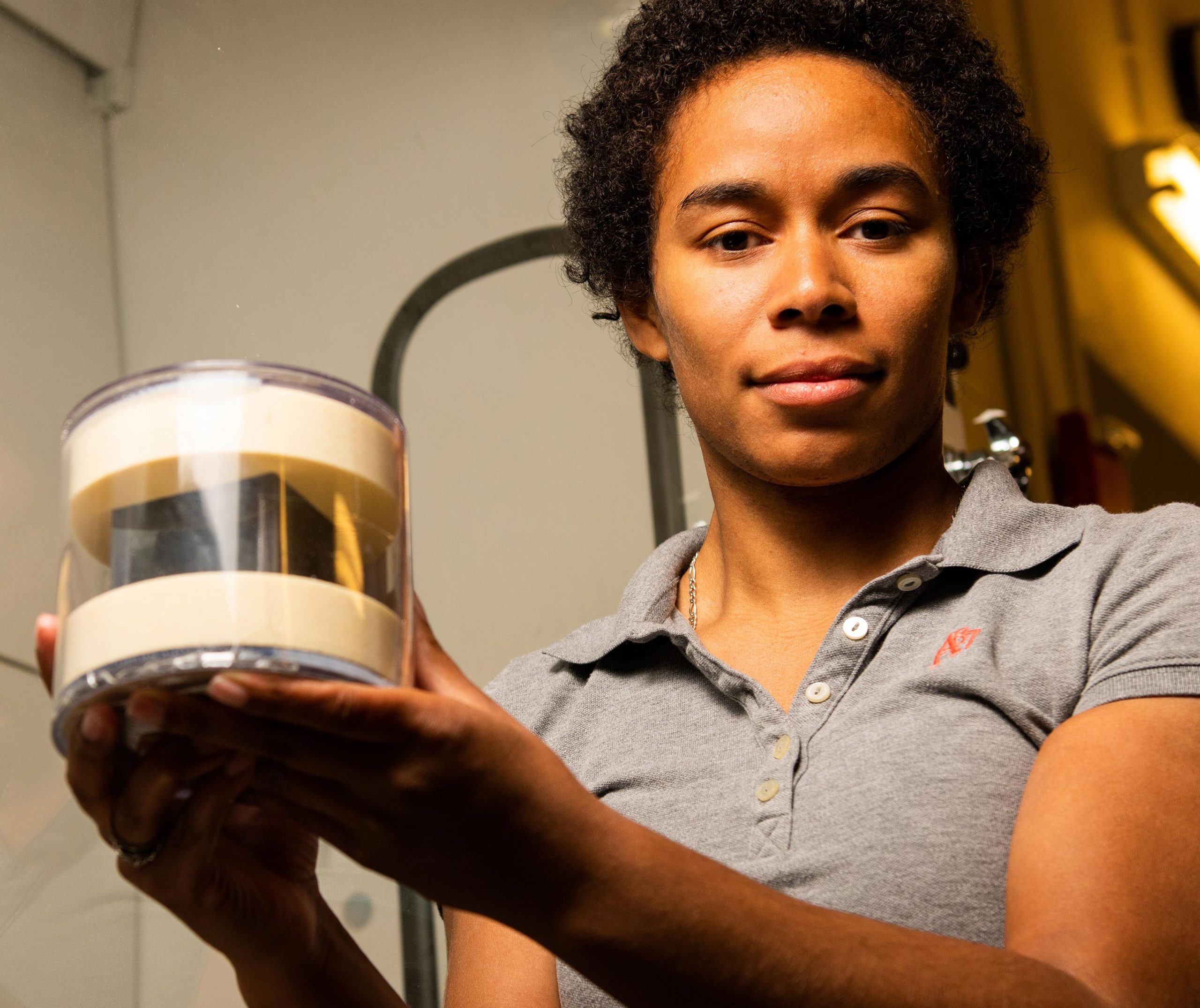
One cube is at Pacific Northwest National Laboratory (PNNL), but no one is sure how it got there, says Jon Schwantes, Ph.D., the project’s principal investigator. Through collaborators, including Timothy Koeth, Ph.D., at the University of Maryland, the lab also has access to a few other cubes. “We don’t know for a fact that the cubes are from the German program, so first we want to establish that,” Schwantes says. “Then we want to compare the different cubes to see if we can classify them according to the particular research group that created them.”
In the early 1940s, several German scientists were competing to exploit nuclear fission to produce plutonium from uranium for the war. The teams included Werner Heisenberg’s group in Berlin (later moved to Haigerloch to try to avoid Allied troops) and Kurt Diebner’s team at Gottow. Uranium cubes were produced to fuel nuclear reactors at these sites. Measuring about 2 inches (5 centimeters) on each side, hundreds of the cubes were hung on cables submerged in “heavy” water, in which deuterium replaces lighter hydrogen. The scientists hoped radioactive decay of the uranium in the assemblies would unleash a self-sustaining nuclear chain reaction — but the design failed.
U.S. and British forces seized some of the Heisenberg uranium cubes at Haigerloch in 1945, and more than 600 of these cubes were shipped to the U.S. Some may have been used in the U.S. nuclear weapons effort — which was launched in part due to fears that Germany was developing nuclear weapons — and a few belong to collectors and sites including PNNL. The whereabouts of the others, including hundreds of Diebner cubes, are unknown.
PNNL uses its sample to help train international border guards and nuclear forensics researchers to detect nuclear material. It’s labeled as a Heisenberg cube, but support for that assertion is anecdotal, says Brittany Robertson, who is presenting the work at ACS Fall 2021. “We didn’t have any actual measurements to back up that claim,” says Robertson, a doctoral student who works at the lab. To prove the cube’s origins, she began modifying some analytical techniques to combine with Schwantes’ established forensic methods. Robertson turned to radiochronometry, the nuclear field’s version of a technique that geologists use to determine the age of samples based on radioactive isotope content.
When the cubes were first cast, they contained fairly pure uranium metal. As time passed, radioactive decay transformed some of the uranium into thorium and protactinium. Robertson is adapting a radiochronometry procedure to better separate and quantify these elements in PNNL’s cube. Their relative concentrations will show how long ago the cube was made. She is also refining this method to analyze rare-earth element impurities in the object. They could reveal where the original uranium was mined, which might indicate whether it was produced for the Heisenberg or Diebner group.
Meanwhile, Robertson and Schwantes are collaborating with PNNL’s Carlos Fraga, Ph.D., to test the cubes’ coatings, which the Germans applied to limit oxidation. The PNNL team recently discovered that the cube at the University of Maryland is coated in styrene — an unexpected finding since Heisenberg’s group used a cyanide-based coating. However, the team has now learned that some of the cubes from Diebner’s group, which used a styrene-based coating, were sent to Heisenberg, who was trying to amass more fuel for his reactor. “We’re curious if this particular cube was one of the ones associated with both research programs,” Schwantes says. “Also, this is an opportunity for us to test our science before we apply it in an actual nuclear forensic investigation.”
While the scientists are intrigued about working with material from the dawn of the nuclear age, these objects are undeniably linked to a horrific time in history. “I’m glad the Nazi program wasn’t as advanced as they wanted it to be by the end of the war,” Robertson says, “because otherwise, the world would be a very different place.”
A recorded media briefing on this topic will be posted Tuesday, August 24 at 9 a.m. Eastern time at www.acs.org/acsfall2021briefings.
The researchers acknowledge support and funding from PNNL.
Title
Nuclear forensic analysis to confirm the pedigree of U metal cubes allegedly recovered from Nazi Germany’s nuclear program
Abstract
Experimental methods for determining the last chemical process age and geological origin of uranium material is of value to the nuclear nonproliferation and safeguards community. Rare Earth Element (REE) patterns are often used to trace the geological origin of materials sourced from ore bodies. Radiochronometry, a common method used for determining process age of uranium bearing material, involves measuring the in grown 230Th produced from the decay of 234U. An additional uranium decay product pair radiochronometer that is less often employed involves measuring the in grown 231Pa produced from the decay of 235U. Applying more than one radiochronometer to unknown materials is good practice, since concordant results from these chronometers provide a level of confidence that the underlying assumptions of radiochronometry have been met. However, doing so adds to the level of effort required to perform the analysis. An experimental method has been developed that can simultaneously separate Th and Pa from a dissolved uranium metal sample efficiently to provide two independent measures of the uranium material age. This same method can also separate trace level REEs that are characteristic of the geological origin of the uranium. Here we test and demonstrate this experimental method to a set of historic samples allegedly recovered from Nazi Germany’s nuclear program during World War, commonly referred to as Heisenberg Cubes. Results to date are presented comparing the two chronometers and rare earth element analysis.
Never miss a breakthrough: Join the SciTechDaily newsletter.
Follow us on Google and Google News.