
Close Menu
    Facebook X (Twitter) Instagram
    SciTechDaily
    • Biology
    • Chemistry
    • Earth
    • Health
    • Physics
    • Science
    • Space
    • Technology
    Facebook X (Twitter) Pinterest YouTube RSS
    SciTechDaily
    Home»Space»Invisible Hydrogen Halo: Revealing a Galaxy’s Hidden Polar Ring
    Space

    Invisible Hydrogen Halo: Revealing a Galaxy’s Hidden Polar Ring

    By NASANovember 25, 20233 Comments2 Mins Read
    Facebook Twitter Pinterest Telegram LinkedIn WhatsApp Email Reddit
    Share
    Facebook Twitter LinkedIn Pinterest Telegram Email Reddit
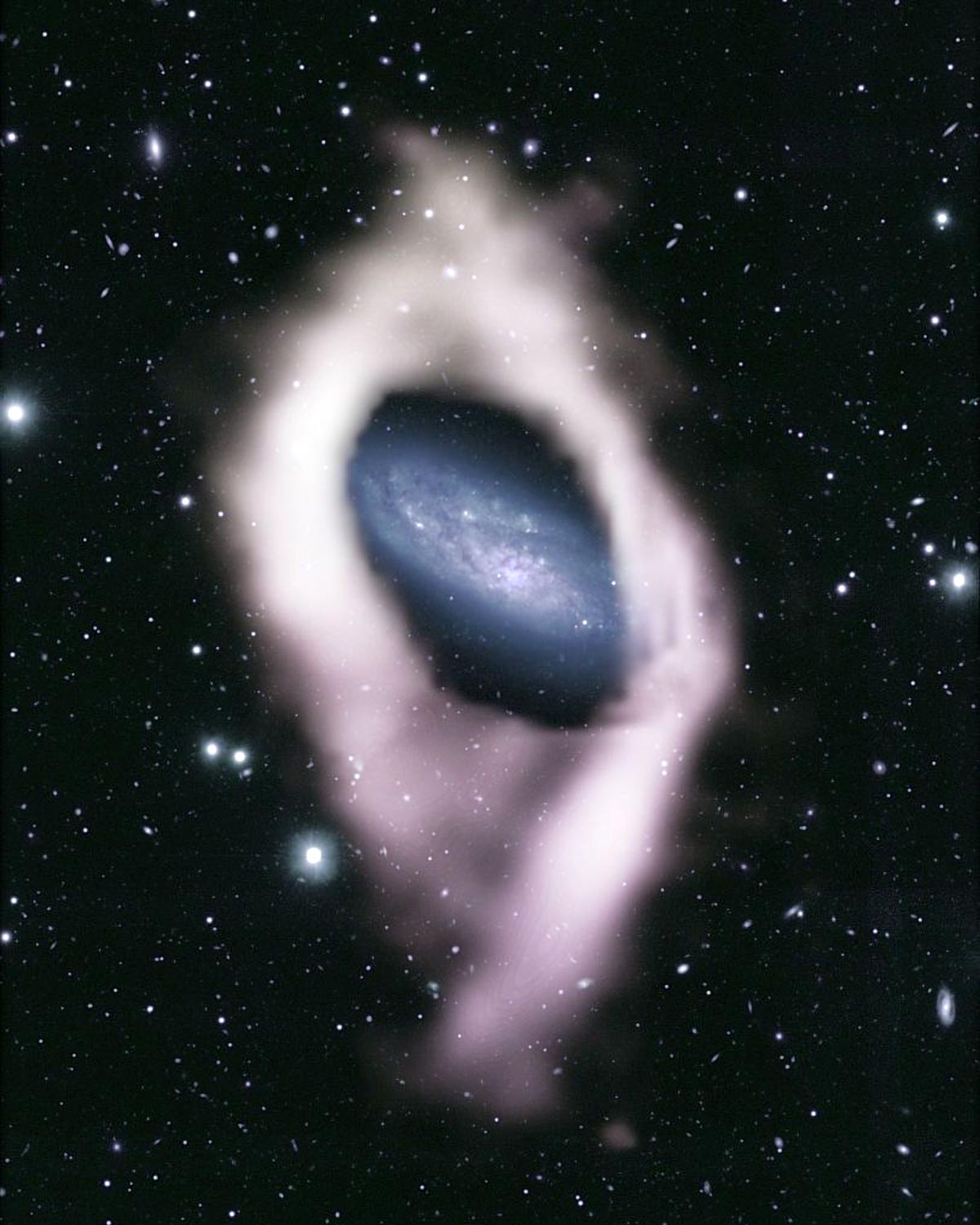
    Polar Ring Galaxy NGC 4632
    Potential polar ring galaxy NGC 4632. The picture shows a gaseous ring perpendicularly circulating the main spiral disk of the galaxy. Credit: Jayanne English (U. Manitoba), Nathan Deg (Queen’s U.) & WALLABY Survey, CSIRO / ASKAP, NAOJ / Subaru Telescope

    Galaxy NGC 4632 harbors a concealed feature invisible to optical telescopes. This galaxy is encircled by a cool hydrogen gas ring that orbits perpendicularly to its spiral disk. Polar ring galaxies, known for such unique formations, are typically identified through starlight observations. However, NGC 4632 stands out as one of the initial discoveries made using a radio telescope survey.

    ASKAP and Subaru Telescopes: A Composite View

    This exceptional find was made possible through a composite image. This image merges the gas ring, captured by the highly sensitive ASKAP radio telescope, with optical data sourced from the Subaru telescope. Astronomers utilized virtual reality technology to differentiate the gas in the galaxy’s main disk from the ring. The image’s subtle color gradient maps the ring’s orbital motion.

    Exploring the Origin of Polar Rings

    The existence of polar rings raises intriguing questions. One theory suggests they might form from material drawn out of a galaxy during gravitational interactions with a neighboring galaxy. Another possibility is the accumulation of hydrogen gas from the cosmic web’s filaments, which then forms a ring around a galaxy. Over time, some of this gas may contract gravitationally, leading to star formation.

    Never miss a breakthrough: Join the SciTechDaily newsletter.
    Follow us on Google and Google News.

    Astronomy NASA
    Share. Facebook Twitter Pinterest LinkedIn Email Reddit

    Related Articles

    Chunk of Moon Rock? NASA Tracks Asteroid 2024 PT5 During Close Earth Flyby

    Webb’s “Weird” Discovery: Meet the Galaxy Where Gas Outshines the Stars

    Don’t Miss the Comet: Witness Tsuchinshan-ATLAS Before It Disappears for 80,000 Years

    Webb Telescope’s Encounter With a Time-Bending Supernova: Rewriting Cosmic Rules

    Sun Unleashes Monumental X9.0 Solar Flare – Most Intense in 7 Years – Captured by NASA Observatory

    Skywatching Magic: October’s Spectacular Comet Lights Up the Night Sky

    Monster X7.1 Solar Flare Unleashed: Intense Blast Captured by NASA’s Solar Dynamics Observatory

    Astronomers Baffled by Black Hole Jets Igniting Star Explosions

    Webb’s Unprecedented Discovery: Potential Missing Link to First Stars in the Universe

    3 Comments

    1. R Rytter on November 26, 2023 4:45 am

      The middle of the galaxy emits something all the time. Could this you observe here be it?

      Reply
    2. Ralph Johnson on November 26, 2023 9:32 am

      What a great angel of observation is this a one time view over time until the direction changes,

      Reply
    3. Ralph Johnson on November 26, 2023 10:09 am

      would this be in consideration as part of how gravitational lensing is influenced seems to have a stage of design to image threw if at a translucent angel.

      Reply
    Leave A Reply Cancel Reply

    • Facebook
    • Twitter
    • Pinterest
    • YouTube

    Don't Miss a Discovery

    Subscribe for the Latest in Science & Tech!

    Trending News

    Popular Supplement Ingredient Linked to Shorter Lifespan in Men

    Scientists May Have Found a Way To Repair Nerve Damage in Multiple Sclerosis

    “Totally Unexpected” – Scientists Discover Pancreatic Cancer’s Fatal Addiction

    A Strange Quantum Effect May Explain One of Biology’s Greatest Mysteries

    James Webb Telescope Reveals the Universe’s Hidden Cosmic Web in Stunning Detail

    Scientists Identify Simple Supplement That Greatly Reduces Alzheimer’s Damage

    You May Have a Dangerous Type of Cholesterol Even if Your Tests Look Normal

    Your Blood Pressure Reading Could Be Wrong Because of One Simple Mistake

    Follow SciTechDaily
    • Facebook
    • Twitter
    • YouTube
    • Pinterest
    • Newsletter
    • RSS
    SciTech News
    • Biology News
    • Chemistry News
    • Earth News
    • Health News
    • Physics News
    • Science News
    • Space News
    • Technology News
    Recent Posts
    • NASA’s New AI Processor Is 500x Faster Than Current Space Computers
    • Scientists Find Evidence Earth Is Drifting Through the Ashes of an Exploded Star
    • This Strange Molecular Signature May Be the Best Clue Yet to Alien Life
    • Scientists Say a 40-Year-Old Childhood Obesity Warning May Be Completely Wrong
    • Marijuana Use May Raise Lung Cancer Risk, Researchers Warn
    Copyright © 1998 - 2026 SciTechDaily. All Rights Reserved.
    • Science News
    • About
    • Contact
    • Editorial Board
    • Privacy Policy
    • Terms of Use

    Type above and press Enter to search. Press Esc to cancel.