

Deep inside a dust-choked galaxy, astronomers have uncovered a chemical environment far more complex than expected.
The James Webb Space Telescope detected abundant small organic molecules in a heavily obscured galaxy nucleus, far exceeding theoretical expectations. Evidence points to cosmic rays fragmenting carbon-rich materials and driving intense chemical activity. Such nuclei may act as cosmic factories of organic compounds.
The discovery comes from a study led by the Center for Astrobiology (CAB), CSIC-INTA, using modeling tools developed at the University of Oxford. By analyzing observations from the James Webb Space Telescope (JWST), the team identified an exceptional concentration of small organic molecules within the deeply buried nucleus of a nearby galaxy. Published in Nature Astronomy, the research sheds light on how carbon and complex organic molecules are transformed under some of the harshest conditions known in space.
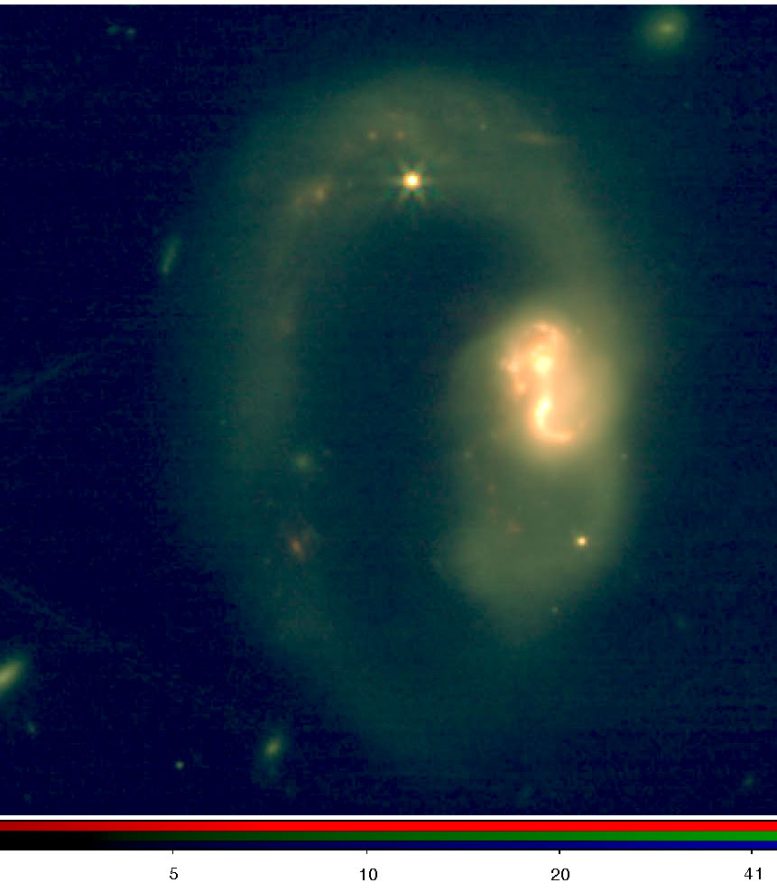
Researchers focused on IRAS 07251–0248, an ultraluminous infrared galaxy whose central region is concealed by thick clouds of gas and dust. This dense material blocks most of the radiation emitted by the supermassive black hole at its center, making it nearly impossible to examine with traditional telescopes. Infrared light, however, can pass through the dust, allowing scientists to probe the hidden core and identify the dominant chemical activity within this heavily obscured environment.
State-of-the-art instruments
To carry out the study, the team analyzed spectroscopic data from JWST spanning wavelengths between 3 and 28 microns, combining measurements from the NIRSpec and MIRI instruments. These observations make it possible to detect the fingerprints of molecules in the gas phase, along with signatures from icy coatings and dust grains. Using this information, scientists determined both the quantities and temperatures of numerous chemical compounds inside the galaxy’s concealed nucleus.
The data revealed a remarkably diverse array of small organic molecules. Among them were benzene (C₆H₆), methane (CH₄), acetylene (C₂H₂), diacetylene (C₄H₂), and triacetylene (C₆H₂). The team also identified the methyl radical (CH₃), marking its first detection outside the Milky Way. In addition to gaseous molecules, the observations showed substantial amounts of solid materials, including carbon-rich grains and water ices.
“We found an unexpected chemical complexity, with abundances far higher than predicted by current theoretical models,” explains lead author Dr. Ismael García Bernete, formerly of Oxford University and now a researcher at CAB. “This indicates that there must be a continuous source of carbon in these galactic nuclei fueling this rich chemical network.”
Although these small organic molecules are not themselves alive, they are considered essential ingredients in more advanced chemistry. Co-author Professor Dimitra Rigopoulou (Department of Physics, University of Oxford) notes, “Although small organic molecules are not found in living cells, they could play a vital role in prebiotic chemistry, representing an important step towards the formation of amino acids and nucleotides.”
Factories of organic molecules in the Universe
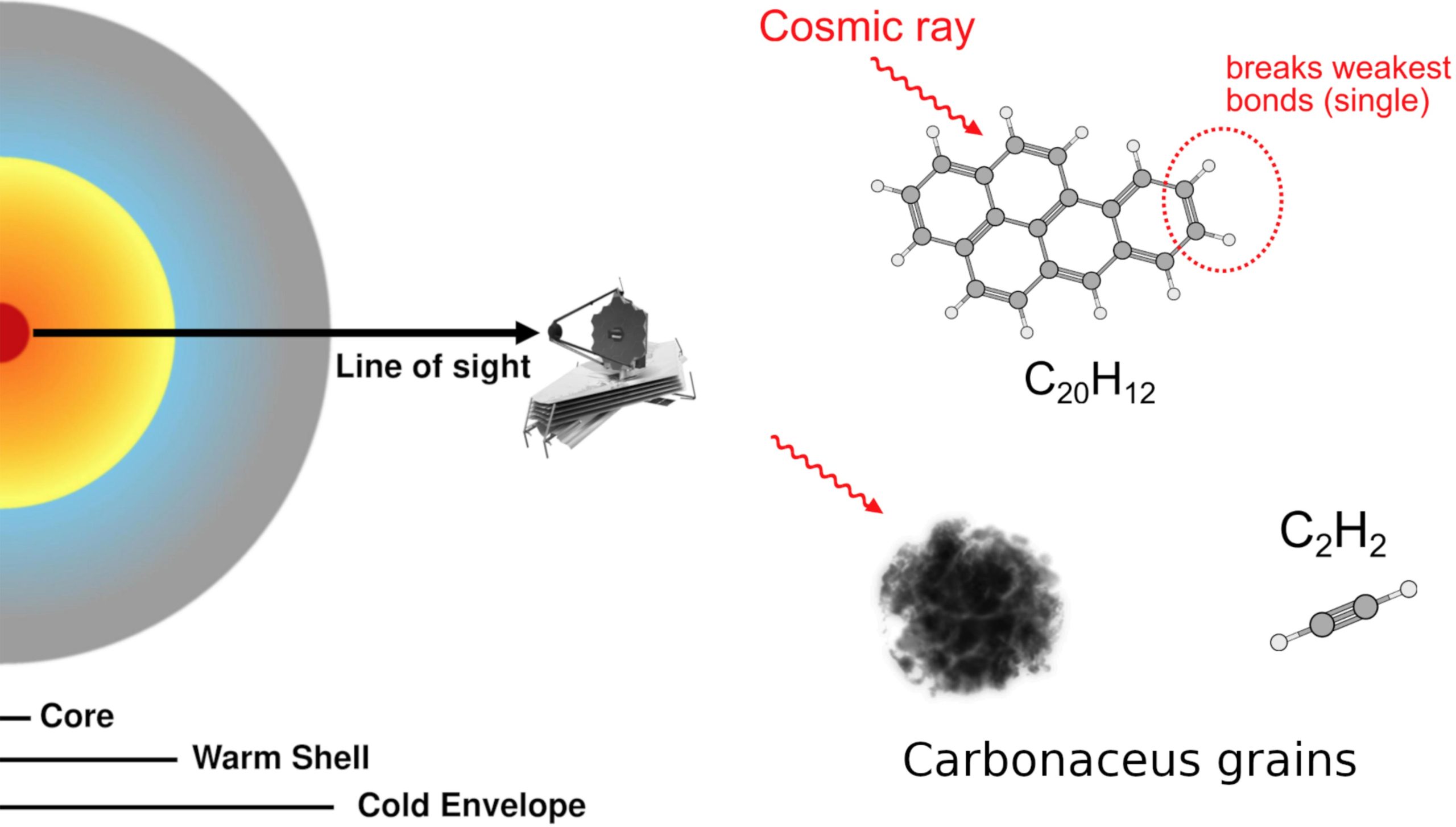
Using analytical methods and theoretical polycyclic aromatic hydrocarbons (PAHs) models developed by the Oxford team, the researchers concluded that high temperatures or turbulent gas alone cannot account for the observed chemical richness. Instead, the evidence indicates that cosmic rays, which are abundant in these extreme galactic cores, are colliding with PAHs and carbon-rich dust grains. These impacts fragment larger structures and release smaller organic molecules into the surrounding gas.
The study also identified a strong link between the abundance of hydrocarbons and the level of cosmic-ray ionization in comparable galaxies, reinforcing this explanation. Together, the results suggest that deeply obscured galactic nuclei function as powerful production hubs for organic molecules and play a significant role in shaping the chemical evolution of galaxies.
By revealing this hidden chemistry, the research opens new opportunities to investigate how organic molecules form and change in extreme space environments. It also highlights the remarkable capability of JWST to peer into regions of the universe that were previously beyond reach.
Reference: “Abundant hydrocarbons in a buried galactic nucleus with signs of carbonaceous grain and polycyclic aromatic hydrocarbon processing” by Ismael García-Bernete, Miguel Pereira-Santaella, Eduardo González-Alfonso, Marcelino Agúndez, Dimitra Rigopoulou, Fergus R. Donnan, Giovanna Speranza and Niranjan Thatte, 6 February 2026, Nature Astronomy.
DOI: 10.1038/s41550-025-02750-0
Project funded through the Programa Atracción de Talento Investigador “César Nombela” (grant 2023-T1/TEC-29030) by the Comunidad de Madrid and INTA.
Never miss a breakthrough: Join the SciTechDaily newsletter.
Follow us on Google and Google News.
4 Comments
Fascinating!
thanks
James Webb Space Telescope Detects Complex Organic Chemistry Beyond the Milky Way
This is one of those “quietly revolutionary” discoveries.
Inside a dust-smothered galaxy called IRAS 07251-0248, JWST found a chemical factory on steroids. Not just simple gases — but benzene, methane, acetylene, diacetylene, triacetylene, and even the methyl radical (CH₃) — detected outside the Milky Way for the first time.
That last one matters. CH₃ is reactive and short-lived. If you see it, something energetic is constantly producing it.
What’s actually happening in there?
The galaxy’s core is buried under thick dust, hiding a supermassive black hole. Visible light can’t penetrate it. Infrared can — and that’s JWST’s specialty.
Researchers used:
NIRSpec (near-infrared spectroscopy)
MIRI (mid-infrared spectroscopy)
They found far more small organic molecules than any model predicted.
The culprit?
Not just heat. Not just turbulence.
Cosmic rays.
High-energy particles are smashing into carbon-rich dust grains and polycyclic aromatic hydrocarbons (PAHs). Think of them as large carbon “plates.” Cosmic rays fragment them into smaller molecules — like breaking apart a molecular Lego structure.
Result:
A constant replenishment of hydrocarbons.
It’s not passive chemistry. It’s active, violent, and ongoing.
Why This Is Big
Organic chemistry is not rare.
It thrives even in extreme, black-hole-adjacent environments.
Deeply buried galactic nuclei may be organic molecule factories.
Not fringe cases — potentially common cosmic production hubs.
Prebiotic implications.
These aren’t amino acids yet. But they’re the building blocks before amino acids. That’s one step earlier in the ladder toward life chemistry.
And this is outside our galaxy.
The Real Takeaway
We used to think extreme galactic cores would destroy complex molecules.
Instead?
They manufacture them.
The universe isn’t chemically fragile. It’s chemically aggressive.
And JWST is now showing us that some of the most hidden, violent places in the cosmos are also the most chemically creative.
Universe is very large, complex and complicated in all sence. We know little about chemistry and chain reactions.
Conversions known to a little scale.
We hope we will get some clue about bio-chemistry and life molecules and that is the progress of science.👏