
Scientists identify T-cadherin as a factor that feeds back a lack of insulin to pancreatic β cells and induces their proliferation, with the potential for treating diabetes.
Wake up pancreas, it’s time for work! Researchers led by Osaka University in Japan have now identified a mechanism by which a lack of insulin may be reported back to the pancreatic cells that produce insulin. This discovery presents a potential new therapeutic target for diabetes.
Type 2 diabetes is estimated to affect over 400 million people worldwide, including 35 million Americans. Despite this prevalence, insulin regulation in the body is still not fully understood.
When the pancreas is unable to supply sufficient insulin, type 2 diabetes occurs. Insulin is the hormone that controls sugar use and storage, to meet physiological demands. If the body’s demand for insulin is not being met, the cells in the pancreas that make insulin, known as β cells, can usually proliferate to increase their numbers. However, it is unknown what factors are released from the insulin-receiving tissues or cells to signal the lack of insulin to the pancreatic β cells.
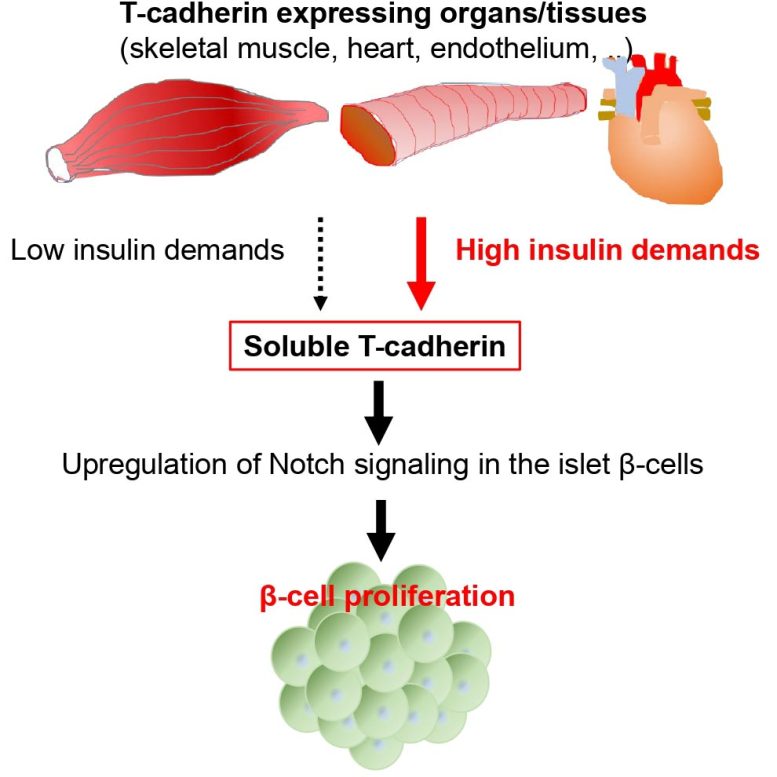
T-cadherin as a Humoral Factor in Diabetes
In a study published in the journal Science on November 7, scientists discovered that a molecule called T-cadherin may be involved in providing feedback to the insulin-producing pancreatic cells and controlling their proliferation. T-cadherin is usually present on the cell surface and is best known as the binding partner for a molecule called adiponectin—a factor secreted specifically by cells that store fat.
However, the researchers showed that T-cadherin is also secreted in previously undescribed soluble forms and can act as a humoral factor, i.e., a molecule transported through the circulatory system. They not only recognized that T-cadherin responds to insulin deficiency but also demonstrated that mice that were genetically engineered to lack T-cadherin had an impaired glucose tolerance when fed with a high-fat diet.
“RNA sequencing analysis, used for investigating genome-wide gene expression levels, revealed decreased expression of Notch signaling proteins in the β cells of mice lacking T-cadherin,” explain lead author Tomonori Okita and corresponding author Shunbun Kita. These proteins play a role in the Notch signaling pathway that is thought to promote β-cell proliferation; this suggests that soluble T-cadherin signals the pancreatic β-cells to increase insulin production via the Notch pathway.
“We then used artificially synthesized T-cadherin to treat isolated mouse pancreatic islets, which are parts of the pancreas that contain β cells” explains senior author Iichiro Shimomura. “This treatment promoted Notch signaling in the mouse islets, which could in turn induce β-cell proliferation.” Excitingly, these findings indicate that T-cadherin could be applied in the fundamental treatment of diabetes.
Reference: “Soluble T-cadherin promotes pancreatic β-cell proliferation by upregulating Notch signaling” by Tomonori Okita, Shunbun Kita, Shiro Fukuda, Keita Fukuoka, Emi Kawada-Horitani, Masahito Iioka, Yuto Nakamura, Yuya Fujishima, Hitoshi Nishizawa, Dan Kawamori, Taka-aki Matsuoka, Maeda Norikazu and Iichiro Shimomura, 7 November 2022, iScience.
DOI: 10.1016/j.isci.2022.105404
Never miss a breakthrough: Join the SciTechDaily newsletter.
Follow us on Google and Google News.
5 Comments
The biggest mechanism that causes type 2 diabetes is the human hand to mouth movement, specifically the hand filled with fatty, sugary, and carb laden highly processed foods.
As a Recovering Food Addict 12+ years by the Grace of God and help of my daily eating recovery group, compulsive eating and compulsive food behaviors are deadly. I’ve learned that when I see an overweight person I now thi k about the layers of very Deep and sharp pain that person is carrying. Compulsive Overeaters are not like ordinary eaters. We have lost the Power of choice to be able to put down the food or the fork. Compassion not judgement or criticism is what people with eating disorders need. Thx. Oa.org is helpful.
Lmao Tennis Guy below or above me be like:
“Well lung cancer is caused by smoking, so trying to cure it is just enabling smokers.”
Get pickled in a jar, dork.
Bro. You literally thought the name Tennis Guy was cool. Hahahahaha
I wish articles like this also mentioned how the research applies to those with Type 1 Diabetes. Kids who are affected their entire lives by T1D, it would be nice to hear of potential breakthroughs that could help them produce insulin again without injections.