
The history of Labor Day is closely tied to New Jersey, where key figures like Peter J. McGuire and Matthew Maguire played a pivotal role in establishing the holiday. The legendary figure John Henry, famed for his contest against a steam drill, is also linked to New Jersey.
His story, rooted in the harsh realities of 19th-century railroad construction, symbolizes the strength and determination of American workers. Despite the debate over the true location of his famous feat, John Henry’s legacy endures, celebrated in songs and memorials across the United States, representing the enduring spirit of labor.
New Jersey looms large in the history of Labor Day. Two labor organizers with roots in the state—Peter J. McGuire and Matthew Maguire—are often credited with being the first to propose the concept of a Labor Day holiday in the United States.
John Henry: A Legendary Steel-Driver
John Henry, legendary for his work on the railroads, was a nineteen-year-old who came from New Jersey as well, at least according to some historians. Many details of the folk hero’s life remain subject to historical dispute, but the ‘steel-driving’ freedman is widely lionized in ballads as a man who did battle with a steam-powered rock drill and won.
Steel drivers were laborers tasked with hammering dynamite holes into rock during the construction of railroad lines in the 1800s. As the legend goes, Henry—a freedman working on a tunnel on the Chesapeake and Ohio (C&O) Railway in West Virginia—was so strong and skilled that he set out to prove to the railroad companies that he could drill faster than a steam-powered drill, a new tool that threatened the jobs of steel-drivers at the time.
“Using two 10-pound hammers, one in each hand, he pounded the drill so fast and so hard that he drilled a 14-foot hole into the rock,” according to an account of the contest published by the National Park Service. “The legend says that the drill was only able to drill nine feet. John Henry beat the steam drill and later died of exhaustion.”
The Legacy of John Henry
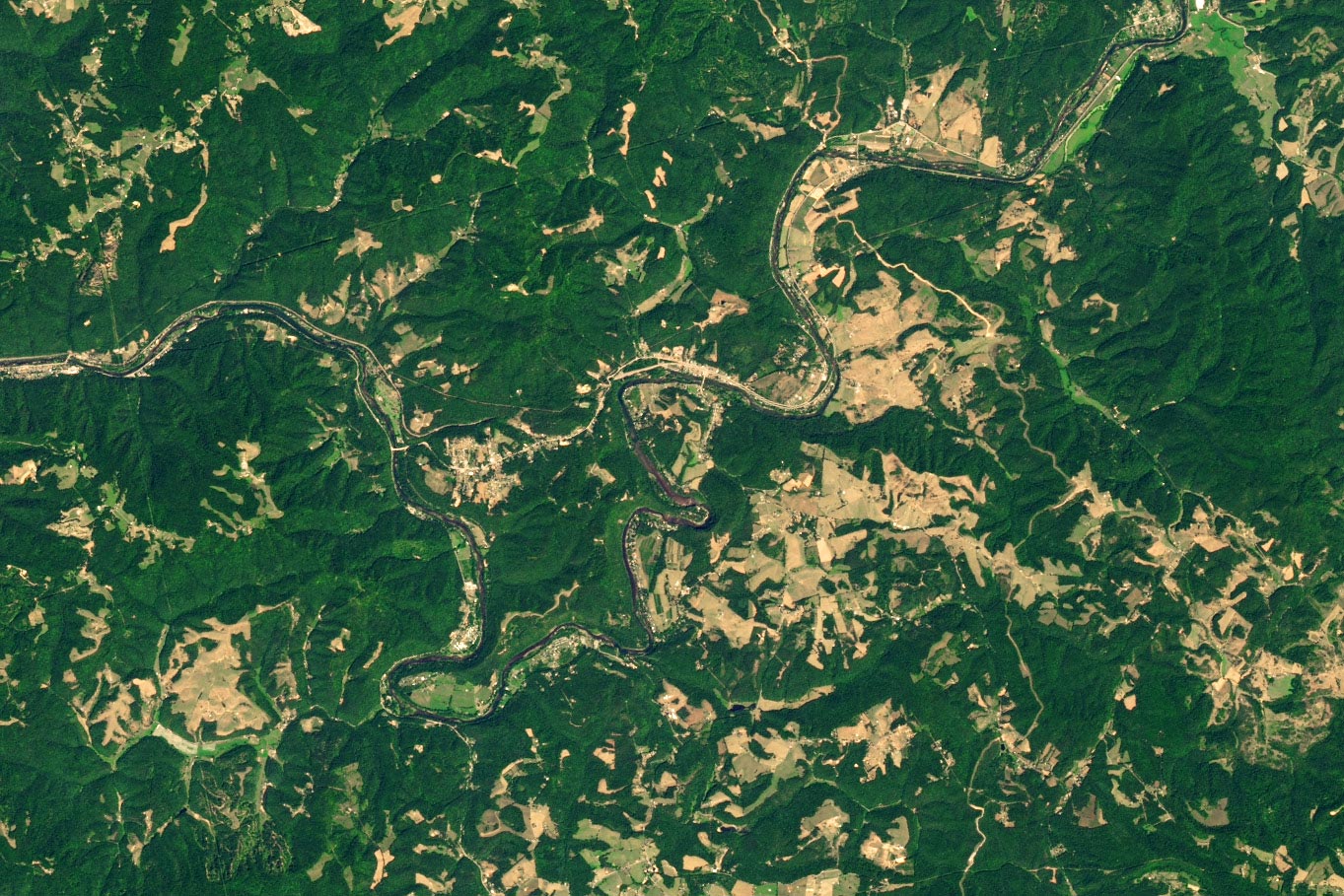
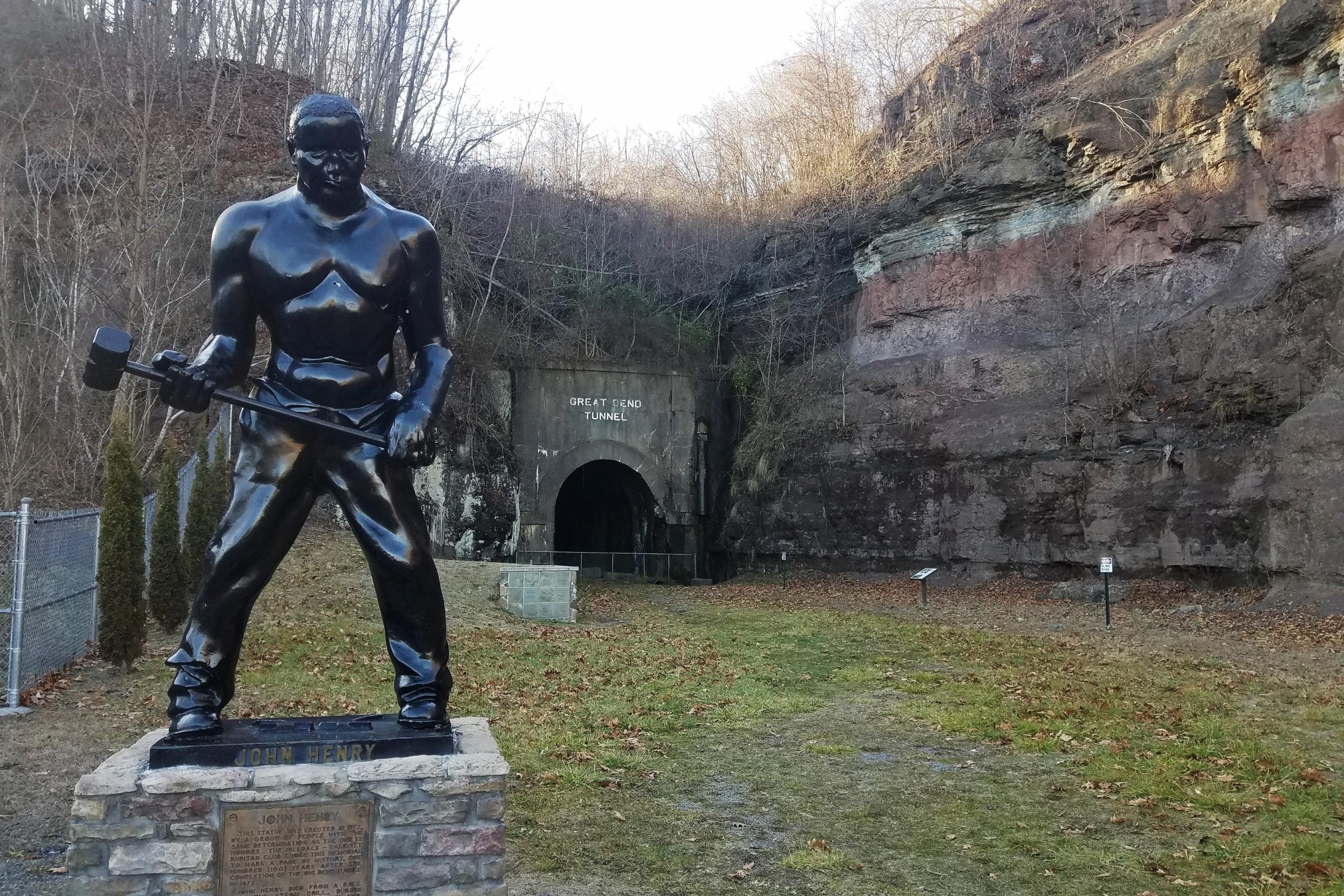
There isn’t consensus on where the reputed contest took place, but one of the leading candidates is Big Bend Tunnel (also called Great Bend Tunnel) in West Virginia. The 6,450-foot (1,966-meter) tunnel cuts off an eight-mile bend in the Greenbrier River, which winds around Big Bend Mountain before joining the New River to the west. The tunnel, built by over 800 men, many of them freed slaves and Irish immigrants, was the longest on the C&O line when it was completed in 1872.
Modern-Day Recognition and Debate
On August 23, 2024, the OLI (Operational Land Imager) on Landsat 8 captured this image of the area where the tunnel bores through red shale in Big Bend Mountain. Cleared forest along the track is visible on either side of the tunnel’s east and west boreholes. The town of Talcott, home to the John Henry Historical Park and an eight-foot-tall bronze statue of John Henry, is visible to the east of the tunnel.
Despite the historical park and research that points to Big Bend Tunnel as the location of Henry’s feat, some scholars believe that Lewis Tunnel, 45 miles to the east in Virginia, is a more likely setting for the duel. Others think that it may have happened in the Coosa and Oak Tunnels in Alabama.
The Legend Lives On in Song and Symbolism
Whatever the location, the legacy of John Henry lives on in songs performed by Arthur Bell, Harry Belafonte, Bruce Springsteen, Gabriel Brown, Johnny Cash, Van Morrison, and many other musicians.
Few who have studied the legend believe Henry actually died of exhaustion during the contest. Others have suggested he died in a rock slide, from fever, or from the lung disease silicosis. Either way, his story has become a potent symbol of the sweat and sacrifice that American workers have given to build the United States into what it is today.
NASA Earth Observatory image by Wanmei Liang, using Landsat data from the U.S. Geological Survey.
Never miss a breakthrough: Join the SciTechDaily newsletter.
Follow us on Google and Google News.
1 Comment
Mythohistorical John Henry? Technology freeing labor for Labor Day? NASA?! What is this garbage?