

Johns Hopkins scientists identified how the G90D mutation in the rhodopsin gene causes night blindness, offering potential therapeutic targets.
In what they believe is a solution to a 30-year biological mystery, neuroscientists at Johns Hopkins Medicine say they have used genetically engineered mice to address how one mutation in the gene for the light-sensing protein rhodopsin results in congenital stationary night blindness.
The condition, present from birth, causes poor vision in low-light settings.
The findings, published May 14 in Proceedings of the National Academy of Sciences, demonstrate that the rhodopsin gene mutation, called G90D, produces an unusual background electrical “noise” that desensitizes the eye’s rods, those cells in the retina at the back of the eye responsible for nighttime vision, thus causing night blindness.
The identification of the unusual electrical activity could “provide future targets for therapeutic interventions,” the study’s authors write.
These electrical events could help scientists better understand how the eye’s rods and cones function, says King-Wai Yau, Ph.D., professor in the department of neuroscience at the Johns Hopkins University School of Medicine.
Research Methodology and Observations
The research was led by Yau and postdoctoral fellow Zuying Chai.
“The G90D mutation in rhodopsin is known to produce background electrical noise to desensitize rods, but the nature of the ‘noise’ and its precise molecular source have not been resolved for almost 30 years,” Yau says. “We were able to help solve the mechanism of this disease with a mouse model with a very low expression level of G90D rhodopsin.”
When comparing the low expression level of G90D found in genetically engineered mice versus the level of G90D found in human patients with this night blindness, the authors concluded that the unusual electrical activity with a low amplitude but extremely high frequency may be the greatest contributor to the disease in people.
Besides the unusual electrical noise, rhodopsin is known to produce another type of electrical activity called spontaneous thermal isomerization, in which the thermal energy inside the rhodopsin molecule triggers rhodopsin to activate at random. Contrasting the observed unusual electrical activity, the spontaneous isomerization of G90D rhodopsin demonstrated a high amplitude but low frequency. In their experiments, the researchers found that the spontaneous-isomerization rate of G90D rhodopsin is about two hundred-fold higher than normal rhodopsin, but their rod-adapting effect is not high enough to contribute significantly to night blindness in humans.
In most circumstances, rods are very sensitive to light, but in people with night blindness, the rods cannot accurately detect changes in light, and fail to function in the dark. People with this condition require brighter light to see in low-light settings, Yau said.
For decades, although researchers knew about the G90D mutation, they had difficulty determining how it caused night blindness because prior mouse models with this mutation would generate a high level of background noise, producing effects similar to background light, which the mouse’s rods quickly adapt to. That made it difficult for researchers to accurately measure the mutation’s signaling effects.
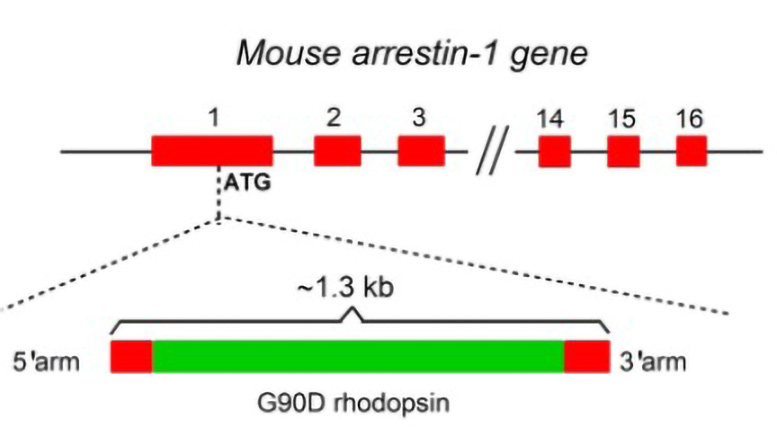
To circumvent this issue, the researchers at Johns Hopkins Medicine genetically modified mice to have a low expression of G90D, a level equal to .1% of normal rhodopsin found in the natural population of mice.
This enabled the researchers to distinguish between different types of activity produced in mice with the G90D mutation as if little or no equivalent background light were present.
The scientists used a high-resolution method to record the electrical activity in individual rods in the mouse retina, which they accessed with an ultra-tiny glass pipette — the width of about one-seventieth the size of a human hair — filled with a saline solution capable of conducting electricity.
Advanced Techniques in Neuroscientific Research
“You can actually see these events,” Yau says. “We used a very special technique called suction-pipette recording to record the activity at such a high resolution that if one rhodopsin molecule isomerizes, or activates, we can see it, because it causes a change in electrical current.”
G90D is one of four mutations of rhodopsin associated with night blindness. First author Chai says the next steps are to identify how other rhodopsin mutations, T94I, A292E, and A295V, lead to this condition.
“The mechanism that causes G90D night blindness could be similar in the three other rhodopsin mutations that cause this condition,” Chai says.
Reference: “Dark continuous noise from mutant G90D-rhodopsin predominantly underlies congenital stationary night blindness” by Zuying Chai, Yaqing Ye, Daniel Silverman, Kasey Rose, Alana Madura, Randall R. Reed, Jeannie Chen and King-Wai Yau, 14 May 2024, Proceedings of the National Academy of Sciences.
DOI: 10.1073/pnas.2404763121
Other scientists who contributed to the research include Yaqing Ye, Daniel Silverman, and Randall Reed of Johns Hopkins, and Kasey Rose, Alana Madura, and Jeannie Chen from the University of Southern California. Funding for the study was provided by the National Institutes of Health grant EY006837, the António Champalimaud Vision Award, Portugal, the Multiphoton Imaging Core at Johns Hopkins, the Daniel Nathans Scientific Innovator Award from the Johns Hopkins University School of Medicine, and the Beckman-Argyros Vision Award from the Arnold and Mabel Beckman Foundation.
Never miss a breakthrough: Join the SciTechDaily newsletter.
Follow us on Google and Google News.
1 Comment
Just turn the light on – problem solved!