

For many people, the New Year is a time to adopt new habits as a renewed commitment to personal health. Newly enthusiastic fitness buffs pack into gyms and grocery stores are filled with shoppers eager to try out new diets.
But, does scientific evidence support the claims made for these diets? In a review article published in the December 26, 2019, issue of The New England Journal of Medicine, Johns Hopkins Medicine neuroscientist Mark Mattson, Ph.D., concludes that intermittent fasting does.
Mattson, who has studied the health impact of intermittent fasting for 25 years, and adopted it himself about 20 years ago, writes that “intermittent fasting could be part of a healthy lifestyle.” A professor of neuroscience at the Johns Hopkins University School of Medicine, Mattson says his new article is intended to help clarify the science and clinical applications of intermittent fasting in ways that may help physicians guide patients who want to try it.
Intermittent fasting diets, he says, fall generally into two categories: daily time-restricted feeding, which narrows eating times to 6-8 hours per day, and so-called 5:2 intermittent fasting, in which people limit themselves to one moderate-sized meal two days each week.
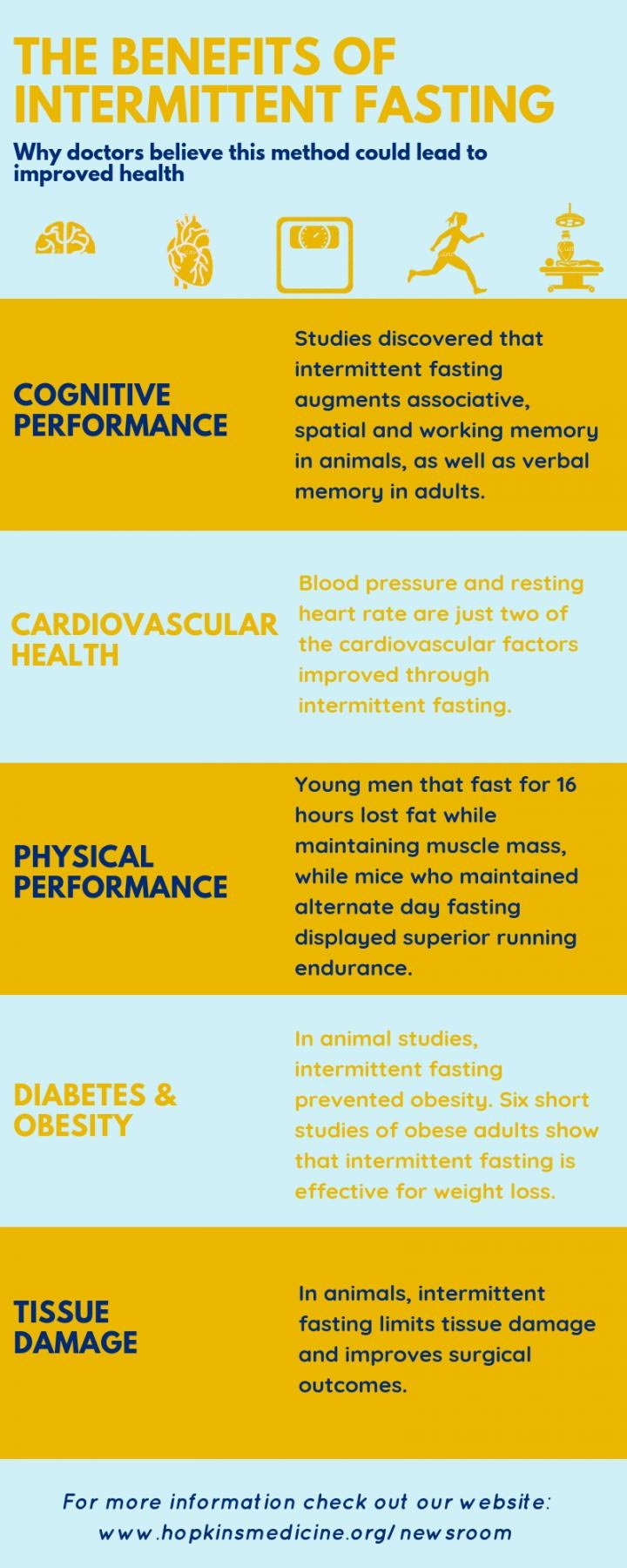
An array of animal and some human studies have shown that alternating between times of fasting and eating supports cellular health, probably by triggering an age-old adaptation to periods of food scarcity called metabolic switching. Such a switch occurs when cells use up their stores of rapidly accessible, sugar-based fuel, and begin converting fat into energy in a slower metabolic process.
Mattson says studies have shown that this switch improves blood sugar regulation, increases resistance to stress, and suppresses inflammation. Because most Americans eat three meals plus snacks each day, they do not experience the switch, or the suggested benefits.
In the article, Mattson notes that four studies in both animals and people found intermittent fasting also decreased blood pressure, blood lipid levels and resting heart rates.
Evidence is also mounting that intermittent fasting can modify risk factors associated with obesity and diabetes, says Mattson. Two studies at the University Hospital of South Manchester NHS Foundation Trust of 100 overweight women showed that those on the 5:2 intermittent fasting diet lost the same amount of weight as women who restricted calories, but did better on measures of insulin sensitivity and reduced belly fat than those in the calorie-reduction group.
More recently, Mattson says, preliminary studies suggest that intermittent fasting could benefit brain health too. A multicenter clinical trial at the University of Toronto in April found that 220 healthy, nonobese adults who maintained a calorie-restricted diet for two years showed signs of improved memory in a battery of cognitive tests. While far more research needs to be done to prove any effects of intermittent fasting on learning and memory, Mattson says if that proof is found, the fasting — or a pharmaceutical equivalent that mimics it — may offer interventions that can stave off neurodegeneration and dementia.
“We are at a transition point where we could soon consider adding information about intermittent fasting to medical school curricula alongside standard advice about healthy diets and exercise,” he says.
Mattson acknowledges that researchers do “not fully understand the specific mechanisms of metabolic switching and that “some people are unable or unwilling to adhere” to the fasting regimens. But he argues that with guidance and some patience, most people can incorporate them into their lives. It takes some time for the body to adjust to intermittent fasting, and to get beyond the initial hunger pangs and irritability that accompany it. “Patients should be advised that feeling hungry and irritable is common initially and usually passes after two weeks to a month as the body and brain become accustomed to the new habit,” Mattson says.
To manage this hurdle, Mattson suggests that physicians advise patients to gradually increase the duration and frequency of the fasting periods over the course of several months, instead of “going cold turkey.” As with all lifestyle changes, says Mattson, it’s important for physicians to know the science so they can communicate potential benefits, harms and challenges, and offer support.
Rafael de Cabo, Ph.D., of the Translational Gerontology Branch of the National Institute on Aging Intramural Research Program, is a co-author of the published review.
This work was supported by the Intramural Research Program of the National Institute on Aging, National Institutes of Health.
Never miss a breakthrough: Join the SciTechDaily newsletter.
Follow us on Google and Google News.
3 Comments
Does Mark Mattson’s, Ph.D. review article in the December 26, 2019 issue of The New England Journal of Medicine indicate that Narrow Eating Times of 6-8 hours per day and 5:2 Intermittent Fasting produce equivalent results or was one fasting process better than the other?
Just checked out NEJM article—study was based on six-hour eating window, 18-hour fast.
Millions of muslims fast at least 12 hours per day for 30 consecutive days or so during Ramadan. This must be the biggest clinical trial a researcher can wish for but still no article mentions Ramadan. I don’t think that fasting muslims are living longer that non fasting people.