
Close Menu
    Facebook X (Twitter) Instagram
    SciTechDaily
    • Biology
    • Chemistry
    • Earth
    • Health
    • Physics
    • Science
    • Space
    • Technology
    Facebook X (Twitter) Pinterest YouTube RSS
    SciTechDaily
    Home»Space»Kepler Characterizes “Starspots” on 2244 Stars
    Space

    Kepler Characterizes “Starspots” on 2244 Stars

    By Harvard-Smithsonian Center For AstrophysicsDecember 15, 2017No Comments2 Mins Read
    Facebook Twitter Pinterest Telegram LinkedIn WhatsApp Email Reddit
    Share
    Facebook Twitter LinkedIn Pinterest Telegram Email Reddit
    Kepler Satellite Characterizes "Starspots" on 2244 Stars
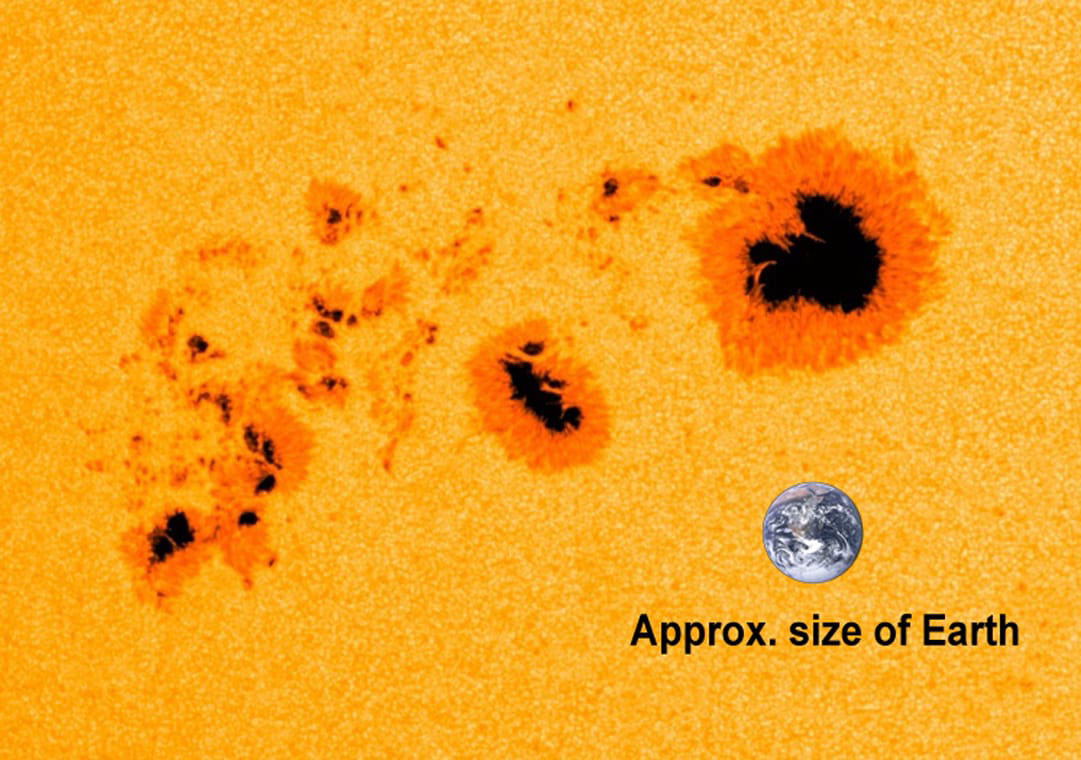
    One of the largest sunspots in the last nine years as seen by NASA’s Solar Dynamics Observatory. An image of Earth has been added for scale. Astronomers have used the Kepler satellite to characterize “starspots” on 2244 stars. Credit: NASA/SDO

    Sunspots are regions on the Sun’s photosphere that appear darker than surrounding areas because they are cooler, usually by one or two thousand degrees Celsius. These spots are temporary phenomena caused by magnetic activity that results from the Sun’s rotation and the complex circulation of hot gas below its surface, and they are accompanied by solar flares, mass ejections, and other energetic phenomena. Other stars have similar regions, called starspots, and there have been some suggestions that in comparison the Sun is comparatively quiescent.

    Starspots are interesting to stellar astronomers because they are informed by the star’s rotation and circulation, details that are otherwise difficult to discern. Although starspots are too small to be imaged directly by current telescopes, they can be inferred from variations in a star’s light.

    CfA astronomer Raphaelle Haywood and two colleagues have analyzed archival data from the Kepler satellite to uncover some of the general properties of starspots. Kepler’s primary goal was the detection of exoplanets from periodic variations in starlight due to transits, but its steady monitoring of starlight revealed many other temporal phenomena, including starspots. From a set of over thirty-four thousand main-sequence stars, the astronomers selected 2244 with rotation periods between 9.5 and 20.5 days.

    They were able to group the observed starspot behavior into three categories based on their persistence, and reached three significant conclusions. One is that our Sun is not unusually quiet. The others are that bigger starspots live longer, and that the starspots on cooler stars decay more slowly.

    The conclusions are consistent with current models of starspots, but this work is the first large-scale survey of the phenomenon.

    Reference: “A Kepler Study of Starspot Lifetimes with Respect to Light-Curve Amplitude and Spectral Type” by Helen A. C. Giles, Andrew Collier Cameron and Raphaëlle D. Haywood, 2 August 2017, MNRAS.
    DOI: 10.1093/mnras/stx1931

    Never miss a breakthrough: Join the SciTechDaily newsletter.
    Follow us on Google and Google News.

    Astronomy Cosmology Harvard-Smithsonian Center for Astrophysics Kepler Space Telescope Sun
    Share. Facebook Twitter Pinterest LinkedIn Email Reddit

    Related Articles

    K2 Mission Discovers a New Kind of Supernova

    Kepler Continues to Surprise, Detects Transiting Exocomets

    Kepler Reveals Solar-Like Oscillations in Other Stars

    Kepler Discovers a Planetary Object Being Vaporized by a White Dwarf

    Kepler Data Suggests 17 Billion Earth-Sized Worlds in the Milky Way

    Probable Distance to Remnant of Kepler’s Supernova

    Two Planets Separated by Less Than 5 Earth Moon Distances

    Calculations Show the Ideal Time to Study the Cosmos

    Earth in Motion and the Galaxies Around it

    Leave A Reply Cancel Reply

    • Facebook
    • Twitter
    • Pinterest
    • YouTube

    Don't Miss a Discovery

    Subscribe for the Latest in Science & Tech!

    Trending News

    Why Popular Diabetes Drugs Like Ozempic Don’t Work for Everyone: The “Genetic Glitch”

    Scientists Stunned After Finding Plant Thought Extinct for 60 Years

    Scientists Discover Tiny New Spider That Hunts Prey 6x Its Size

    Natural Component From Licorice Shows Promise for Treating Inflammatory Bowel Disease

    Scientists Warn: Popular Sweetener Linked to Dangerous Metabolic Effects

    Monster Storms on Jupiter Unleash Lightning Beyond Anything on Earth

    Scientists Create “Liquid Gears” That Spin Without Touching

    The Simple Habit That Could Help Prevent Cancer

    Follow SciTechDaily
    • Facebook
    • Twitter
    • YouTube
    • Pinterest
    • Newsletter
    • RSS
    SciTech News
    • Biology News
    • Chemistry News
    • Earth News
    • Health News
    • Physics News
    • Science News
    • Space News
    • Technology News
    Recent Posts
    • Pomegranate Compound Could Help Protect Against Heart Disease
    • Your Blood Test Might Already Show Alzheimer’s Risk
    • Common Pregnancy Medications Linked to Higher Autism Risk in Massive U.S. Study
    • Scientists Teach AI To Think Like a Professional Chemist
    • Scientists Were Wrong About This Strange “Rule-Breaking” Particle
    Copyright © 1998 - 2026 SciTechDaily. All Rights Reserved.
    • Science News
    • About
    • Contact
    • Editorial Board
    • Privacy Policy
    • Terms of Use

    Type above and press Enter to search. Press Esc to cancel.