
Close Menu
    Facebook X (Twitter) Instagram
    SciTechDaily
    • Biology
    • Chemistry
    • Earth
    • Health
    • Physics
    • Science
    • Space
    • Technology
    Facebook X (Twitter) Pinterest YouTube RSS
    SciTechDaily
    Home»Earth»La Palma’s Phoenix: Rising and Rebuilding on a Lava Flow
    Earth

    La Palma’s Phoenix: Rising and Rebuilding on a Lava Flow

    By NASA Earth ObservatoryDecember 21, 2023No Comments3 Mins Read
    Facebook Twitter Pinterest Telegram LinkedIn WhatsApp Email Reddit
    Share
    Facebook Twitter LinkedIn Pinterest Telegram Email Reddit
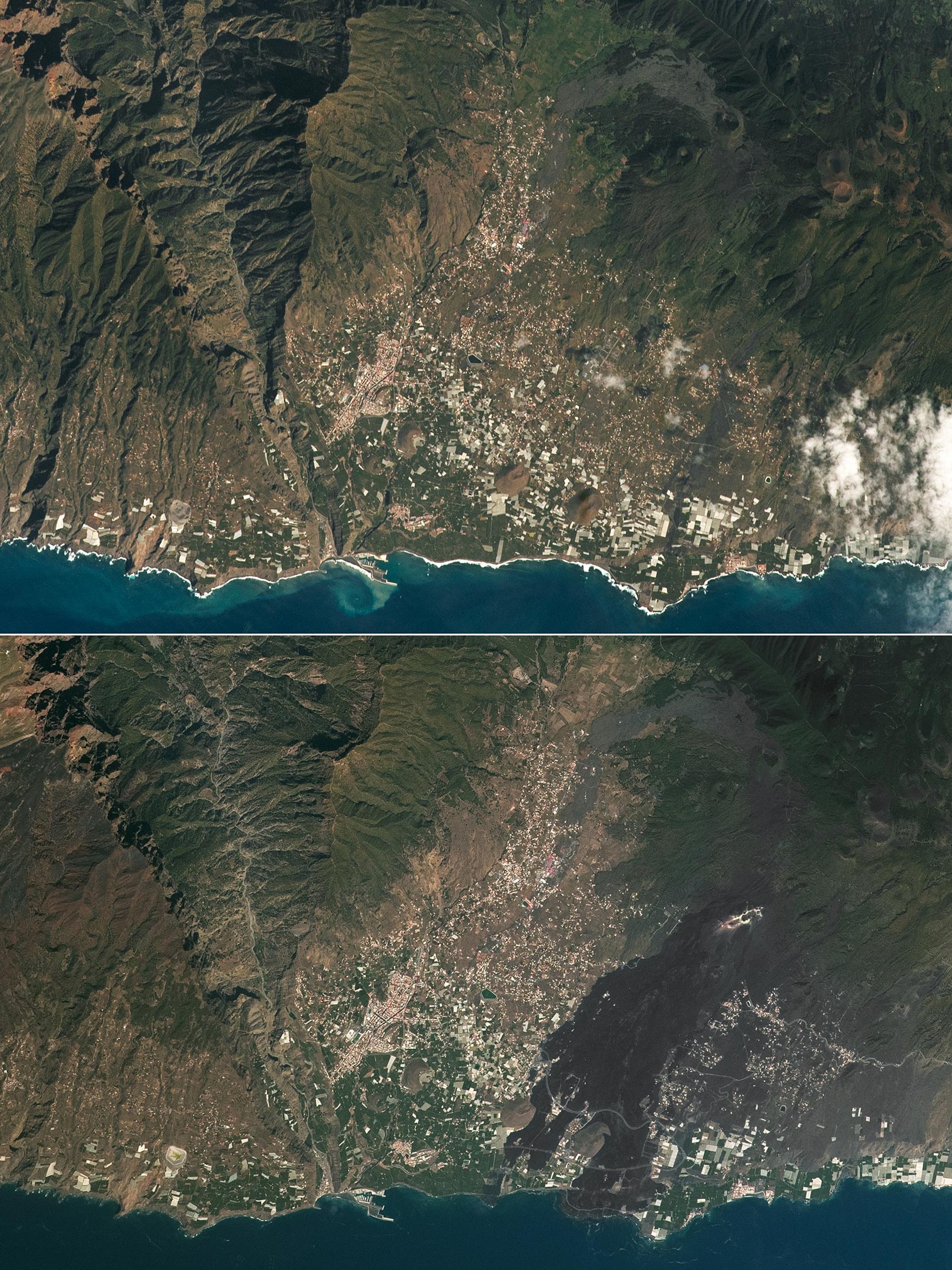
    Rebuilding on a Lava Flow in La Palma
    Upper: Photo captured on February 13, 2016 (before the eruption) from an astronaut aboard the International Space Station. Lower: Photo captured on August 18, 2023, from an astronaut aboard the International Space Station.

    Two years after the eruption of Cumbre Vieja in the Canary Islands, some roads have been reconstructed.

    An astronaut aboard the International Space Station (ISS) took these photographs of La Palma island while in orbit over the North Atlantic Ocean. La Palma is part of Spain’s Canary Islands, located about 480 kilometers (300 miles) off the coast of Morocco and Western Sahara. The island is a basaltic shield volcano that is composed of two volcanic centers: the older collapsed Caldera de Taburiente and the younger active Cumbre Vieja.

    From September through December 2021, a strong eruption on the southwestern flank of Cumbre Vieja produced lava flows, lava fountains, and ash clouds. The activity lasted about 85 days, giving astronauts aboard the space station the opportunity to capture photos of ash plumes and nighttime glowing lava flows.

    In total, lava flows and ash covered more than 12 square kilometers (5 square miles) of La Palma extending 5 kilometers (3 miles) from the fissure to the coastline. The ash and lava damaged more than 3,000 buildings and several banana plantations, and caused the yellowing of pine forests.

    These photos, taken in February 2016 (top) and August 2023 (bottom), show the landscape several years before and after the eruption. In the two years since the eruption, some roads have been reconstructed, visible as thin, light-colored lines cutting through the lava flow. The roads reconnect the towns of Los Llanos de Aridane with Puerto Naos and other nearby communities. The eruption fissure is evident in this photo as a brighter, linear feature midway up the volcanic flank.

    Although not noticeable at the spatial resolution of these images, sparse trees and shrubs continue to grow amidst the deposited ash, including the Canary Island pine (Pinus canariensis). This fire-resistant serotinous conifer, endemic to the Canary Islands, relies on heat from fires to melt the resin enclosing its pine cones to yield viable seeds.

    Astronaut photograph ISS069-E-62382 was acquired on August 18, 2023, with a Nikon D5 digital camera using a focal length of 400 millimeters. Astronaut photograph ISS046-E-40929 was acquired on February 13, 2016, with a Nikon D4 digital camera using a focal length of 400 millimeters. The images are provided by the ISS Crew Earth Observations Facility and the Earth Science and Remote Sensing Unit, Johnson Space Center. The images were taken by a member of the Expedition 69 crew and the Expedition 46 crew. The images have been cropped and enhanced to improve contrast, and lens artifacts have been removed. The International Space Station Program supports the laboratory as part of the ISS National Lab to help astronauts take pictures of Earth that will be of the greatest value to scientists and the public, and to make those images freely available on the Internet. Caption by Cadan Cummings, Jacobs, JETS II Contract at NASA-JSC.

    Never miss a breakthrough: Join the SciTechDaily newsletter.
    Follow us on Google and Google News.

    Geography NASA NASA Earth Observatory Volcano
    Share. Facebook Twitter Pinterest LinkedIn Email Reddit

    Related Articles

    Island Obliterated: Dramatic Changes at Hunga Tonga-Hunga Ha’apai

    Hunga Tonga Island Obliterated – NASA Satellites Capture Massive Blast

    A Wolf Awakens in the Galápagos Islands at Night

    A Deadly Day on Mount Semeru: Destructive Rivers of Debris on Indonesian Volcano

    Wall of Lava Burns a Path Through La Palma

    Cumbre Vieja Lights Up the Night – Astronaut Photo Captures Volcanic Eruption From Space

    Socked in Stratovolcano: Astronaut on ISS Captures Incredible View of Uninhabited Atlasov Island

    Kilauea’s Lava Lake Returns – Hawaii’s Most Active Volcano Is Erupting Again

    Newberry Volcano Photographed by Astronaut Onboard the International Space Station

    Leave A Reply Cancel Reply

    • Facebook
    • Twitter
    • Pinterest
    • YouTube

    Don't Miss a Discovery

    Subscribe for the Latest in Science & Tech!

    Trending News

    Why Popular Diabetes Drugs Like Ozempic Don’t Work for Everyone: The “Genetic Glitch”

    Scientists Stunned After Finding Plant Thought Extinct for 60 Years

    Scientists Discover Tiny New Spider That Hunts Prey 6x Its Size

    Natural Component From Licorice Shows Promise for Treating Inflammatory Bowel Disease

    Scientists Warn: Popular Sweetener Linked to Dangerous Metabolic Effects

    Monster Storms on Jupiter Unleash Lightning Beyond Anything on Earth

    Scientists Create “Liquid Gears” That Spin Without Touching

    The Simple Habit That Could Help Prevent Cancer

    Follow SciTechDaily
    • Facebook
    • Twitter
    • YouTube
    • Pinterest
    • Newsletter
    • RSS
    SciTech News
    • Biology News
    • Chemistry News
    • Earth News
    • Health News
    • Physics News
    • Science News
    • Space News
    • Technology News
    Recent Posts
    • Seeing the Invisible: Scientists Develop New Way To Track Particles in 3D
    • The Atomic Gap That Could Cost the Semiconductor Industry Billions
    • Earth’s Secret Advantage: Why Most Alien Worlds May Be Too Dry for Life
    • Ancient Bacteria Turned a DNA System Into a Cell Skeleton
    • Researchers Finally Solve 50-Year-Old Blood Group Mystery
    Copyright © 1998 - 2026 SciTechDaily. All Rights Reserved.
    • Science News
    • About
    • Contact
    • Editorial Board
    • Privacy Policy
    • Terms of Use

    Type above and press Enter to search. Press Esc to cancel.