
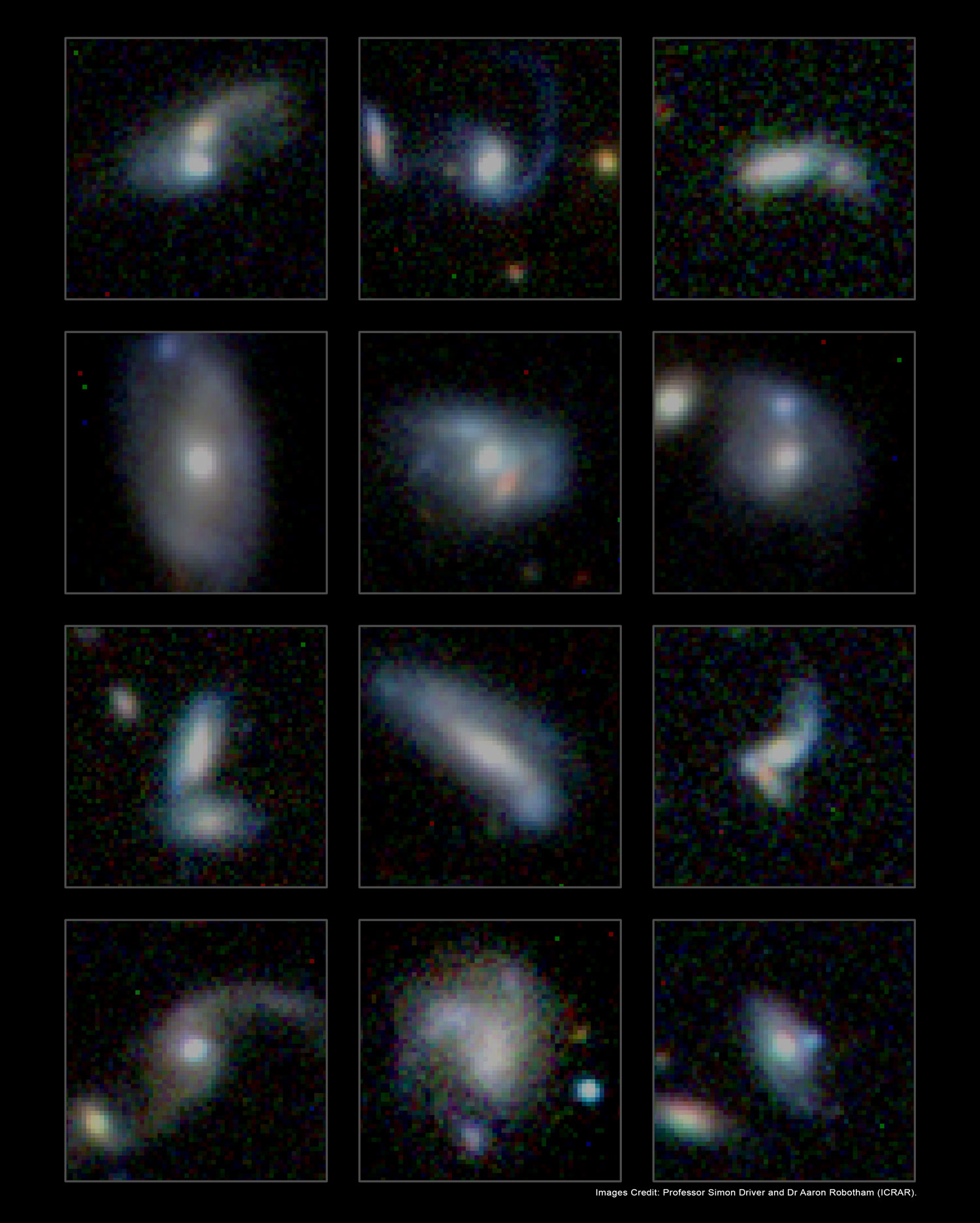
A newly published study examined galaxy growth, revealing that massive galaxies are much less efficient at star formation than smaller galaxies and instead grew by merging other galaxies.
Massive galaxies in the Universe have stopped making their own stars and are instead snacking on nearby galaxies, according to research by Australian scientists.
Astronomers looked at more than 22,000 galaxies and found that while smaller galaxies were very efficient at creating stars from gas, the most massive galaxies were much less efficient at star formation, producing hardly any new stars themselves, and instead grew by eating other galaxies.
The study was released today in the journal Monthly Notices of the Royal Astronomical Society, published by Oxford University Press.
Dr. Aaron Robotham based at The University of Western Australia node of the International Center for Radio Astronomy Research (ICRAR), said smaller ‘dwarf’ galaxies were being eaten by their larger counterparts.
“All galaxies start off small and grow by collecting gas and quite efficiently turning it into stars,” he said.
“Then every now and then they get completely cannibalized by some much larger galaxy.”
Dr. Robotham, who led the research, said our own Milky Way was at a tipping point and expected to now grow mainly by eating smaller galaxies, rather than by collecting gas.
“The Milky Way hasn’t merged with another large galaxy for a long time but you can still see remnants of all the old galaxies we’ve cannibalized,” he said.
“We’re also going to eat two nearby dwarf galaxies, the Large and Small Magellanic Clouds, in about four billion years.” But Dr. Robotham said the Milky Way would eventually get its comeuppance when it merged with the nearby Andromeda Galaxy in about five billion years.
“Technically, Andromeda will eat us because it’s the more massive one,” he said.
Almost all of the data for the research was collected with the Anglo-Australian Telescope in New South Wales as part of the Galaxy And Mass Assembly (GAMA) survey, led by Professor Simon Driver at ICRAR.
In about five billion years time, nearby massive galaxy Andromeda will merge with our own galaxy, the Milky Way, in an act of gallactic cannibalism (technically Andromeda will be eating us, as it’s the bigger of the two galaxies.). There haven’t been any large mergers with our galaxy recently, but we can see the remnants of galaxies that have previously been snacked on by the Milky Way. We’re also going to eat two nearby dwarf galaxies, the Large and Small Magellanic Clouds sometime in the future. This simulation shows what will happen when the Milky Way and Andromeda get closer together and then collide, and then finally come together once more to merge into an even bigger galaxy. Simulation Credit: Prof Chris power (ICRAR-UWA), Dr Alex Hobbs (ETH Zurich), Prof Justin Reid (University of Surrey), Dr Dave Cole (University of Central Lancashire), and the Theoretical Astrophysics Group at the University of Leicester.Video Production Credit: Pete Wheeler, ICRAR.
The GAMA survey involves more than 90 scientists and took seven years to complete.
This study is one of more than 60 publications to have come from the work, with another 180 in progress.
Dr. Robotham said as galaxies grew they had more gravity and could therefore more easily pull in their neighbors.
He said the reason star formation slowed down in really massive galaxies was thought to be because of extreme feedback events in a very bright region at the center of a galaxy known as an active galactic nucleus.
“The topic is much debated, but a popular mechanism is where the active galactic nucleus basically cooks the gas and prevents it from cooling down to form stars,” Dr. Robotham said.
Ultimately, gravity is expected to cause all the galaxies in bound groups and clusters to merge into a few super-giant galaxies, although we will have to wait many billions of years before that happens.
“If you waited a really, really, really long time that would eventually happen but by really long I mean many times the age of the Universe so far,” Dr. Robotham said.
Reference: “Galaxy And Mass Assembly (GAMA): galaxy close pairs, mergers and the future fate of stellar mass” by A. S. G. Robotham, S. P. Driver, L. J. M. Davies, A. M. Hopkins, I. K. Baldry, N. K. Agius, A. E. Bauer, J. Bland-Hawthorn, S. Brough, M. J. I. Brown, M. Cluver, R. De Propris, M. J. Drinkwater, B. W. Holwerda, L. S. Kelvin, M. A. Lara-Lopez, J. Liske, A. R. Lopez-Sanchez, J. Loveday, S. Mahajan, T. McNaught-Roberts, A. Moffett, P. Norberg, D. Obreschkow, M. S. Owers, S. J. Penny, K. Pimbblet, M. Prescott, E. N. Taylor, E. van Kampen and S. M. Wilkins, 18 September 2014, MNRAS.
DOI: 10.1093/mnras/stu1604
arXiv: 1408.1476
Never miss a breakthrough: Join the SciTechDaily newsletter.
Follow us on Google and Google News.
1 Comment
It’s all fun, fundamental in a binary-choice , The Golden Rule is The Theory of Everything